
All the pieces in place as Big League Utah pushes for MLB expansion
Published at
Brian Preece, KSL.com
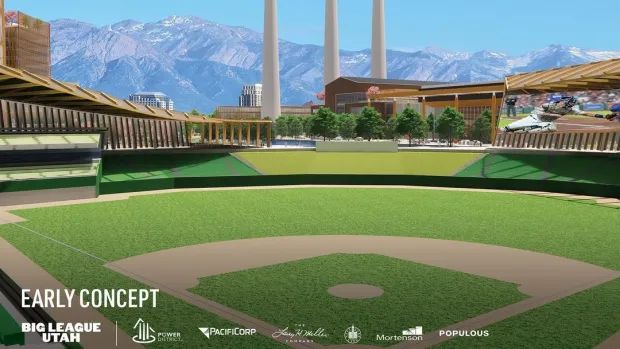
SALT LAKE CITY (KSL.com) — Few expansion cities can check every box Major League Baseball looks for. Big League Utah believes Salt Lake City is capable of knocking it out of the ballpark.
“Most expansion candidates don’t have a location, they don’t have public-private partnerships, they don’t have an ownership group,” Larry H. Miller Company CEO Steve Starks told KSL Sports Zone’s Scott Garrard in an exclusive interview earlier this week.
Utah’s capital city has seen tremendous growth since welcoming the 2002 Olympic Winter Games, and professional sports of all types have been a focal point of Salt Lake’s ascension.
A multitude of factors allow Big League Utah and Salt Lake City to separate from competing expansion markets.
Proven ownership – The Larry H. Miller Company owned the Utah Jazz for 35 years and now operates Real Salt Lake, Utah Royals FC, the Salt Lake Bees, and Megaplex Theatres.
Established infrastructure – LHM oversaw the construction of The Ballpark at America First Square, widely regarded as one of Minor League Baseball’s premier venues.
Power District – 100-acre stadium site located near downtown SLC. The Power District is minutes from the Salt Lake International Airport and has direct access to I-15, I-80, and multiple major traffic arteries in and out of Salt Lake City.
“We have this tremendous site close to our capital city, which is important to Utah, that we keep our professional sports downtown,” Starks stressed. “There’s a whole lot of things that we like.”
Those fundamentals, he added, are complemented by something many expansion bids lack: political alignment.
Utah, Salt Lake City political leaders aligned with Big League Utah dreams
The sudden arrival of an NHL franchise in the spring of 2025 sent shockwaves across the nation.
No longer was Salt Lake going to sit back and let the Denvers and Nashvilles of the U.S. pass them by.
With the Jazz already in his portfolio, Ryan Smith rapidly acquired and relocated the Arizona Coyotes to Utah following 28 unimpressive seasons in the Phoenix desert.
A native Utahn himself, Smith immediately began making alliances with State and local politicians to revitalize downtown, with the Delta Center as a centerpiece.
Similarly, LHM and Big League Utah dream of turning the Power District into a vibrant community gathering place for decades to come.
Uniting so many individuals with differing ideologies and political motivations is never easy, but Starks believes everybody is pulling in the same direction.
“The lack of dysfunction gives us a competitive advantage,” he said. “We’re fortunate to be part of this community in this state.”
Landscape architect consultants have been brought in to redesign and restore portions of the Jordan River in that area. LHM has also begun construction on what will be the state’s tallest office building.
Utah’s legislature has embraced the project, allowing Governor Spencer Cox to sign two significant bills—HB562 and SB272—each allocating $900 million in long-term public funding during the 2024 legislative session.
HB562 allocates funding for the surrounding Fairpark neighborhood development, provided Utah is awarded an expansion team by 2032.
With land secured, funding approved, and political support in place, the remaining question is timing — and whether Major League Baseball views Salt Lake City as ready to join its next generation of markets.
 Get more sports news here