
For Idaho State’s esports broadcasters, the game never stops
Published at | Updated at
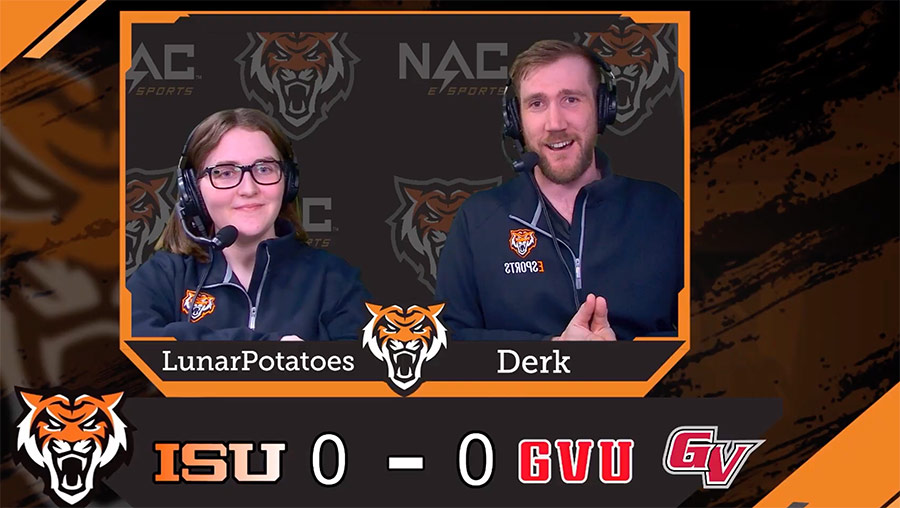
POCATELLO — The game clock does not exist. There is no huddle, no timeout called by a coach pacing the sideline, no moment where the action pauses long enough to catch your breath. In esports, the match moves at the speed of a processor, and the broadcaster moves with it — or falls behind.
That is the job Derek Hansen signed up for.
As assistant broadcast coordinator for Idaho State University’s esports program, Hansen is a shoutcaster. The title sounds casual. The work is not. Where a traditional sports broadcaster follows a ball, reads a stat line and fills dead air between plays, a shoutcaster operates with no dead air, no natural breaks and no script.
Six abilities can fire simultaneously in a single Overwatch 2 match. A team fight can flip in half a second. The game itself gets patched every few weeks, reshuffling strategies overnight. The broadcaster has to know all of it cold before the match starts — and explain it to a live audience while the action is still unfolding.
Hansen calls Overwatch 2 alongside co-caster Wendy, splitting play-by-play and strategic analysis in real time. Unlike a football booth where the camera follows one ball down one field, esports casters work from a full-field view of a digital battlefield, deciding what to call and what to let go in fractions of a second. There is no commercial break to reset.
The season tested that composure early.
“If you asked me a month ago how the team’s season has been, I would have had a different answer,” Hansen said. “It was a rough start. But also, a good one. Many of our teams had amazing wins in their first week of the regular season. But for the next three weeks we didn’t witness a single win across eight of our teams. But then Big Sky came around. And holy cow.”
What followed at the Big Sky Qualifiers was the kind of run that reframes an entire season. For broadcast coordinator Daniel Shelden, known online as Stormraige, it was the program’s defining moment.
“Last year our Rocket League team lost in the championship and our Overwatch team missed out on the top four playoffs,” Shelden said. “This year our Rocket League team won the championship, and our Overwatch team went on one of the most incredible runs I’ve ever seen from them. They lost their first game but then won six games straight. Seeing both teams lock in and showcase their true growth in skill was simply incredible.”
That growth did not happen overnight. Shelden has watched the Rocket League program build from its earliest days, when the talent was present but the timing was not.
“In our first season they already showed a great amount of potential, but there were a few games that felt winnable if they were just able to mesh a little bit quicker,” Shelden said. “In their second semester they missed out on the Big Sky Qualifiers by losing in the championship match. They then went on to win the Big Sky LAN later that year.”
The path back included loss. The team lost a key player in Adam Storms, and it took time to find footing again. When Storms returned in the spring, Shelden said, the difference was visible — calmer under pressure, sharper in communication, more willing to trust each other when it mattered most.
“It’s always fun being a broadcaster,” Hansen said. “But what’s been really fun about the job is watching just how much the Overwatch team has grown. We are watching them go up against some of the top teams in the nation — in some cases the world — and giving them a run for their money.”
Behind the commentary, a full student production crew makes each broadcast possible. Shelden coordinates five students who rotate between observing games, shoutcasting and directing. Every stat overlay, every replay and every camera cut is executed digitally and in real time by students learning the craft while performing it.
Hansen spent the season building custom tools and graphics, upgrading the visual quality of the broadcast week over week. Shelden took notice.
“I am incredibly lucky,” Shelden said. “I have a wonderful group of students that are passionate and engaged about esports. Derek Hansen has gone above and beyond this year, helping create tools and graphics to level up our broadcast each week.”
The skills those students develop extend well beyond the booth. Shoutcasting forces students to communicate under pressure, troubleshoot technical failures on the fly and explain a complicated subject clearly to two audiences at once — those who know the game deeply and those who have never seen it.
“They learn to communicate quickly during extremely high-tension situations,” Shelden said. “Then of course they get more confidence with public speaking and communicating about very complicated topics in terms that are appreciated by those who know what you’re talking about, as well as explaining them to a lay audience who may not understand everything that’s going on.”
For Hansen, reaching nationals carried a weight that went beyond the scoreboard.
“Nationals means legitimacy,” he said. “The world and even some of our very own faculty are slow to recognize esports as a legitimate sport. For me personally, it means I have a bigger duty to the players — to bring the broadcasting standard up to the very levels of ESPN quality.”
 Get more sports news here