


Where did they go?: The 3 phases of Kokanee fishing at Ririe Reservoir this winter
Published at | Updated at

“Here they come; they are running 20 to 40 feet deep,” Mike yelled at me from 50 yards away.
I grabbed two baited rods and headed for his ice-hut. He had forgotten to drill a couple of extra holes for me, so he had six kokanees on the ice before I got a hole drilled.
Twenty minutes later, each of us had 15 kokanees from 11 to 16 inches on the ice. It was 9:06 and we were done for the day. The glow-in-the-dark pink lures and pink dyed, krill-flavored corn had done their job. It was the third day of fishing in a week that I had limited out and the first day of the season that Mike had got his limit and we were heading home before noon.
Mike is still working and as I have retired, I get more opportunities for chasing the coveted land-locked salmon that my family loves to eat. Many fishermen, including me, have found it difficult to consistently catch these red meated, delicious fish on Ririe Reservoir this season.
The kokanee fishing on Ririe has gone through three phases so far this season. The first phase was when the reservoir froze over on New Year’s Eve and after the ice was about three inches thick, a few fishermen began having success. They found plenty of kokanee from the Juniper boat ramp to the dam but a fierce storm broke up the ice and stopped the fishing.
To start phase two, bitter cold temperatures followed the storm and by January 12, the ice was thick enough for fishing to resume, but wooden planks were needed to cross a pressure ridge to get to the fishing areas. After three days of great fishing, the fish totally disappeared in the lower end of the reservoir.
The disappearance of the fish coincided with the Civil Rights Day weekend plus a “no school day” due to COVID-19. On Friday, January 14, more than 200 people descended on the clear ice with augers, huts, fish-finders and crunching the ice with their ice grippers. Fishing became spotty on Friday and Saturday with very few schools of kokanee being seen, but on Monday, no schools were seen and only one kokanee was caught between the estimated 150 anglers.
“Where do you think the kokanee went?” I was asked by Bob Johnstone, the manager of the Juniper Campground. “Nobody is seeing any schools of them.”
There were many theories about what happened to the kokanee; many thought that all the noise had moved them up into the canyon, some blamed the concentration of all the fish-finders while others felt that the plankton, which the kokes feed on had disappeared. Whatever the reason, most of the kokanee fishermen got skunked multiple times in the next two weeks.
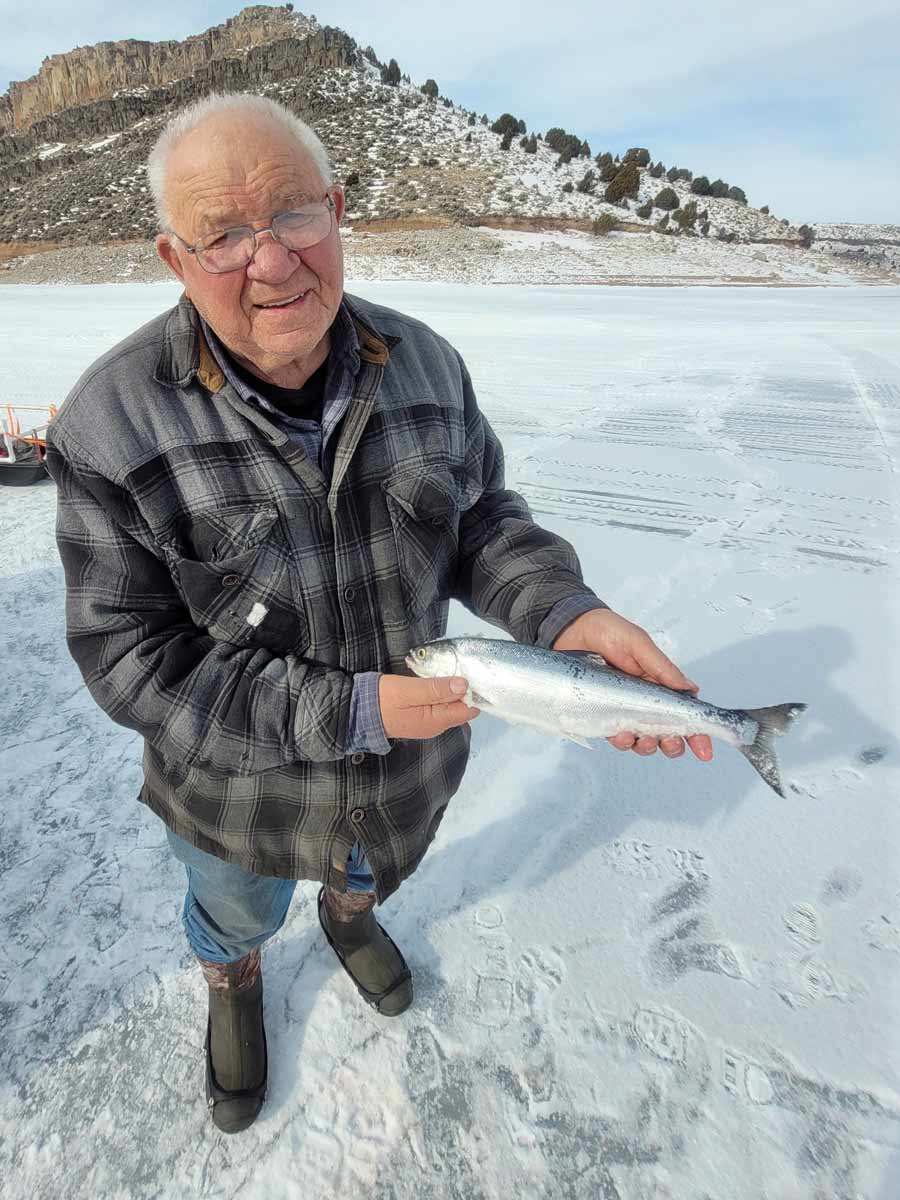
Phase three began when the ice in the canyon got thick enough for fishermen to get up to the powerline that crosses the reservoir. On January 28, large schools of kokanee were found in the canyon and they were willing to bite. Limits were common among many of the fishermen working in that area for a week
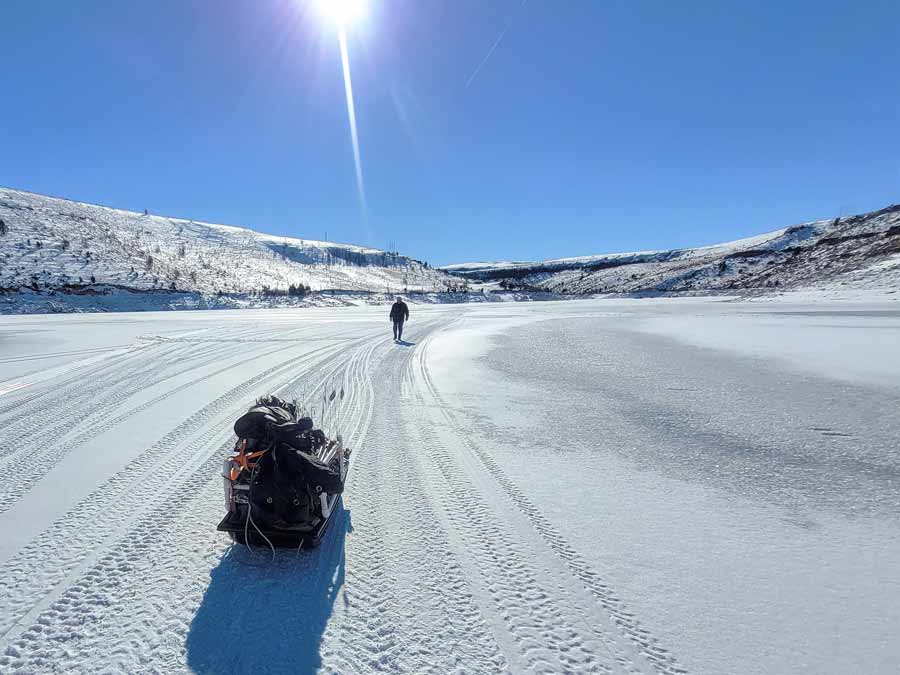
News traveled fast through the local communities about the great fishing in the canyon near the power line crossing. Last Saturday a few fishermen walked the mile and a half, but over 40 ATVs, snowmobiles and the new Snow-Dogs began racing up to the successful area. Large groups gathered and fish-finders were turned on, sending sonic waves into the water. Schools of kokanee were still seen, but they moved quickly under the groups of fishermen or they dropped to 50 to 70 feet below the ice, making them hard to hook. Instead of limiting out as they had earlier in the week, most of the experienced fishermen landed only three or four on Saturday.
Last Sunday and Monday, a few kokanees were being caught back down by the Juniper boat ramp while the fishing for them in the canyon had slowed down to a crawl by Wednesday.
It will be interesting to see what happens during the next week or two. Will the fish move farther up the reservoir, or will most migrate down toward the dam?
Some groups of fishermen have found success by keeping fish-finders at least 50 to 100 yards away from the next one. Studies show that one fish-finder will not emit enough sound waves to scare fish but “multiple fish-finders in an area will magnify sounds that create sounds that will scare fish causing them to go below the intensified sound or cause them to move quickly through the area.”
Whatever the cause of the disappearing kokanee, it will continue to be debated; but one fisherman had a positive attitude.
“Whether I catch my limit or get skunked, being out here is better than my best day at work.”
Be safe out there and it is February; we only have about a month left to enjoy fishing through the ice at Ririe. Enjoy it.

Living the Wildlife is brought to you by Yellowstone Teton Territory. Experience 7,500 square miles of untamed wilderness in Eastern Idaho's Yellowstone Teton Territory. Where majestic peaks meet endless adventure, your perfect outdoor escape is waiting. Start planning at YellowstoneTeton.com.