


Wyoming Game and Fish workers pull moose calf from icy pond
Published at | Updated at
Billy Arnold, Jackson Hole News & Guide
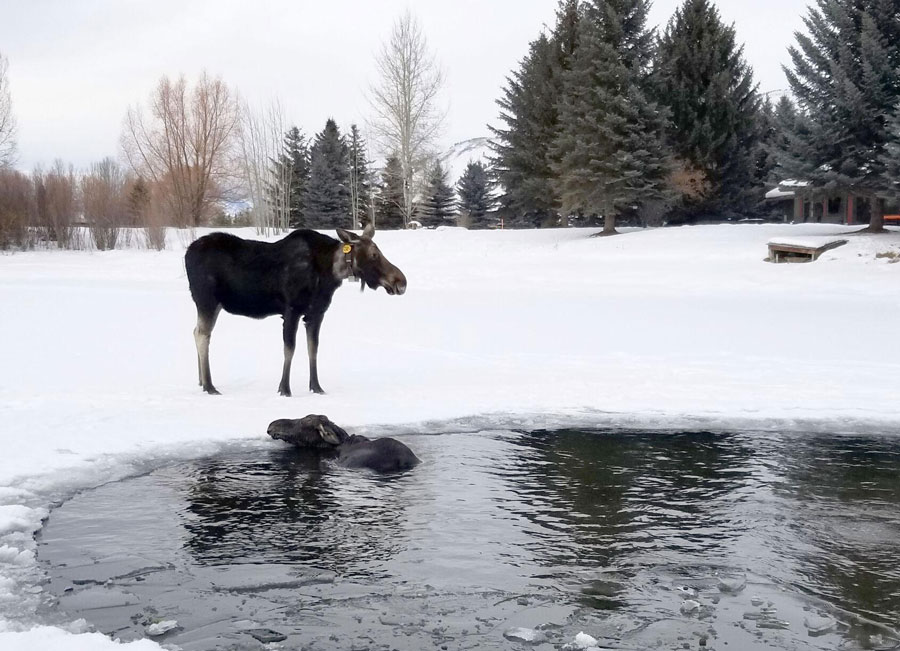
JACKSON, Wyoming (AP) — Gary Fralick had seen something like it before.
A few years back the Thayne-based wildlife biologist with Wyoming Game and Fish had been called to the Palisades Reservoir, where a herd of elk had fallen through the ice. They were rescued by volunteers and Game and Fish officials, who teamed up to pull the ungulates out of the freezing water.
But this was near Jackson, far from the waters of the Palisades and the valley’s larger lakes. A moose calf had ended up in icy pond water in the Polo Ranches subdivision, and the situation was bad. For one, the calf’s mother was still on its feet, the Jackson Hole News & Guide reported.
“What really struck me on Monday” — Jan. 24 — “was that two members of the public were standing eye to eye with the cow,” Fralick told the News&Guide. “Just four meters away.”
The situation was caused by an aerator that had been running in the pond.
People run aerators to keep man-made bodies of water oxygenated, either to help fish or prevent eutrophication of their waterways. But in the winter, bubbles from the device can either prevent ice from freezing or make it weak above the aerator. And, when wildlife walk near or over that section of the ice, it can collapse, plunging them into the frigid water.
The same can happen with dogs. Or children, Fralick warned.
Game and Fish wildlife biologist Aly Courtemanch said critters don’t fall through ice around aerators that frequently — the department gets one or two calls a winter. But consequences can be severe.
“Honestly, a lot of times the animal drowns before we’re able to get there,” Courtemanch said.
Running devices in winter is against county code, which some wildlife advocates and a Polo Ranches resident who declined to be named said they were unaware of.
By the time Game and Fish arrived in Polo Ranches, the calf had been in the water for some time. They had to act quickly.
But first, they had to figure out what to do with the cow.
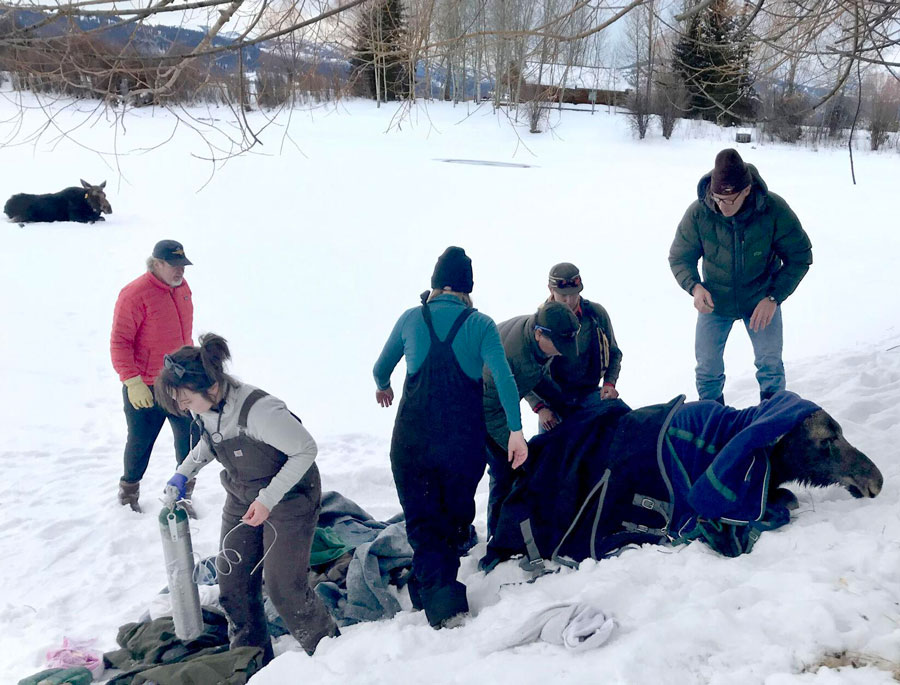
“My fear was that there was going to be some sort of vocalization from the calf that would be an alarm and the cow would proceed to attack us,” Fralick said.
So Courtemanch darted the mother moose, hitting it in the rump with a sedative referred to as “BAM.”
But that wasn’t without risk. It takes about 10 minutes for a moose to go down, and the animals can wander while the drugs take effect.
“We didn’t want her to lay down in a spot or stumble down and break through the ice herself,” Courtemanch said. “If she had broken through the ice fully sedated, she would have drowned.”
Eventually the mother moose did lie down. And in a good spot. So Fralick, a wildlife technician and some people watching the scene unfold got to work.
Two people had climbing rope that they stretched across the open water, Fralick said, and then dragged across the opening until it caught the calf under the jaw.
They were able to direct the animal toward the edge of the ice, where Fralick and wildlife technician Tucker Russell managed to get another rope around its neck, hoping to pull it out of the water.
But, as Courtemanch was guarding the cow a few feet away, things moved under her feet.
“There was a crack,” Courtemanch said.
The ice held.
But Courtemanch decided it would be best to start waking the moose up so she would be somewhat alert if the ice broke.
That introduced a new layer of complexity to the situation: The moose might charge the people handling her calf.
But the operation continued, though Fralick was also worried about the conditions.
He, Russell and the two men were attempting to pull a roughly 350-pound calf onto the ice.
“It certainly could have gone very wrong,” Fralick said.
But the ice still held.
Game and Fish officials got the calf’s front legs on the ice and pulled it out with the rope “relatively easily,” Fralick said.
Polo Ranches residents and onlookers then rushed up with hotpacks and blankets to dry the young moose off and warm it up.
Public involvement in wildlife rescues is generally avoided, Fralick said. But in this case it was helpful.
“Had they not been there, I don’t know if it would have gone as quickly as it had,” Fralick said.
Two Game and Fish veterinarians were also on scene, in town because of moose collaring elsewhere in the valley.
The county code and aerators
Game and Fish officials said aerators are becoming more common in Teton County.
“As we get more and more ponds getting built in Jackson and people wanting ponds in their backyard, we’re definitely seeing more aerators,” Courtemanch said.
Mark Gocke, spokesman for the department, said the best thing people can do is turn aerators off in the winter. Short of that, he said, aerators should be installed next to shorelines so, if an animal falls in, it can clamber out as long as the slope is gentle enough.
That’s in line with county code, which requires aerators to be turned off between Dec. 1 and April 15 and built “so that the bubble trail from the aerator reaches the shoreline.”
Those requirements have been enshrined in county regulations since 2018, when the Teton County Board of Commissioners reviewed rules relating to man-made ponds and berms, concerned about their environmental impacts.
Teton County Planning and Building Director Chris Neubecker said there hadn’t been a code compliance case about aerators in ponds since the new regulations were approved. And whether the regulations apply to ponds built before 2018 depends on the language in their specific permit, he said.
But the planning director wrote in an email that “barring specific language in the application or permit on aerator use, the prohibition from Dec. 1 to April 15 would apply.”
Bill Long of the Wyoming Wetlands Society, which partners with landowners in the area to provide habitat for trumpeter swans in their ponds, said he encourages people to turn their aerators off in the winter, or at least install them close to shore.
“We’ve tried to encourage landowners that, if they don’t have fish in a pond, not to aerate it,” Long said. “And if they aerate it, follow the regs. Make sure that you have an open avenue to dry land from that open hole.”
But Kyle Kissock, communications manager for the Jackson Hole Wildlife Foundation, reads the regs to mean that, in winter, aerators should be off — and regardless of placement.
“Is this confusion in the way they’re written?” Kissock said.
Neubecker said both standards apply as the code is written: Aerators should be turned off in the winter and built so that the bubble trails open a hole in the ice adjacent to shore.
“However, I believe the intent was that this be an ‘or,’ with the intent that the pond either freeze over completely in winter, or that the bubbles from the aerator prevent freezing of the entire pond,” he wrote.
Some wildlife watchers said they weren’t aware of the regs.
“It seems like it’s been one of those more obscure things,” said Kristin Combs of Wyoming Wildlife Advocates. “I was completely unaware of it.”
The Polo Ranches homeowner said they were also unaware, and that the aerators are now off.
In the subdivision south of Jackson the calf slowly revived after about an hour of drying.
And, after waking up, the mother moose didn’t interfere with the people drying her calf.
“She brought her head up but just kind of stayed lying down watching the whole situation and chewed her cud and just seemed really, really chill,” Courtemanch said.
Aerators create unusual moose habitat
Away from human development, waterways moose frequently tend to either fully ice over or be less dangerous than the situation like the one officials encountered in late January, Courtemanch said.
“You wouldn’t have open water and thick ice right next to each other,” the Game and Fish biologist said. “It is an artificial scenario that they’re not really used to.”
But the rescue still had a better outcome than most similar situations the Game and Fish department deals with.
And it appears the mother moose and her calf are still around.
After a technician went down to the area Monday and saw the calf by itself, some of the people in the area when the animal was pulled from the ice sent officials a picture of the two moose together Tuesday evening.