Idaho Department of Agriculture confirms quagga mussel larvae in the Snake River
Published at | Updated at

The following is a news release from the Idaho State Department of Agriculture.
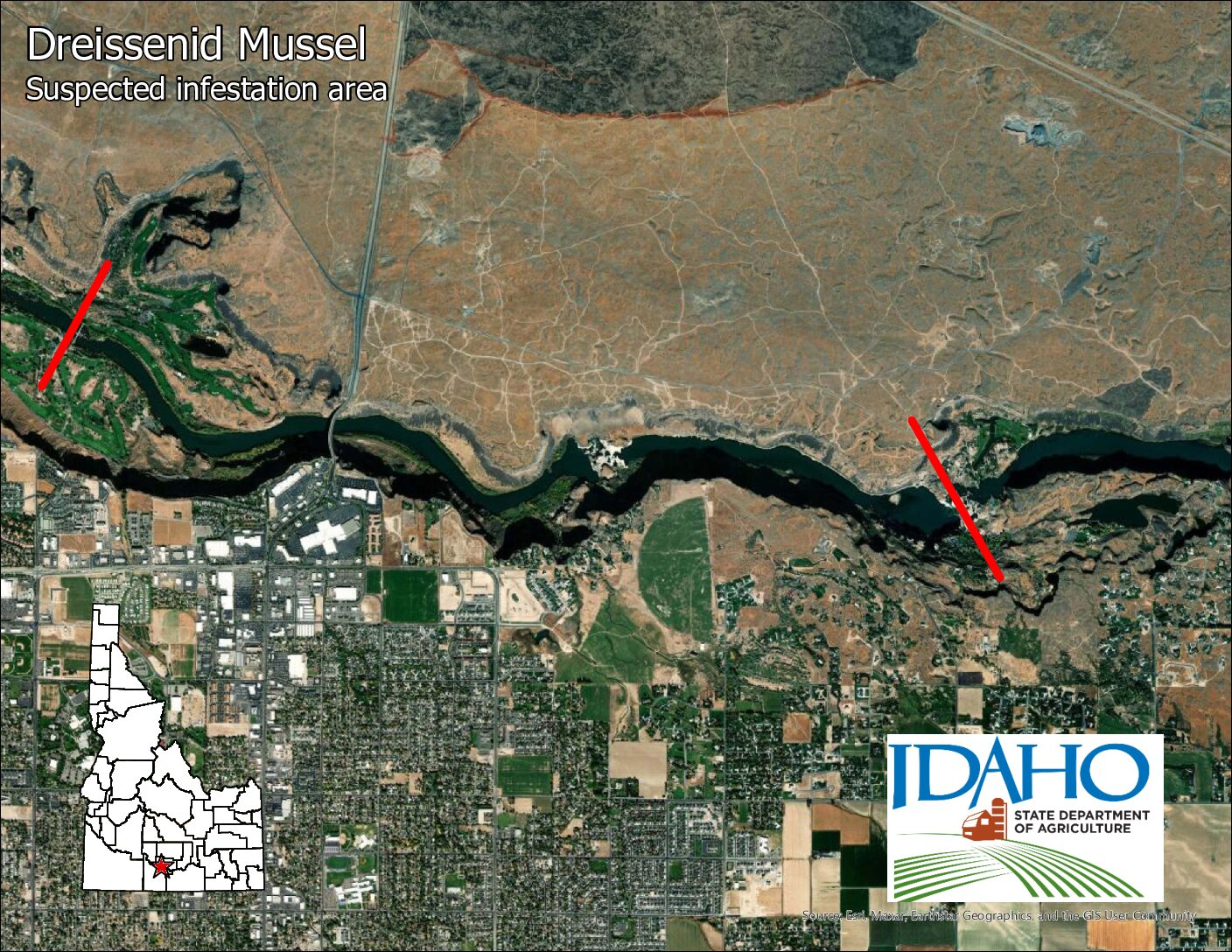
TWIN FALLS — The Idaho State Department of Agriculture confirmed Monday the presence of quagga mussel larvae in the Centennial Waterfront Park area of the Snake River. Multiple samples of quagga mussel at larval life stages have been found in the Twin Falls area by ISDA’s early detection monitoring program.
The findings mark the first time a rapid response plan has been put into action for quagga mussels in Idaho. ISDA is implementing a rapid response plan that includes notifying impacted entities, implementing containment measures, conducting delimiting surveys and evaluating for potential treatment options.
“These invasive pests will clog pipes that deliver water for drinking, energy, agriculture, and recreation,” Governor Little said. “This is a very high priority for Idaho and for me, given the gravity of the risk. If we are not successful, an unchecked spread – which we are doing all we can to stop – has the potential to cost Idaho hundreds of millions of actual and indirect costs. Thankfully, we caught the mussels early on and have already started a robust response to get these mussels OUT of our waters. We need everyone to support these efforts.”
ISDA is asking for the public’s cooperation in staying out of the water in the Centennial Waterfront Park area, in an effort to contain the mussel populations. ISDA staff and boats will be in the water performing delimiting surveys to determine the physical range of the impacted area. Boat ramps and public access to the water are closed temporarily.
“Our invasive species program is prepared to respond to these findings quickly in an effort to contain mussel population growth in such a vulnerable area,” said Chanel Tewalt, ISDA Director. “We greatly appreciate the public’s cooperation and plan on opening the area as soon as possible to minimize the impact to businesses that rely on the Snake River.”
Quagga and zebra mussels pose a major threat to Idaho’s water systems, native species, agriculture, utilities and more. ISDA’s early detection monitoring program works to detect new outbreaks early, which allows ISDA to quickly control mussel populations. While working to determine the scope of the impacted area, ISDA officials will be exploring potential control strategies for the mussels.
All watercraft users are encouraged to follow the “Clean, Drain and Dry” actions for watercraft and equipment before entering and after leaving Idaho waterbodies. ISDA watercraft inspection stations are also currently operating across the state and mandatory for watercraft users to stop at.
Lt. Governor Scott Bedke issued the following statement in response to the announcement.
“I am disappointed to learn that this invasive species has infiltrated the Snake River. This is a major issue for not just the surrounding area but the entire state. If left unchecked, this can negatively affect our water quality, majorly impact the Snake River’s ecosystem, clog our irrigation pipes, and take over our ship and boat hulls. I applaud the Department of Agriculture’s early detection and quick response to this issue and have faith in their action plan to contain – and potentially treat or remove – these mussels. I urge everyone to adhere to the Department of Agriculture’s rapid response plan so we can get this serious situation under control.”
For updates on the issue, visit agri.idaho.gov/main/plants/snake-river-quagga-mussel-veligers/.