



Idaho DOGE committee asks for public to report government ‘waste’
Published at | Updated at
Ryan Suppe, Idaho Ed News
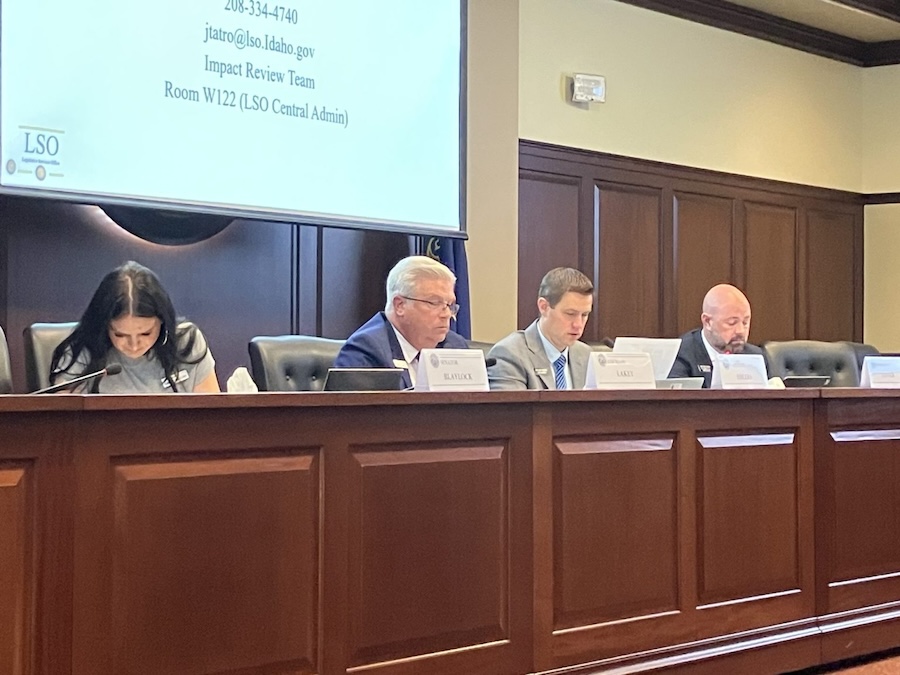
BOISE (Idaho Ed News) — In its first official act, the Legislature’s new DOGE Task Force announced Friday that it has launched an online portal for the public to report government “duplication, waste and inefficiencies.”
The eight-member joint committee, with House and Senate representatives, held its inaugural meeting at the Statehouse in Boise. House and Senate Republican leaders formed the task force following this year’s legislative session. The acronym, DOGE, is a nod to tech mogul Elon Musk’s federal cost-cutting initiative, housed under the Department of Government Efficiency.
Rep. Jeff Ehlers, who’s co-chairing the Idaho committee with Sen. Todd Lakey, said the effort marks the first time since the 1970s that state leaders have undertaken an government overhaul. Ehlers said he anticipates DOGE being a “multiyear activity,” with the goal of recommending legislation as soon as 2026.
“We actually want to get results from this committee,” said Ehlers, R-Meridian.
The new online portal — accessible here — asks the public to fill out a form identifying “instances of government duplication, waste or inefficiencies” along with potential solutions. “Your submission will be reviewed and incorporated into our ongoing efforts to make government processes more efficient and improve services,” the form says.
DOGE member Rep. Heather Scott, R-Blanchard, said she hopes the task force takes seriously the public’s recommendations.
“If we start to get a lot of feedback from the public, which I’m guessing we will, I don’t want that to slip through the cracks, because we’re focusing on how many employees we’re going to get rid of or consolidate or what have you,” she said.
When convening the task force in April, Republican leaders pointed to three “primary areas of concern:”
- Government agency consolidation: Evaluating and implementing strategies to merge redundant agencies and optimize resources.
- Government employee travel: Reviewing and reducing unnecessary state-funded travel to cut costs.
- Eliminating unnecessary state government employee positions: Assessing and restructuring government roles to ensure taxpayer dollars are spent efficiently.
- Sen. Todd Lakey, R-Nampa (co-chair)
- Sen. Carl Bjerke, R-Coeur d’Alene
- Sen. Camille Blaylock, R-Caldwell
- Sen. Carrie Semmelroth, D-Boise
- Rep. Jeff Ehlers, R-Meridian (co-chair)
- Rep. Heather Scott, R-Blanchard
- Rep. Dustin Manwaring, R-Pocatello
- Rep. Josh Tanner, R-Eagle
Ehlers said that the task force will focus on these three areas. But committee members may have some additional ideas, he said, and they offered some hints Friday.
Lakey, R-Nampa, said he’s interested in reducing occupational licensing regulations, “making it easier for people to practice their occupation.” Rep. Josh Tanner, R-Eagle, asked questions about Idaho Public Television and the state’s insurance fund, which both rely on a combination of public and private funding.
“I couldn’t find (any law) that really allowed for a private-public functionality,” he said.
Tanner also praised Gov. Brad Little’s Division of Financial Management for directing state agency directors to prepare budget holdback scenarios this summer. DFM in May issued the directive for 2%, 4% and 6% plans in case of midyear budget cuts. Tanner said the plans will provide a “roadmap,” and signaled the task force could use them to identify cuts.
Also Friday, the task force heard presentations on state department structures and Transparent Idaho, a budget transparency website managed by the controller’s office. Lawmakers also heard from a state official from Arkansas, which launched a DOGE-style overhaul a decade ago.
Led by former Gov. Asa Hutchinson, a Republican, Arkansas’ “transformation” initiative consolidated 42 cabinet-level agencies into 15. The goal was to create savings and efficiencies, improve managerial support and improve delivery of services to the citizens, said Amy Fecher, former chief transformation officer and current director of the Arkansas Public Employees’ Retirement System. But Hutchinson pledged to avoid layoffs, Fecher said, and instead left about 2,000 positions unfilled after workers moved on or retired.
Since Musk made DOGE trendy, at least 26 states have launched similar efforts, according to the Economic Policy Institute, a Washington, D.C.-based think tank. Some DOGE initiatives were created by lawmakers, like Idaho’s, while governors spearheaded other efforts.
Fecher urged the Idaho task force to focus on “consensus-building” between the executive and legislative branches. She also recommended that lawmakers start looking into a method to track savings from DOGE efforts.
“The Legislature really wanted to see the bottom line on the savings, and that was something that, really, we were unable to do in the first couple years,” she said.
Before wrapping up Friday, the DOGE committee took public comments.
Fred Birnbaum, director of legislative affairs at the Idaho Freedom Foundation, asked the task force to investigate $2 billion to $3 billion in continuous appropriations, spending that doesn’t require legislative approval year-to-year, making it more difficult to track spending growth. Birnbaum pointed to the School District Facilities Fund, a property tax relief fund created by House Bill 292 in 2023, as an example.
“I was struck by the fact that the (Arkansas) presenter couldn’t actually speak to what was saved,” he said. “Generally, the yardstick is dollars. So you know, the budget went from X to Y. We didn’t hear any of that.”
Lakey agreed that the task force should collect more information on continuous appropriations.
The committee did not set a date for its next meeting.