


Instead of closing, local elementary will open its doors as a charter this fall
Published at
Carly Flandro, Idaho Ed News
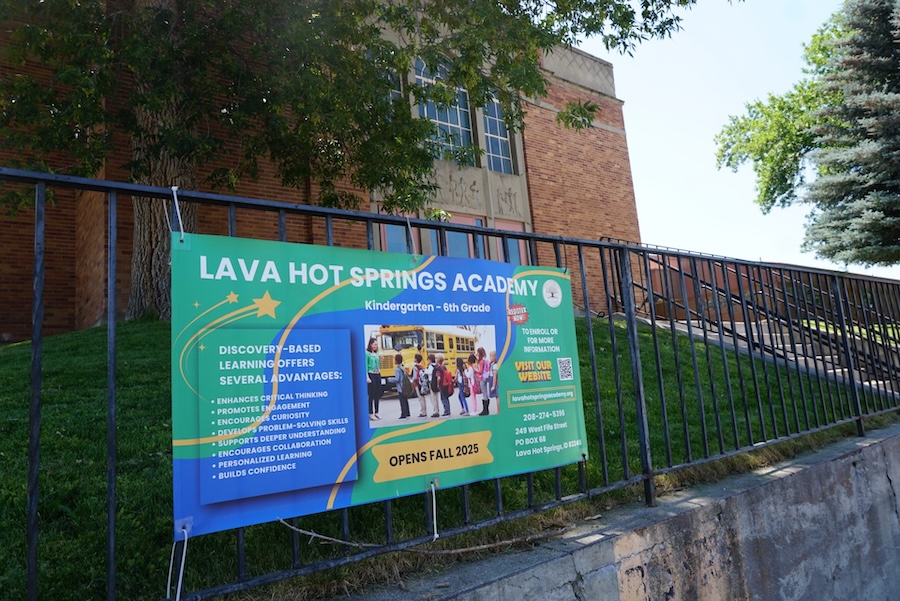
LAVA HOT SPRINGS (Idaho Ed News) — Kolleen DeGraff came to Lava Hot Springs with plans to enjoy retirement in the scenic destination town. But when it became clear that the town’s Lava Elementary School would soon shutter amid declining enrollment and budgetary constraints, locals turned to her for help.
DeGraff, a former private school owner from Utah, had just the expertise needed to keep the school open. With some convincing, DeGraff agreed to take on the project of turning Lava Elementary, formerly part of Marsh Valley School District, into Lava Hot Springs Academy, a public charter school.
“When a town loses its school, it loses a lot of its identity,” DeGraff said. “And these townspeople really fought hard to keep a school here.”
It pulled at her heartstrings, DeGraff said, so she decided to “dive in.”
The K-6 academy, which opens Aug. 12, will have a discovery-based educational model, incorporating project-based, experiential and expeditionary learning. The last hour of each day will be spent on hands-on projects — anything from building a snow cave to canning food to identifying fish in the Portneuf River.
“Kids ought to be actively doing, not just sitting,” she said.
The concept is proving popular. Already, the academy’s enrollment is at 86 students — double what it was at Lava Elementary last school year, DeGraff said.
Dropping student numbers and financial shortfalls have driven school trustees across the state to close or consider closing schools. When that happens, the school building becomes a new problem — do trustees repurpose it, sell it, or let it sit empty?
For Marsh Valley School District and Lava Hot Springs residents, a charter school partnership has become the answer. The charter will keep the school from falling into dilapidation, but get the benefit of using the building.
“It’s a win-win situation,” said Megan Reno, a board member for the new academy.
Reno, a parent and local business owner, spearheaded a local group to save the school when she heard about its impending closure.
“The school is the heart of our community,” Reno said. “It’s just so important, not just for educational purposes, but also for the social and economic (impacts).”
Several of her children will attend the school in coming years, and she said the community’s effort to save it has been “heartwarming.”
Still, the elementary’s transition from a traditional to charter school hasn’t been without its challenges.
While many locals have been supportive of the new school, others are skeptical of DeGraff — partly because of her religious background. The private school she previously owned, Liahona Preparatory Academy in Pleasant Grove, Utah, was essentially a “BYU for K-12 students,” DeGraff said. Brigham Young University is a private, postsecondary institution “founded, supported, and guided by The Church of Jesus Christ of Latter-Day Saints.”
But DeGraff reiterated multiple times that the new Lava Hot Springs Academy is a public school and will remain secular: “It won’t be religious at all.”
Another hangup: The school, part of which was built in the 1930s, needs a “lot of love,” DeGraff said. The kitchen’s major appliances don’t work, so a third party will bring in lunches. The school’s historic gym needs upkeep, and the playground turf is in the process of being replaced.
Wednesday, DeGraff was busy preparing for the academy’s opening day, which is less than a month away. Outside, her husband Brent, a former high school teacher who came out of retirement to do the groundskeeping, was cutting the grass.
Inside, teacher Taylor Spurrier was busy preparing her classroom. She previously taught in Soda Springs and is looking forward to teaching fifth and sixth grades at Lava Hot Springs Academy this fall.
“It seemed like a really amazing chance to grow and start fresh with an entirely new school that has a new culture,” she said.
At one point, a local business owner popped in to provide a $2,500 donation to the school. It’s one of a few donations school leaders are grateful to have received, but the academy will primarily be funded with state dollars, DeGraff said.
She and the board members are also providing some funding out of their own pockets.
“Does that tell you how much I believe in this?,” she said.
For her part, DeGraff said she is committed to leading the school for at least three years, before finally getting back to where she was: enjoying retirement.