


Bannock County approves one-time payments to nonprofits affected by charitable contribution cuts, with stipulations
Published at | Updated at
POCATELLO – The commissioners have voted in favor of distributing previously unused funding to most of the nonprofit agencies that saw their funding reduced under next year’s budget for Bannock County.
But this wasn’t a restoration of the funds that they cut.
“It should be noted that this is not intended to be ongoing; it is a one-time payment,” reads a memo proposing the payments, sent out by Commissioner Ken Bullock on Sept. 11.
RELATED | Commissioners make cuts to nonprofits, with potential for more funding down the road
Bullock told EastIdahoNews.com that he and the other commissioners spent time meeting with the local nonprofits whose contributions were cut under the new budget, and that doing so changed his perspective.
“I got to meet some of the not only the directors, but some of the board members, and talk to them about what they were doing. In light of that, I felt like we probably did overlook some needs that maybe if there was a way we could take care of that, that was my goal,” Bullock said.
Bullock’s memo recommended “approving the payment of invoices to help minimize the effects of the Fiscal Year 2026 approved budget.” The memo also explained that the funding would come from unused funds in County Operations prior to the end of Fiscal Year 2025, which ends on September 30.
Here are all the agencies that received a one-time payment from the commissioners:
- Mother/Infant Care Program: $10,000
- Pocatello Free Clinic: $10,000
- Pocatello Senior Activity Center: $10,000
- South Bannock County Historical Center/Museum: $6,000
- Portneuf Valley Economic Development: $20,000
- Aid for Friends: $30,000
- Health West: $5,000
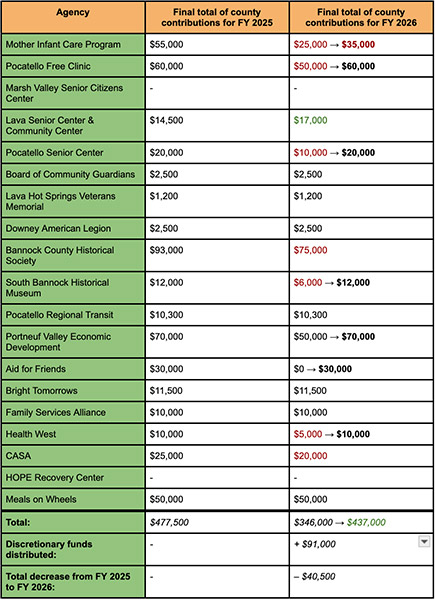
The payments total $91,000. These payments reduced the total decrease in charitable contributions from FY 2025 to FY 2026 from the original $131,500 to $40,500.
Here is an updated table reflecting the final total of charitable contributions from the county, with the values updated to include the payments:
“These are discretionary funds. These are funds that we had the ability to use this year, but … we have no idea what the future holds. We have no idea what the future may hold for expenses or anything else. But with that, we will encourage them to continue to look for other sources, other help,” Bullock said.
Bullock said these other sources could come from organizations, churches or city governments in the surrounding area.
“I’d encourage them … to be more engaged, share the load,” Bullock said.
EastIdahoNews.com spoke with two agencies that saw charitable contributions cut, one of which did not receive an additional payment and one that did.
Aid for Friends
While Jessica Buckley, grants and programs administrator at Aid for Friends, is “grateful” for the payment that brought their budget back up to the previous year, she’s also “hesitant.”
“We’re excited, but also hesitant because of the stipulations they put on it … (but) I’m grateful that they listen to the community. It’s not every day that you get an elected official that truly does listen to the voice of the community,” Buckley said.
Buckley said that thanks to the payment, Aid for Friends won’t have to scale back its shelter’s capacity, and they hope to increase it during the upcoming winter. They feel this is necessary due to the Refuge Warming Center closing this year.
And while the commissioners approved these payments with stipulations, Buckley said that Aid for Friends intends to ask for its full funding contribution at its budget presentation for FY 2027. She sees this as necessary because when grant reviewers ask Aid for Friends for matching grants, they’ve been able to point to the county contributions as an example.
“They go, ‘Oh, that’s fantastic, (we) can see this broad range of support.’ So in our next year’s renewals, we wouldn’t have had that $30,000, and we would have had to find that matching funding kind of cobbled together elsewhere,” Buckley said.
Now that they have a better idea of what concerns the commissioners might have, Buckley said it will change how they present to them in the budget meetings.
But she also wanted to make it clear that the organization never took the county funding for granted.
“Especially where we started hearing from other other areas around the state who said ‘(that’s) amazing.’ And we’re like, ‘yeah, we have a really great county.’”
CASA – 6th Judicial District
The 6th Judicial District CASA office is one of the two organizations that did not receive a payment to supplement its charitable contribution cut.
While CASA normally receives $25,000 from the county, its contribution was cut to $20,000. The agency was able to make up for this funding cut, but it’s prepared for the possibility of seeing further cuts next year.
“I’ve already prepared for that next year and told the board, ‘if we get cut again next year, then I will just take that cut out of my own salary,’” said Lesli Schei, executive director of the local CASA office.
This possibility is coming at a time when their office is representing an increasing number of children. Schei explained that their office has had a 10% increase in cases over the last two years, and are on track to take on an additional 12% above last year.
The majority of the agency’s budget comes from the state of Idaho, but it also raises money and applies for other grants, and it’s already receiving funding from surrounding counties.
“We already get money from the other counties that are in our judicial district … but we ask for it a little bit more proportionally for our smaller counties. We don’t have as many cases out there, so we don’t ask for as much money,” Schei explained.
Schei said that the county cutting funding contributions to some nonprofits has a ripple effect on all of the nonprofits in the area.
“All of the nonprofits do great work, but we all ask the same people for money every year, and we’re all fundraising, and we’re all writing grants. And so there’s only so much that can be spread amongst us,” Schei said.
Schei also intends to ask for CASA’s full contribution at next year’s budget presentations.
“I think having been through it once, and knowing that they cut the funding this last year, I might prepare a little bit differently this next time,” Schei said.