



Idaho’s only woman on death row appeals over brain damage. Justices just ruled
Published at | Updated at
Kevin Fixler, Idaho Statesman
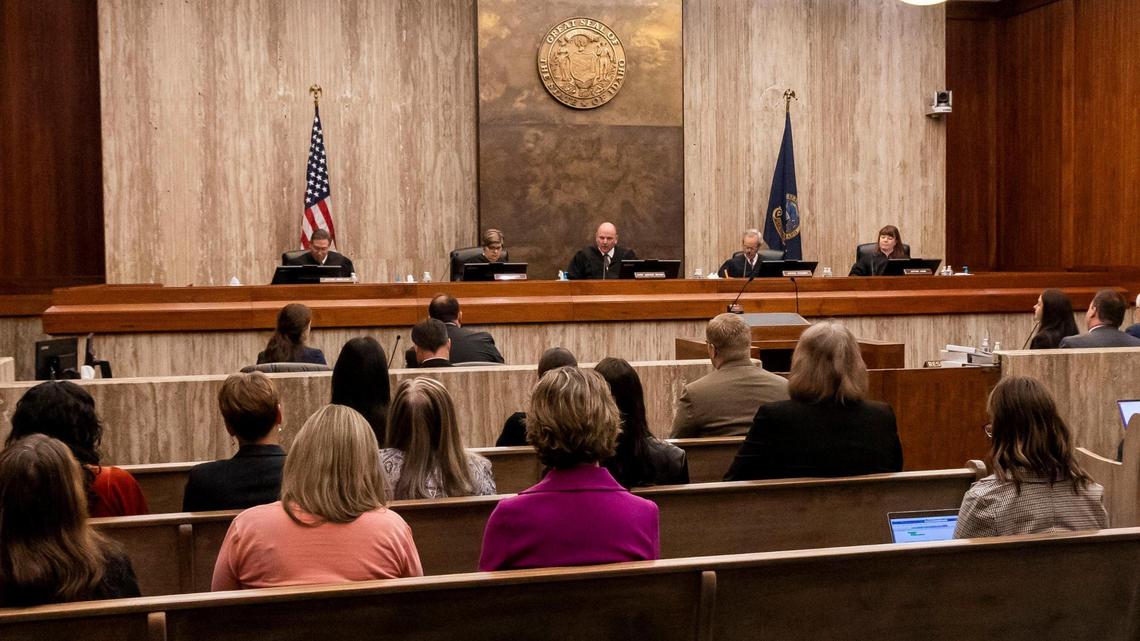
BOISE (Idaho Statesman) — Idaho took another step toward its first execution of a female prisoner after the state’s highest court rejected an appeal Thursday from the only woman on its death row.
The Idaho Supreme Court ruled to deny a request to send the capital case of Robin Row, convicted of three murders more than 30 years ago, back to state district court for possible resentencing to life in prison. Her attorneys argued she received inadequate legal representation in her original trial, when she was sentenced to death, after they failed to offer evidence of Row’s brain damage.
Medical scans of Row’s brain taken before the murders, which revealed cognitive impairment, were not presented by her prior legal team, Row’s current attorneys said. Had that been introduced during her sentencing, they argued, it could have influenced whether she received life imprisonment instead of the death penalty.
But Idaho’s laws and legal precedents limit the window of time that such a capital appeal can be made, Idaho Supreme Court Justice Gregory Moeller wrote in a unanimous decision against Row. And recent U.S. Supreme Court decisions also closed new avenues for her to file past legal claims, the court ruled.
“Nearly three decades later, Row now asks this court to revisit her same arguments but reach a different result,” Moeller wrote. “Row’s argument is unavailing.”
Row, 67, was found guilty of killing her husband and two young children when she set their Ada County home on fire while they slept in February 1992 in an attempt to collect life insurance money. She was convicted in March 1993 and handed the death penalty later that year.
The eight men on death row in Idaho are kept at the state’s maximum security prison south of Boise, while Row is held at the Idaho women’s prison in Pocatello. She has been incarcerated for more than 33 years, during which she has mounted repeated appeals trying to avoid being put to death.
Executions are on hold in Idaho as the state prison system remodels its execution chamber in the transition from lethal injection to a firing squad as the lead method. Construction is pegged at more than $900,000, and prison officials are pursuing a remote-operated firing squad. The renovation is expected to be finished in early 2026 ahead of the new law taking effect in July.
In one of Row’s recent appeals, U.S. District Judge B. Lynn Winmill issued a preliminary decision in September 2021 that the evidence suggested her trial court attorneys “performed deficiently” when they didn’t present her brain scans at her sentencing, according to court records. As a result, Winmill wrote, the case “cries out to be returned to a jury of Row’s peers to decide her fate” with a new hearing.
A U.S. Supreme Court ruling in May 2022, however, upended the legal path Row’s attorneys sought in federal court. The decision determined that federal courts generally cannot consider evidence in an appeal that was not previously presented at the state court level.
After that ruling, Winmill was forced to dismiss Row’s federal appeal, though he wrote he did so “with great reluctance.”
Row’s federal public defenders then appealed the case to the 9th U.S. Circuit Court of Appeals. It is pending a decision.
“The court recognized that Ms. Row has suffered a clear violation of her constitutional rights,” Deborah Czuba, a supervising attorney for the nonprofit Federal Defender Services of Idaho, said in a prior statement to the Idaho Statesman.
Ineffective legal counsel claims filed too late, Idaho justices rule
In the meantime, Row’s state-level public defenders pushed forward for further review of her case from the Idaho Supreme Court.
At a hearing in May in front of Idaho’s highest court, Garth McCarty, Row’s attorney with the Idaho State Appellate Public Defender’s Office, advocated for revisiting his client’s death sentence based on their client’s documented brain damage. An exception should be made for Row’s unique situation, he argued, given she was on the verge of receiving a reduced sentence to life imprisonment in U.S. District Court, but that was “snuffed out” by the U.S. Supreme Court.
“To send her to the firing squad knowing that she had a claim that was considered meritorious in federal court, but refusing to hear that claim in state court, strikes me as an absurd result — in addition to an unfair one,” McCarty told Idaho’s five justices.

Even though Row’s brain damage arguments were not presented in past appeals, the deadline to do so has lapsed, Moeller wrote.
“Row did not raise her brain damage-related ineffective assistance of trial counsel claim in her first petition for post-conviction relief,” Thursday’s ruling read. “Because that claim reasonably could have been known at the time of her first petition, the time limitations in Idaho … bar her from bringing such a claim in a successive petition.”
There are nearly 2,100 prisoners on death row in the U.S., according to the latest data from the Washington, D.C.-based nonprofit Death Penalty Information Center. Just 44 women and seven transgender people — six of whom are also women — are part of the national total, the Cornell Center on the Death Penalty Worldwide reported.
Besides Row’s three murder convictions, she also had two other children who died under suspicious circumstances, but she was not charged in either of their deaths. In 1977, her 15-month-old daughter was thought to have died of sudden infant death syndrome, or SIDS, in New Hampshire, and her 6-year-old son died in Northern California in a cabin fire in 1980.
Row is the second woman to receive the death penalty in Idaho. The first was Karla Windsor in 1984. A year later, the Idaho Supreme Court threw out Windsor’s death sentence, and a federal judge resentenced her to life in prison with the chance of parole after 10 years. Windsor was later released from prison in December 2004.