



Utah House passes bill to fully ban transgender treatments for minors
Published at
Katie McKellar, Utah News Dispatch
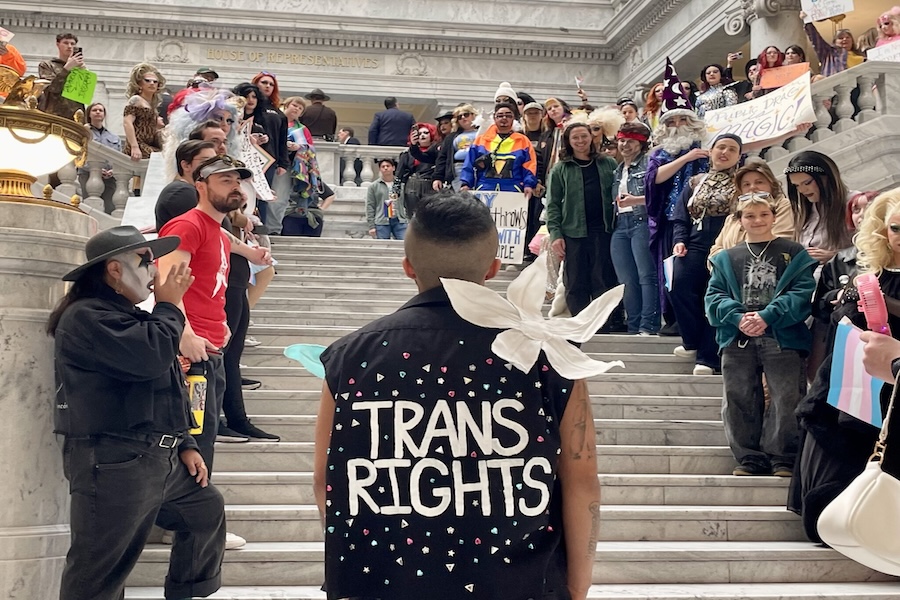
SALT LAKE CITY (Utah News Dispatch) — Two bills to restrict access to gender-affirming care for transgender people and another to require private insurers to cover “detransition” treatments won approval from the Republican-controlled Utah House on Thursday.
All three bills now advance to the Senate for further consideration.
Full ban on transgender hormonal treatments for kids
The first bill to win approval was HB174, which would turn Utah’s 2023 moratorium on newly prescribed hormonal transgender treatments for Utahns under the age of 18 into a full ban. It would require Utah doctors for teenagers currently undergoing treatments to stop writing prescriptions by Jan. 28, 2027.
The bill, sponsored by Rep. Rex Shipp, R-Cedar City, passed on a 54-16 vote, despite objections from Democrats that the arguments in support of turning Utah’s moratorium into a full ban were not supported by good science.
“Denying health care to a very marginalized, at-risk population of children is always going to be a mistake,” said Rep. Jennifer Dailey-Provost, D-Salt Lake City. “But I also am really, really distressed that we’ve allowed bad science to be reasoning for bad legislation.”
Data presented in support of the bill, she argued, “utilizes selective data citation and cherry picking, misrepresentation of systematic reviews, false claims about scientific consensus, inconsistent evidentiary standards, out-of-context statistics, causal inference errors, and dismissal of conflicting evidence.”
In HB174’s first public hearing last week, Shipp and the bill’s supporters argued that kids shouldn’t be given hormonal treatments that could result in “irreversible physical harm.” Much of Shipp’s bill presentation focused on discrediting the state’s own commissioned academic research, which concluded that a consensus of evidence supports that hormonal gender-affirming treatments for minors are safe and effective for mental and physical health.
Shipp said that report “displayed serious bias,” while citing conflicting conclusions from the group Do No Harm, which advocates for “keeping identity politics out of medical education, research and clinical practice,” and opposes “youth-focused gender ideology,” according to its website.
Gender dysphoria is a “mental health problem,” Shipp said.
“Distress is real and often excruciating for these youth,” Shipp said. “These young people need and deserve compassionate care.”
But Shipp also argued that “no blood test or MRI can diagnose a transgender identity” and there’s “nothing medically wrong with physically healthy bodies of children” who identify as transgender.
“Mental health professionals’ job is to help people adjust to reality, not avoid it,” he continued. “Instead of encouraging young people to reject their bodies, we need to help them reconcile distressed emotional feelings with what their body is.”
During last week’s public hearing, transgender Utahns and parents of transgender kids urged lawmakers not to expand the moratorium into a ban, arguing it would impact a small number of Utah kids who haven’t already been banned from the treatments. They also argued gender-affirming care can be life-saving for a group that’s at a higher risk of suicide.
One mother, Catherine Dillon, said her 16-year-old transgender daughter is currently undergoing hormonal treatments because she was “grandfathered” under Utah’s current moratorium. Dillon argued that of an estimated 135 kids who were allowed to continue treatments because they had already started them before the 2023 moratorium took effect, less than 100 haven’t yet turned 18, she said, “and my daughter is one of them.”
“I’m not asking you to understand my daughter’s identity, only to understand that this law won’t change it, and it will harm her,” she said. “This bill does not protect children. … This bill only pushes care underground, out of state and out of reach.”
Before the debate on the House floor was cut short, Rep. Tyler Clancy, R-Provo, said that he would be voting to support the bill because the hormonal treatments are “very powerful” and “almost too serious” for teenagers to consent to, and “it’s important that individuals make these decisions when they’re adults.”
Clancy also noted, however, that throughout the debate over the bill, it’s become evident to him “that we’ve got to do better as a state, as the human race, to better understand one another.”
Restricting public-funded insurance coverage for transgender care
The House on Thursday also voted 48-21 to advance HB193, which would restrict publicly-funded Utah employers, like the state or city governments or school districts, from offering insurance that covers transgender surgical procedures or hormonal treatments.
The bill’s sponsor, Rep. Nicholeen Peck, R-Tooele, said the bill was “brought to me by a constituent who was concerned” about city governments “having to choose to cover certain elective procedures that their tax base may not agree with.”
The bill also includes a provision that would require a publicly-funded insurance that already paid for a transgender procedure, “then it would also have to pay for a de-trans procedure for that person, if they wanted it, of course,” Peck said.
One Republican, Rep. Ray Ward, of Bountiful, spoke against the bill, pointing to the debate minutes prior that transgender people should be able to make these decisions when they’re adults.
“I hope that we would be in a position to really honestly say, ‘That’s a choice we may not agree with, but a choice that they as an adult can make, and we would not try and take away a portion of their insurance coverage over that issue.”
House Minority Assistant Whip Rep. Sahara Hayes, D-Millcreek, who has previously publicly said she’s the partner of a transgender woman, argued that if the bill was really just about “keeping public dollars out of elective procedures,” then it wouldn’t target transgender care, but also “things like breast augmentations and reductions and hormone replacement therapy.”
“This bill is singling people out,” she said, while also noting it focuses on adults, not minors, who should be able to make decisions for their own bodies. “One person’s elective is somebody else’s medically necessary, and that is a distinction that should be made between the patient and their doctor. Not 104 legislators in the exam room with them.”
Peck argued that her bill doesn’t restrict adults from making their own decisions, but “the question is just who pays for it? And we shouldn’t be forcing municipalities to pay for elective procedures.”
Requiring private insurers to cover ‘detransition’ treatments
Next up was Peck’s HB258, which the House passed on a 53-16 vote. It would require private insurers that cover transgender surgical procedures and hormonal treatments to also cover “detransition” procedures and treatments.
“We just want to make sure that if we’re covering one population of people that we also cover the other population of people,” Peck said.
She called it a “good step forward in really caring about our growing de-trans population.”
Bills put lives at risk, House Democrats say
After the votes on the bills, Utah House Democrats issued a statement saying they represent “a troubling pattern of government overreach that targets transgender Utahns and interferes with personal medical decisions.”
“Instead of ensuring people can access evidence-based healthcare, these bills create fear and instability for patients and their families,” House Democrats said.
The bill to fully ban transgender hormonal treatments for kids “singles out a small group of Utahns and puts their health and safety at risk by forcing children to detransition, disregarding medical consensus and the well-being of patients,” they said.
The bill to ban publicly-funded insurance from covering gender-affirming care “would harm constituents in every district” by restricting their access to treatments, House Democrats said.
“Lives will be profoundly impacted, and potentially at risk, if these bills were signed into law,” they said. “Our caucus stands with transgender Utahns. We recognize that this annual onslaught of targeted legislation causes lasting harm. To everyone impacted, we want you to know: we see you, we stand with you, and we will keep fighting for you.”
Utah News Dispatch is part of States Newsroom, a nonprofit news network supported by grants and a coalition of donors as a 501c(3) public charity. Utah News Dispatch maintains editorial independence. Contact Editor McKenzie Romero for questions: info@utahnewsdispatch.com.