



Cremated remains were also lost in the Spokane fires. With the help of archaeologists, one woman got her mother’s back
Published at
Alexandra Duggan, The Spokesman-Review
SPOKANE, Washington (The Spokesman-Review) — A German shepherd known as Quinn trampled through the rubble of a duplex that had burned to the ground in Spokane’s Old Trails fire, sniffed and sat down.
The team of forensic archaeologists and K-9 handlers were getting close.
On Saturday, they were looking among the ashes for a different kind of ashes : the cremated remains of CaitLynn Burt’s mother, Tara Rooney, who died a decade ago.
When Burt learned their home was on fire, one of her first thoughts was of her mom.
“It’s obviously like an initial shock, like our whole house is gone,” she said. “But then you start going through, and you’re like, ‘I didn’t have a chance to grab this, or this, or my mom’s ashes.’ ”
The volunteer-led team from Alta Heritage Foundation, a California-based nonprofit that specializes in unearthing cremated remains from fire-devastated homes, descended into the area adjacent to a brick fireplace where Quinn had alerted. Rooney’s remains had been positioned in a box on a shelf next to that fireplace. Burt had not put her mother’s ashes in an urn.
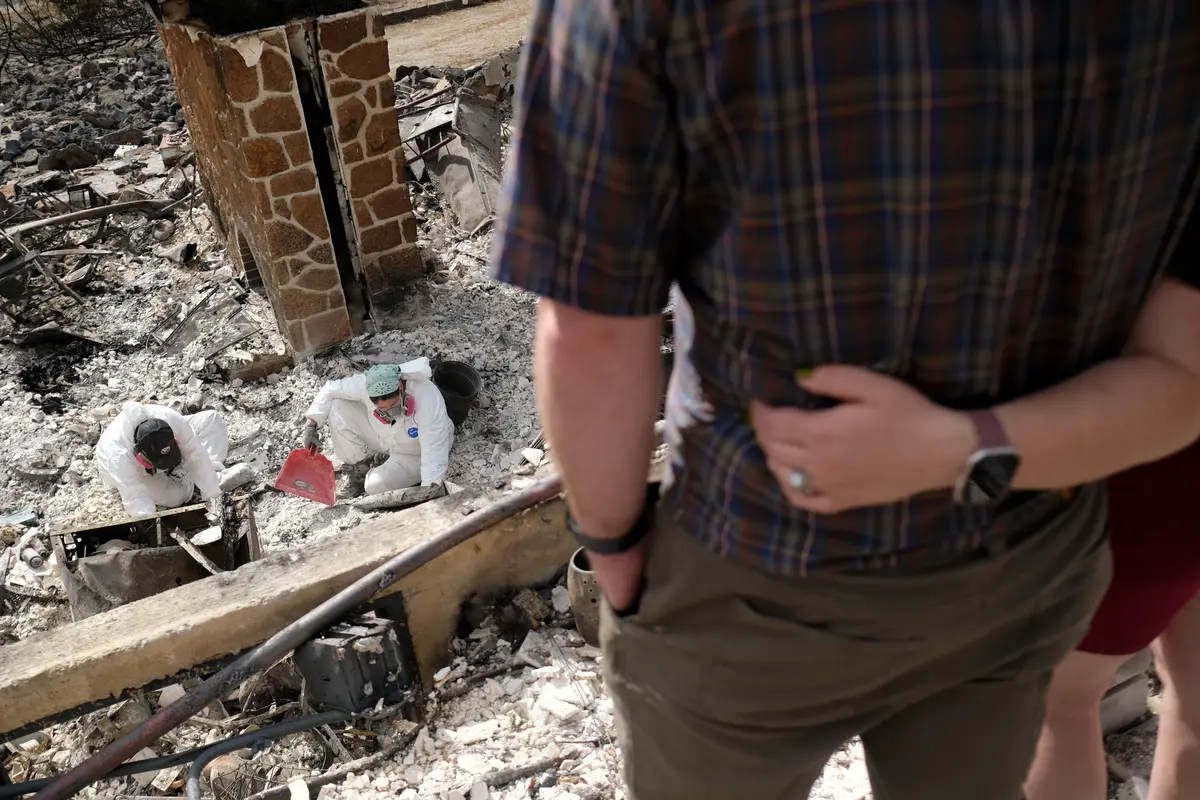
Slowly, the team clad in their white Tyvek suits and breathing masks dragged away burned pipes and twisted metal, then got on their knees and scraped away layers and layers of charred rubble.
Archaeologist Kassie Rippee held up what appeared to be a Harry Potter-themed card set.
“You Harry Potter fans?” she asked.
“That’s us,” replied CaitLynn Burt’s husband, Keenan.
One by one, they picked out pieces of glass, a vase and other mementos. The vase, a family heirloom, was on the same shelf as Rooney’s remains and held her grandmother’s antique rings. CaitLynn Burt gasped as the team pulled more from the area – a glass case holding some jewelry and other heat-damaged gifts.
Now they were closer than ever.
The archaeologists peeled back mounds of charred clothing and cardboard boxes, an area that used to be a child’s closet. One more layer and a clump of tan-colored ash appeared, a stark contrast to the rest of the white ash surrounding it. With a metal tool, they scooped the ash and some other debris into a red dustpan and let it fall gently into a large Ziploc bag. Both seemed confident in what they had found.
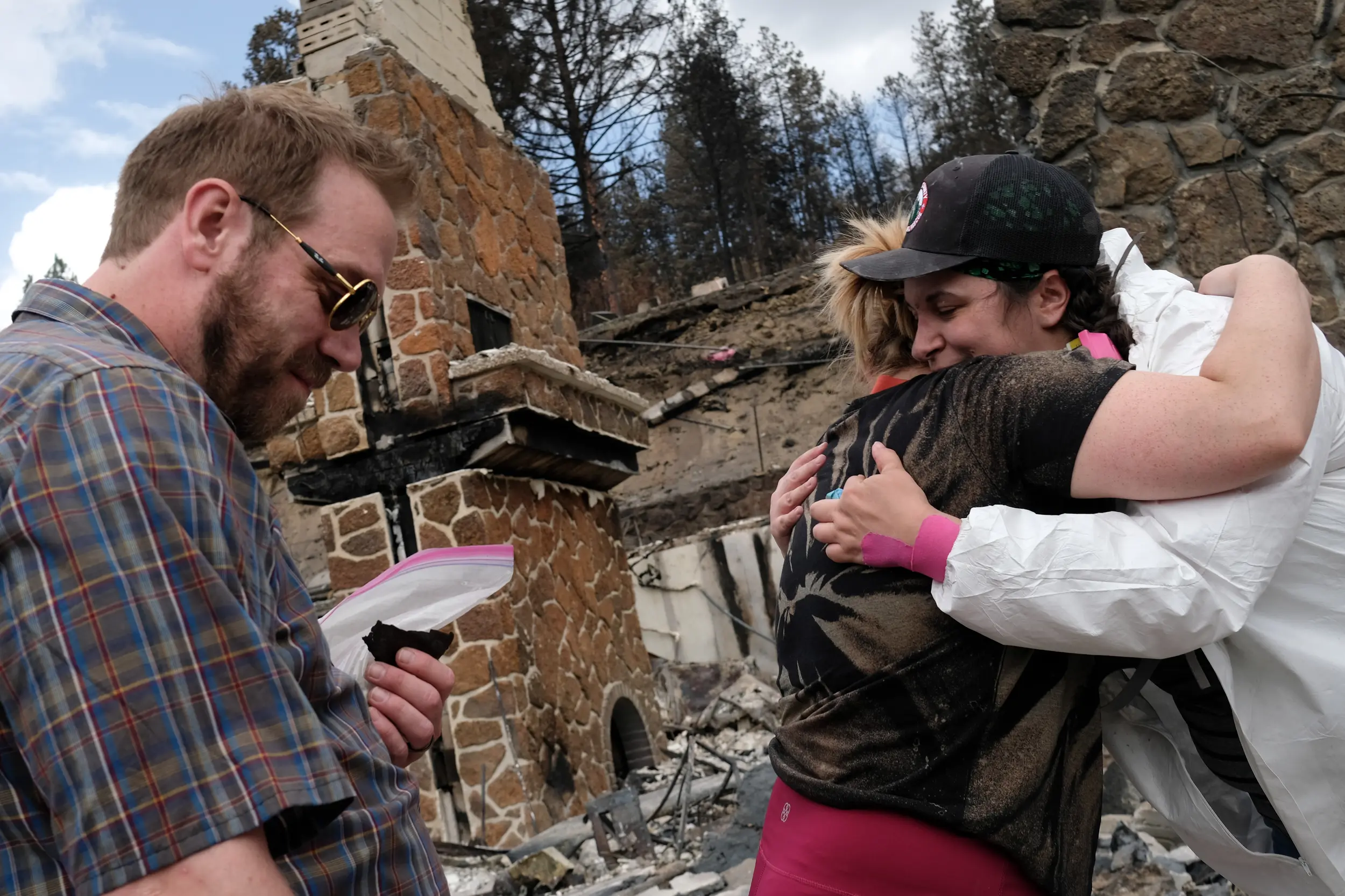
Rippee and fellow archaeologist Amanda Cervantes walked over to the Burt family, who were wide-eyed and staring at the bag in Rippee’s hands.
“We collected as much as we could of the material that doesn’t present ‘right,’ ” Rippee said. “We can say with confidence that there’s some material in here, some of her remains in here.”
CaitLynn Burt cocked her head and smiled at Rippee. “Can I give you a hug, too? Is that OK?” she asked.
The two embraced in the driveway of the duplex that once housed the Burt couple and their three young children.
“We always hope we can find more,” Rippee said.
Saturday was the first day the couple had returned to their rental property off Indian Trail Road since the fire started Aug. 1. They were out of town at a family reunion in Idaho at the time, but knew their home had burned from a video posted to social media.
“It’s not really closure, but a weird sense of it, since we haven’t been up here,” Keenan Burt said. “Being here is part of the process.”
Like cutting into a cake
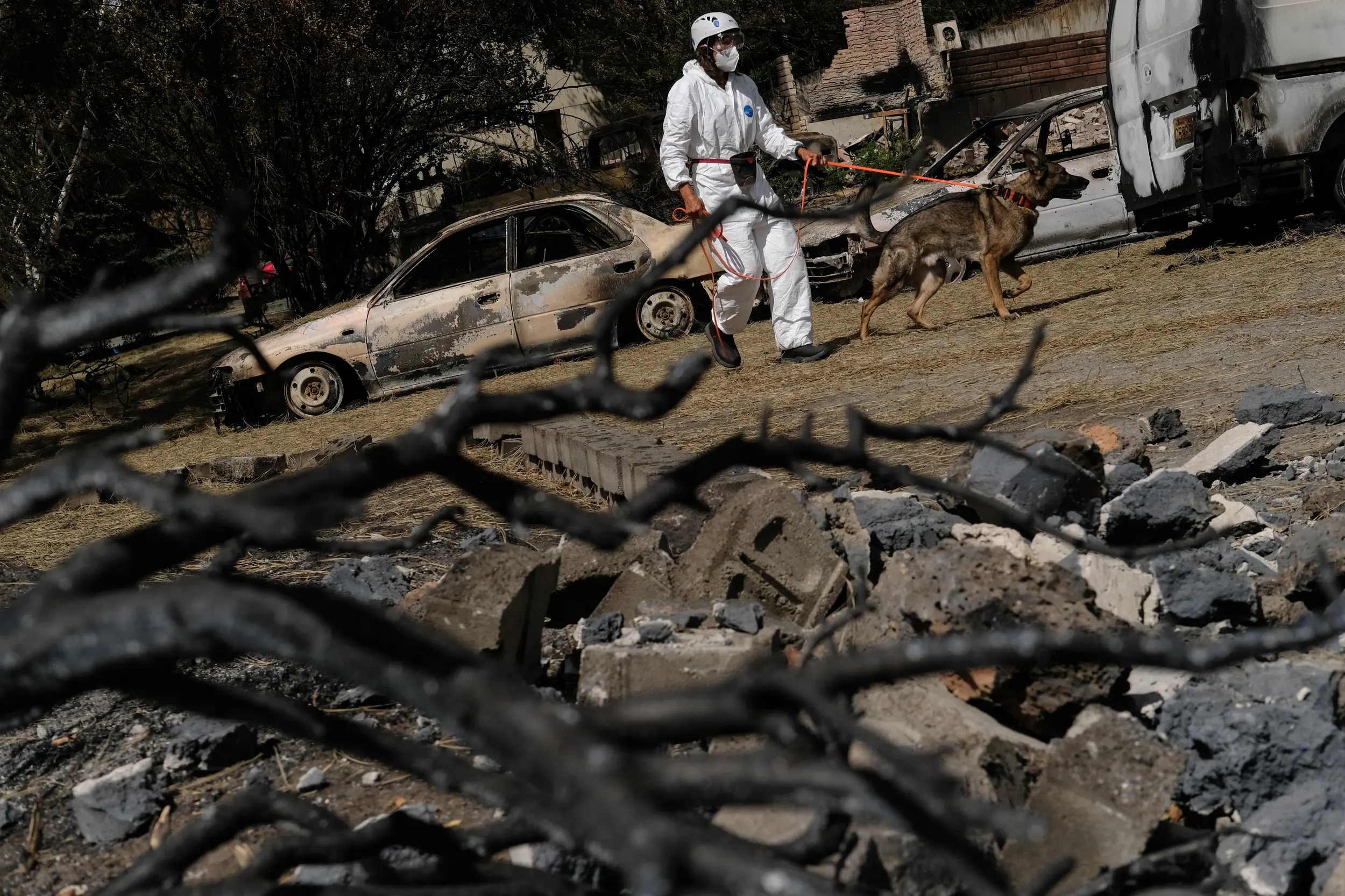
For archaeologists who descend on disasters, identifying ash from other ash is like muscle memory. The Alta Heritage team first deploys shepherds that go through rigorous training to identify cremated remains.
Because their training is so specialized, the dogs will not alert on recent human remains, pet remains or charred food, said Crook County, Oregon’s search manager and K-9 handler Lori Blackburn. Blackburn is also a certified human remains detection specialist at the Institute of Canine Forensics, where she works with her police dog, Cagney.
The Institute of Canine Forensics has assisted the U.S. Forest Service, the U.S. Bureau of Land Management, multiple native tribes, cities, churches, universities and even survivors of the Jan uary 2025 devastating Palisades fire in California.
In 2017, National Geographic Society even paid for the organization to bring the dogs to an island north of Fiji where scientists believe Amelia Earhart could have taken refuge after likely crashing her plane.
Those dogs are integral to the Alta Heritage Foundation’s archaeologists, who use them to narrow down areas they can start excavating.
“It’s chemical markers they’re trained on,” said the foundation’s treasurer and client coordinator, Emily Taber, who has been an archaeologist for more than 15 years and also specializes in animal remains. “That’s how they can come into a building full of ash and home in on where cremains may be.”
This time, Cagney and Quinn were the canine stars of the show. Cagney, a black, shiny-coated German shepherd, tramped around burned drywall for a few seconds and headed straight for a bathtub sticking out of the rubble. Cagney stuck her face below a piece of metal and began pushing and prodding it with her nose.
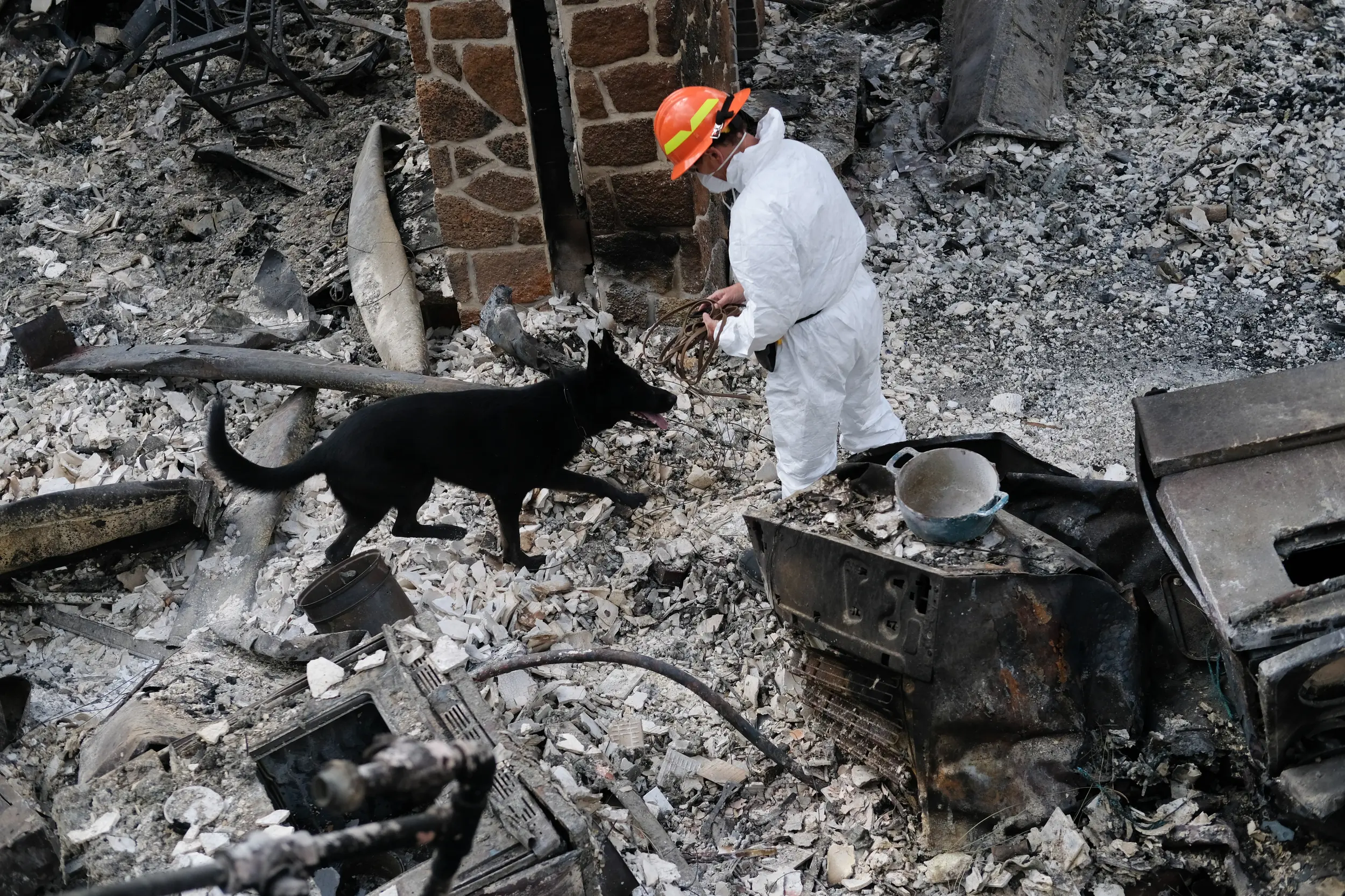
Looking frantically around her, Cagney twisted her body and let out a yelp. She retreated to Blackburn, where she got a pat on her head and a treat.
“Her response is to (lay) down, but these areas are hard,” Blackburn said. “She was interested in a particular area, stuck her nose in there and got frustrated with that shriek. She couldn’t get her nose right on the source.”
Quinn promptly followed to check Cagney’s work. Both alerted to the same area. CaitLynn Burt stood over the top of her former home, showing the crews videos she had taken months before to try and reconstruct where each room used to be. The dogs were alerting to what used to be the bathroom.
With tools in hand, four to five archaeologists began to excavate the area. Seeing nothing, they returned to CaitLynn Burt. Her mother’s remains were nowhere near the bathroom, she told them.
Rippee said later that spot was a “scent pool,” or an area where the scent of human remains travel in wind and fire into an open gap and become trapped.
The archaeologists moved around some metal, called back the dogs, and they didn’t return to that spot. Instead, they sat down right next to the fireplace.
“We moved all of that material first to confirm what we suspected. When we moved that material, the dogs came back in and had no interest in that area,” Rippee said. “Then they alerted in that first location right there, right where you said they would. … That confirmed to us that that’s where your mother was.”
Once they found the spot, it took all but 40 minutes for the archaeologists to find what they were looking for, even though excavating and differentiating human cremated remains from the ash of a home is extremely technical, Taber noted.
“We tend to cut in more like we’re cutting into a cake because that exposes in profile what we’re looking for. The texture, the appearance, the color of a lot of cremated human remains look very distinct from a lot of the things that we see mixed in with building ash after a wildfire,” she said.
The foundation pulls archaeologists from similar backgrounds with extensive experience on human remains and cremated remains, Taber said. It’s why they can so quickly identify what they’re looking for. Cremated remains following a house fire can often be white, green, gray, tan or a pinkish salmon color, which is the most common, the crews said Saturday.
“We use our archaeological skills to say, ‘Is this the texture? Is this the color?’ And then (we) can eliminate other things from our area of consideration,” Taber said. “From the top down, it might look like we are just looking through structural debris. But we are keeping an eye out for subtle changes in color and texture.”
Remembering Tara
Tara Rooney died in 2014 of a heart attack when her daughter was a teenager, CaitLynn Burt said. Rooney had some complications with multiple surgeries, and was eventually given a round of opioids to assist in those complications. That’s when she became addicted to them.
“When my niece was born, she (didn’t want) to be addicted anymore. She wanted to live a healthier life. She was trying to get clean,” Burt said. “But she had a heart attack because she was so used to being on them. And she didn’t survive it.”
Years went by without Burt receiving her mother’s remains. She didn’t have a great relationship with her stepfather, and he was the person who had been holding onto them. It was only until he died recently that CaitLynn Burt was able to get her mother’s remains back, she said. Any other physical piece of the rest of her family being lost in the fire hits even harder because they are no longer around, either.
“My grandma had passed away, my aunt died of cancer when she was not even 40. Then my uncle passed away recently. It’s really hard … I lost so many people growing up,” she said. “The only thing that I got from my mom was, like, a blanket. What I had was cherished.”
Now, CaitLynn Burt has found solace in her husband’s family. The fire has strengthened their marriage, she said. Keenan Burt stood beside his wife for hours Saturday as she watched and hoped they’d find the rest of her mother.
“No matter what happened in our life, she had a really big heart. She was very sweet, and she would always just be there emotionally in that way,” CaitLynn Burt said. “She was trying to get clean to be there because she wanted to be there.”
If Rooney was standing in the same driveway, watching her daughter wait to receive a Ziploc bag of her remains, CaitLynn Burt joked about what she’d probably say.
“What the hell are you doing, wasting all this time on me?”