



‘Resident Evil’ may have cracked the code for making a great video game movie
Published at | Updated at
Making a great video game movie shouldn’t be this difficult.
You already have the characters, the world and the story. Not to mention millions of fans ready to buy a ticket.
What could possibly go wrong?
Well, as decades of video game movies have taught us, quite a bit.
For years, Hollywood has struggled to figure out what to do with video games. Some movies tried to recreate the games as faithfully as possible. Others seemed almost embarrassed by their source material and changed so much that fans wondered why they bothered using the name in the first place.
Things have certainly gotten better in recent years, but adapting a video game still presents an interesting problem.
Watching someone play a video game and actually playing it are two very different experiences.
With “Resident Evil,” writer-director Zach Cregger may have figured out a pretty clever solution.
Don’t recreate the game. Rather recreate the feeling of playing it.
A new trip to Raccoon City
I should mention that I’m not a big “Resident Evil” guy.
I don’t have anything against the games. I’m just not much of a gamer, and the previous movies were never really my thing.
That actually made Cregger’s approach especially interesting.
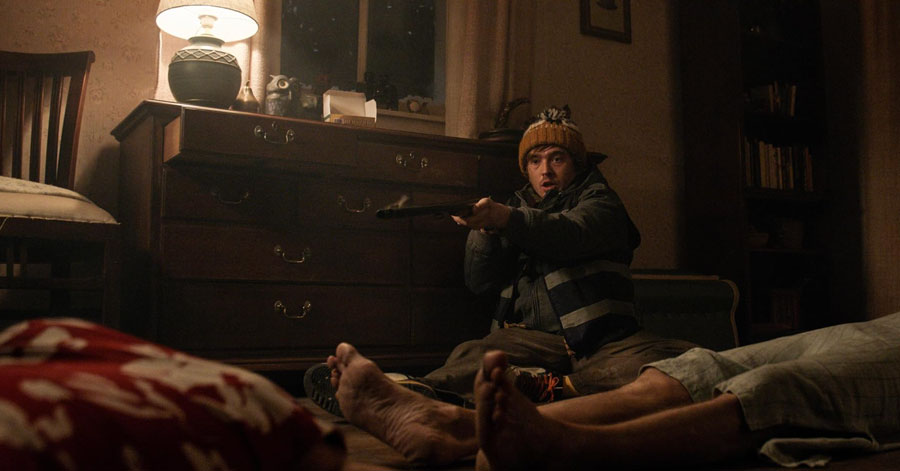
Rather than expecting audiences to know decades of “Resident Evil” history, the movie gives us Bryan, played by Austin Abrams, a medical courier who accepts an extra delivery that sends him toward Raccoon City.
If you’re familiar with “Resident Evil,” you probably already know Raccoon City isn’t exactly where you want to be headed late at night.
Bryan doesn’t.
Before long, his simple delivery becomes an increasingly bizarre and horrifying fight to survive the night.
That’s about as much as you need to know.
Part of the fun of “Resident Evil” is discovering just how much worse Bryan’s evening gets. If you’re curious, it gets a lot worse.
It captures the experience instead of the story
This is where I think Cregger made his smartest decision.
“Resident Evil” isn’t particularly interested in recreating one of the games scene for scene. Instead, it borrows the language of video games and works it into an original story.
There are first-person sequences that put us directly into Bryan’s perspective. He starts with very little and essentially upgrades his weapons as the danger increases. New locations feel a little like entering the next level, where the enemies get nastier and survival becomes more difficult.
The movie understands what it feels like to play a video game without constantly announcing, “Look! We’re doing the thing from the game!”
Video games are interactive. Movies aren’t. When we play a game, we’re making decisions and exploring environments while trying to survive. Simply recreating those moments in a movie doesn’t really recreate the experience because we’re no longer the ones making the decisions.
Cregger understands that.
Rather than trying to turn a game into a movie, he made a horror movie that occasionally makes you feel like you’re playing a game. And it works really well.
Smaller is better
Another smart decision was keeping the story relatively intimate.
Big properties tend to become big movies.
It’s like they think more characters and more mythology along with bigger monsters and bigger explosions means better.
“Resident Evil” certainly has its share of chaos, but the movie works best when Cregger resists the temptation to get too big.
For much of the movie, we’re simply following one regular guy through one terrible night.
Bryan isn’t some elite soldier who has been preparing his entire life for a zombie outbreak. He’s a medical courier who would very much like to finish his job and go home.
Austin Abrams is excellent because he makes Bryan feel like an actual person instead of a video game protagonist. He’s terrified, has no idea what he’s doing, and is in way over his head. It also helps that he’s really funny.
Cregger did something similar with “Weapons,” blending genuine horror with unexpected comedy. That combination works even better here because the humor usually comes from Bryan reacting to situations that have become completely absurd.
I laughed a lot during “Resident Evil,” but the comedy rarely killed the tension. If anything, it made Bryan easier to connect with.
He’s reacting a lot closer to how I imagine I would react. Except I have no doubt I would have made it nearly as long.

The smaller movie eventually gets bigger
There is a downside to all of this.
The first half of “Resident Evil” was easily my favorite part of the movie.
Cregger is terrific at creating tension and raising questions. Strange things happen, we don’t understand why they’re happening, and he gives us just enough information to make us desperate for the next piece.
That’s when the movie is scary, funny, and unpredictable.
Eventually, however, a “Resident Evil” movie has to become a “Resident Evil” movie.
The scale increases, the chaos grows, and we get away from what was making this movie really special.
None of that is necessarily bad, and I’m not sure how Cregger could have avoided it. But I found the movie slightly less interesting as it got bigger.
I had a similar reaction to “Weapons.” Cregger is so good at leading me into the unknown that sometimes getting the answers isn’t quite as much fun as asking the questions.
Thankfully, that didn’t ruin the experience.
Maybe this is the video game movie lesson
I’m not suggesting every video game adaptation should now copy “Resident Evil.”
Please don’t.
The last thing Hollywood needs is to discover something interesting and then repeat it 37 times in a year.
But I do think there’s a lesson here. Maybe the best video game adaptations don’t need to obsess over recreating everything we already experienced in the game. Maybe they need to understand why people enjoyed experiencing it in the first place. Recreate the feeling and what made me curious, nervous, or scared.
That’s what Cregger seems to understand about “Resident Evil.”
He made something that has plenty for longtime fans to recognize, but he didn’t forget that eventually all of those references, monsters, and familiar locations have to serve a story.
“Resident Evil” does exactly that, and by the time the credits rolled I’d had a blast.