



USDA wants to rebuild the American beef herd. Idaho ranchers aren’t sold yet
Published at | Updated at
EDITOR’S NOTE: “From the Field” is a weekly feature bringing you the latest agriculture news in eastern Idaho.
IDAHO FALLS – On the heels of President Donald Trump’s efforts to temporarily allow foreign beef imports to lower consumer prices, the administration announced an initiative to rebuild the domestic herd.
In a Monday morning news release, the U.S. Department of Agriculture announced the Ranchers First Initiative, a series of five new actions intended to build on its October 2025 plan to “fortify the American beef industry.”
“The nation’s cattle herd sits at a 75-year low, with ranchers forced out of business by burdensome regulations and an outright war on beef,” U.S. Secretary of Agriculture Brooke Rollins says in the news release. “We are investing real dollars to rebuild the Great American beef herd, giving producers the risk management tools they need, cutting the red tape that has squeezed small and independent operators, and demanding transparency in a marketplace that has been consolidated and foreign-owned for far too long.”
Among the initiative’s actions are the revitalization of local processing and the prioritization of American beef in federal spending. As part of its efforts to strengthen processing for U.S. ranchers (SPUR), the USDA is creating a guaranteed loan program to expand independent and regional processing capacity.
The goal, according to the USDA, is to “shift the capacity toward American-owned independent small, mid-size, and new co-ops and keep our critical meat supply out of the hands of foreign control.”
The effort comes as the nation’s beef-processing industry remains highly concentrated. Four companies — Tyson Foods, Cargill, JBS USA and National Beef — account for about 85% of U.S. steer and heifer purchases, according to the USDA’s Economic Research Service.
The push to expand smaller, independent processors is particularly relevant in Idaho because the state does not operate its own meat inspection program. Idaho has relied on the USDA for meat inspection since 1981. Idaho processors seeking to sell beef across state lines generally must operate under federal USDA inspection.
RELATED | Local butcher shop’s mobile services helping it thrive during COVID-19
For ranchers, that means expanding the number of small, federally inspected plants could create additional opportunities to have cattle processed and sell the resulting beef beyond Idaho’s borders.
‘The devil is in the details’
EastIdahoNews.com reached out to local officials for comment about the USDA’s announcement. Cameron Mulrony, executive vice president of the Idaho Cattle Association, provided his initial reaction.
“Anything that can expand and grow the industry is something I can support, but … there’s a lot of detail that isn’t addressed,” Mulrony says. “The devil is in the details.”
As the USDA prioritizes federal procurement of locally processed beef and the sale of it across federal and state institutions, Mulrony says he wants to ensure that food safety standards remain intact.
“We don’t want to do anything to jeopardize food safety for the consumer,” says Mulrony.
The National Cattlemen’s Beef Association issued a statement last week in response to a social media post from President Trump. On August 28, he announced that he is “authorizing legal documents (to) be drawn … to allow farmers and ranchers … the right to process their own food.”
— Rapid Response 47 (@RapidResponse47) August 28, 2026
The NCBA wrote in its statement that it “strongly supports” creating more opportunities for small and regional beef processors and the elimination of “unnecessary regulations.” However, the “weakening (of) federal meat inspection and food safety standards, as President Trump has suggested, is not the answer.”
“Beef sold to American consumers should continue to meet rigorous, science-based food safety and inspection standards, regardless of the size of the processor,” the association said.
In an interview with Glenn Beck on Monday, Secretary Rollins clarified that point, saying, “America has the best food inspection system in the world,” and that eliminating safety regulations was never the plan. Those standards “will continue unabated,” she said.
The real problem
Similarly, state legislator and Menan feedlot owner Jerald Raymond says he likes the idea of creating more processing capacity, but the real problem, as stated by the USDA, is “too few cattle.”
“We don’t have a shortage of processing capacity. We’ve already seen regional packing houses close up because they can’t survive financially,” Raymond explains.
American Farmers Network, a 66,000-square-foot beef and bison processing plant in Idaho Falls, formerly known as Intermountain Packing, closed its doors in April. An employee cited low cattle volume as one reason for the closure.
RELATED | Idaho Falls packing plant suddenly closes and 150 people lose their jobs
“Something the feds could help with is providing more USDA inspectors at the local level,” Raymond says.
While Raymond praises some aspects of the Ranchers First initiative, he says the bulk of it is “a lack of foresight for the long term.” Rebuilding the American herd will take time, he says, and government involvement is not the solution.
“The solution to the challenges we’re facing right now is for the government to get out of the way. If we could let supply and demand play out, I think the beef industry would survive just fine. In fact, I think it would thrive,” he says.
Mulrony says that the federal government’s efforts to expand domestic beef production “is a good thing,” but specifics on how to get there and the program’s effectiveness remain unclear. Still, he says he’s optimistic that with continued communication, “there can be some positive change.”
RELATED | Trump defends pause on beef tariffs amid criticism from US cattle producers
Raymond circles back to President Trump’s efforts to import cattle to lower beef prices, despite nationwide pushback from producers. To him, it shows that “our president does not understand the complexities of our beef industry.”
“The president has suggested a short-term, stop-gap measure to lower beef prices at a time when ranchers are finally making a dollar. They’re facing increased input costs at the same time that the president is trying to lower their return on investment,” says Raymond. “Consumers love American beef, and they’re standing in line to get it. (Trump’s actions) are only hurting the American rancher.”
AG AT-A-GLANCE
Eastern Snake Plain Aquifer sees major water loss as spring flows decline
The following is an excerpt from a news release from the Idaho Dept. of Water Resources.
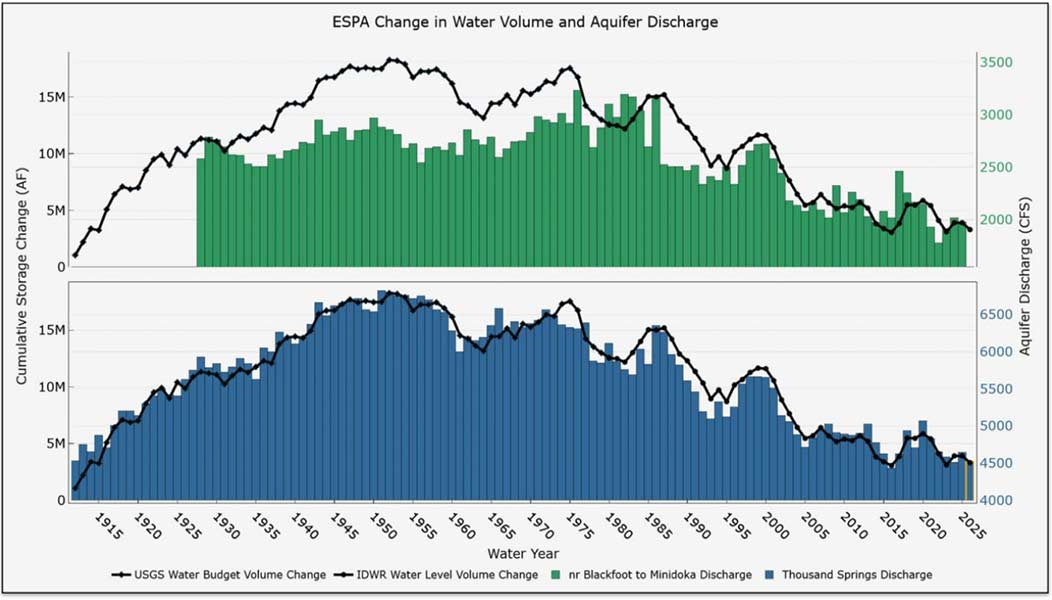
BOISE – Hydrologists with the Idaho Department of Water Resources provided an update to the Idaho Water Resource Board Aquifer Stabilization Committee last Wednesday on the change in water storage in the Eastern Snake Plain Aquifer, natural spring flows that discharge from the aquifer, and the impact of managed aquifer recharge.
The water volume in the ESPA had no change from 2024-2025, and this year, it had a net reduction of 600,000 acre-feet of water, based on the water measurement of 329 monitoring wells prior to the 2026 irrigation season, according to IDWR hydrogeologist Mike McVay.
Meanwhile, spring flows that discharge from the ESPA at Thousand Springs and in the Blackfootto-Minidoka Reach are expected to decline in 2026.
Read the full story here.
Public invited to U of I’s 25th anniversary celebration of its Salmon extension office
The following is an excerpt of a news release from the University of Idaho.
SALMON – The public is invited to attend a 25th anniversary celebration of University of Idaho’s Nancy M. Cummings Research, Extension and Education Center.
It’s happening on Sept. 15 at 16 Hot Springs Ranch Road in Carmen, an unincorporated community near Salmon, from noon to 2 p.m.
NMCREEC is U of I’s primary cow-calf and forage research station. It encompasses 1,100 acres, including 850 acres of irrigated land, and supports 340 cow-calf pairs, 125 replacement heifers and 12 bulls, while providing the facilities needed for forage, nutrition, feed-efficiency, reproductive and cattle-management research.
The celebration will include a free luncheon, research posters, featured speakers and tours of the scenic facility.
If you have a From the Field story idea, send it to rett@eastidahonews.com. Remember to use ‘From the Field’ in the subject line.
IN CASE YOU MISSED IT…