



‘I think we’re going to be OK’: Pocatello streets director offers positive outlook on winter budget
Published at

POCATELLO — Deputy Public Works Director Tom Kirkman said clearing Pocatello’s roads is like a slow road trip.
“We’ve got about 265 centerline miles of road, so if a plow goes up and down that four times, it’s over 1,000 miles,” he told EastIdahoNews.com. (Centerline miles are the length of a road from start to end.) “We try to plow snow at 5 miles per hour … so it’s like driving to Chicago at 5 miles per hour.”
It will get done, he said. “It just may take a day or two to get to it.”
In addition to the more than 1,000 miles traveled by the city’s plows with each “snow event,” street operations run salt trucks between snow storms. The combination of manpower, fuel and material costs account for the vast majority of the department’s winter operating budget, which has stabilized over the past month due to equally stabilized weather, Kirkman said.
At a Pocatello City Council meeting on Dec. 15, Council President Rick Cheatum asked Kirkman if his department’s projected operating budget would last through the winter.
“We’re, right now, at about 300% of last year,” Kirkman responded. “However, that was a very low year last year.”
At that point, he added, it was “close” and “too soon to tell” if the projected budget would last through February — what the department considers the end of winter.
The look of trepidation that Kirkman carried on that December night was not visible when he spoke with EastIdahoNews.com on Tuesday.
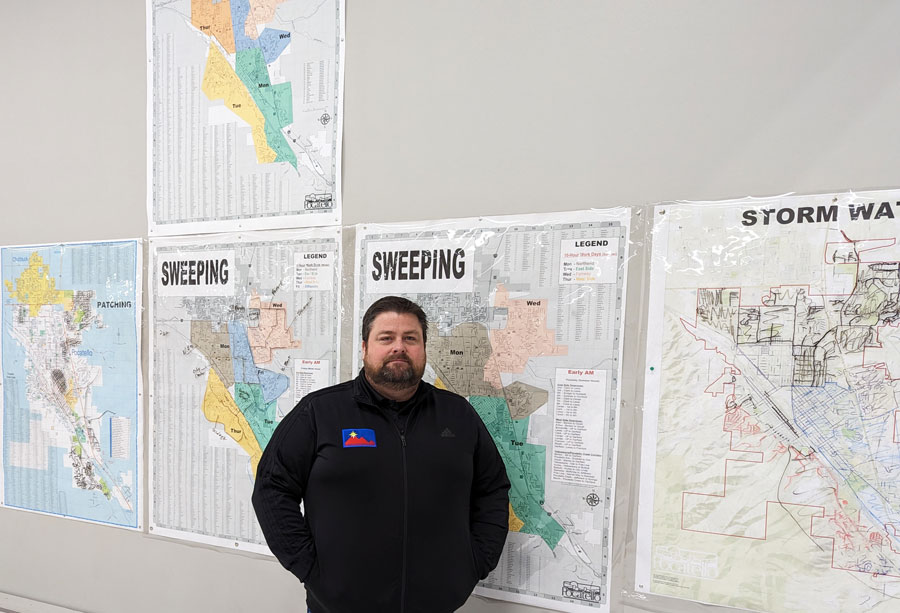
With the slowed weather in January, Kirkman said, the winter materials costs for his department sit at roughly 75% — around $50,000 of the $70,000 budgeted for — approximately three-quarters of the way through the winter season. Labor costs, he added, are around 70%, though fuel costs continue to be a “moving target.”
Weather is fickle, he cautioned, so a multi-foot February snowstorm could throw a massive monkey wrench into the latest projections.
“But we’re never going to reach a point where we say, ‘Sorry, we can’t afford any more salt,'” he said.
Kirkman said that if streets run over budget in the winter, he has two options for maintaining operations.
The department can either leach money from the paving budget used in the spring and summer months, or it can request money from the city’s excess reserves. Of the two, he prefers the former, due to the difficulty of replenishing the paving budget mid-year.
For now, though, Kirkman and the streets department are focused on continuing to improve efficiency.
Pocatello salt trucks distribute a brine the city makes at its own plant, he said. The brine is especially useful after a minimal-accumulation snowfall.
Using drawings, Kirkman laid out the brine — which is a mixture of salt, sand and water — and how it works.
Because plows have difficulty clearing snow packs of 1 inch or less, the brine is placed on top of those shallow packs. In time, the water evaporates and activates the salt, which then loosens what is now the ice underneath while also working to melt the snow above. Then, when the plows do come around, the multilayer mixture is easily moved.
Perfecting the brine mixture has positively impacted both the materials and labor costs.
“We’ve had a lot of success with the salt brine,” Kirkman said. “We’re getting super-efficient on how we use salt.”
Recent rainfall has added another issue to the mix, he added.
“A lot of the stuff we’re fighting right now we call a rain-on-snow event, where you get rain showers — you get rain and the ground’s frozen, so the water has nowhere to go and you get a lot of flooding,” he said.
But with increased efficiency throughout the winter operation, Kirkman’s department is able to address these issues and others without negatively impacting the city’s ability to keep its streets safe.
“As long as January can keep doing what it’s doing, I think we’re going to be OK,” he said.