



Looking back: Man traps over 3,000 coyotes in 15 years; officers chase after teens on horses
Published at | Updated at
IDAHO FALLS — EastIdahoNews.com is looking back at what life was like during the week of Jan. 12 to Jan. 18 in east Idaho history.
1900-1925
RIGBY — A 9-year-old Idaho Falls boy was severely injured when a train he was crawling underneath started moving, The Rigby Star reported on Jan. 12, 1911.
Frank Bybee was on his way home from school with several friends when they went into the railroad yard at the end of Elm Street. They were going between some empty railroad cars then came to the freight train that was on the main track.
Several of the children had gone underneath the car without getting hurt; however, when Bybee went under, he got caught underneath as the cars started. For some reason he wasn’t able to crawl out before the train passed over his right leg. Two of the boys ended up dragging Bybee out from under the moving train.
Some of the switchmen, as well as men from the lumber company, rushed to the scene when they heard the boys crying for help.
Bybee was rushed to a doctor’s office, and the article said the boy was going to lose his foot because of the accident.
1926-1950
DRIGGS — A Driggs man made headlines after trapping more than 3,000 coyotes over the span of 15 years, the Idaho Falls Post Register reported on Jan. 12, 1939.
L. Doyle Mathews started trapping for the U.S. Biological Survey when he was 19 years old. In 1939, at the age of 34, he’d trapped more than 3,000 coyotes and held the district record for a three-month catch, under mountain conditions, of 131 coyotes.
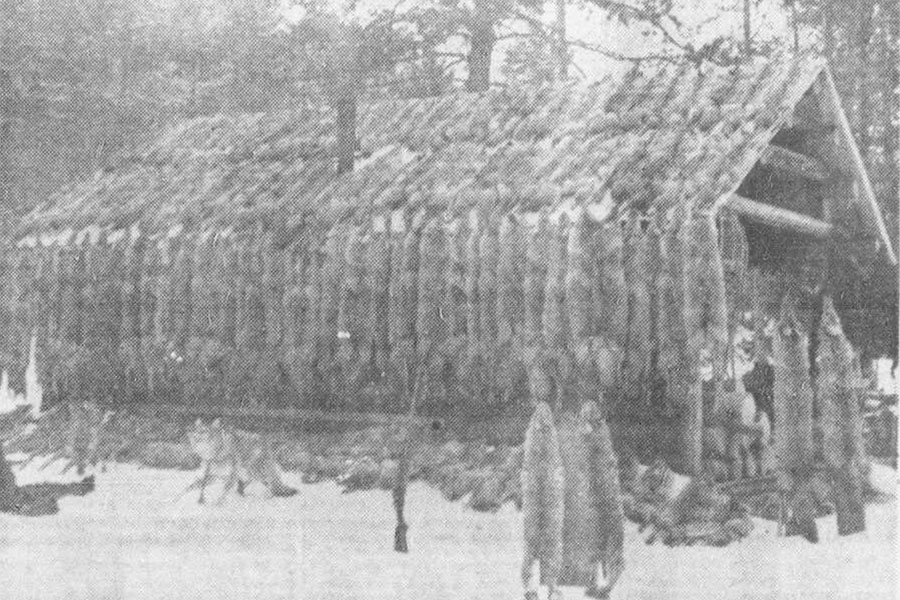
“But Mr. Mathews doesn’t think he knows enough about the trapping game yet,” the article states.
The paper said “his surprised but pleased superiors” announced that Mathews decided to enroll at Utah State University for a three-month course in game management.
He was set to return to work in March and resume his trapping activities on the spring lambing ranges in Fremont County.
During the winter months, Mathews is typically stationed in the rugged mountain vastness of Teton Basin and Island Park.
1951-1975
ST. ANTHONY — Three youths escaped from the Idaho Industrial Training School on horseback and were captured by law enforcement officers chasing them on horses, the Idaho Falls Post Register reported Jan. 13, 1951.
“Shades of the Wild West returned to Fremont County Friday,” the article reads.
The trio that escaped was James Harrington, 19; Walter Alison, 18; and Ray Demeary, 18. They stole three horses belonging to the school when they made their escape.
Deputy Sheriff John White and state patrolman Ben Newman said they decided to leave behind their police cars and ride horses into the rough country to apprehend the youth.
“There is a lot of rough country up there I didn’t know was in Fremont County,” White mentioned.
He said the teenagers ended up leaving their horses and took off on foot after the horses became exhausted. An airplane spotted the three teenagers 12 miles north of Ashton in Rattlesnake Canyon.
When they were apprehended, the teenagers were soaked in sweat from trying to walk through the snow. The snow was reported to be 4 feet deep in some places.
White said the teenagers were so weary when placed on the horses that one of them had to be tied to keep him from falling off.
On their way back to St. Anthony, the officers and teenagers stopped at the George Nedrow farm, where the officers had borrowed horses for the chase. The teenagers were also fed there.
“A physician who examined the youths Saturday morning in the Fremont Jail found them suffering from no ill effects from their adventure,” the paper wrote.
No charges had been filed at the time the article was published.
1976-2000
DUBOIS — A father and son were injured in a blast in the Beaver Creek Canyon near Dubois, the Idaho Falls Post Register reported on Jan. 17, 1977.
Harold Wilson, 20, said the accident happened as he and his father, Charles Wilson, 39, were setting off a charge. The two were blasting lava rock to place in Beaver Creek as riprap.
“We loaded the holes with dynamite and nitrate the night before and let them set over night,” Harold said. “The bases must have been trapped in the ground because of frost and when we set off the charge it was a lot bigger blast than we had expected.”
Both men, employees of the construction firm of E.J. Wilson and Sons, were struck from flying rock in the blast.
They were taken by car to the Idaho Falls Hospital. Charles was in intensive care. It’s not clear if Harold was still in the hospital or if he was released.