
After teenage softball player nearly died, she and her family are on a mission
Published at | Updated at
Note: As a bonus to our readers who have followed us into Year 2, the East Idaho Sports staff will post a special story on Sundays – Could be a column, opinion, feature, or just something fun and goofy. Hope you enjoy and thanks again for coming along on this journey.
RIGBY – It was a warm July day in Helena, Montana, despite unusually cloudy skies.
The sights and sounds of youth softball games were in full swing as Addie Cox lined a shot to right-center, rounded the bases, and dove head-first into third base with an RBI triple for her travel-ball team.
That’s when she died.
That’s the story the 16-year-old from Rigby High will tell a few select friends and teammates.
And no, that’s not an overly-dramatic take on what could have been a tragic day.
The Cox family didn’t want to publicize the full video, where chaos ensued in what turned out to be a race to save Addie’s life.
East Idaho Sports agreed not to post the full video because the real story is what happened afterwards.
But first, some background.
SUDDEN CARDIAC ARREST
That’s what it’s called.
“I got up and felt a little dizzy,” said Addie, who’s been playing softball since age 9. “In my head I was thinking I should get a pinch runner since I was catching … then I blacked out. I don’t remember anything until I woke up … I didn’t really remember at first, it was like I woke up from a nap. I saw the base … people started asking me a bunch of questions.”
According to the Mayo Clinic, sudden cardiac arrest (SCA) is the sudden loss of all heart activity due to an irregular heart rhythm. Breathing stops. The person becomes unconscious. Without immediate treatment, sudden cardiac arrest can lead to death.
“The first few seconds were utter chaos,” Addie’s mother Karina said. “Trying to figure out if she’s having a seizure or did she just faint?”
Within seconds, the chaos turned into a perfect storm of medical response.
Two of the spectators at the game happened to be nurses and immediately jumped into action.
Karina, who was watching the game from beyond the outfield fence came running in, and Addie’s father Robert, who was coaching first base, rushed across the field.
The nurses assessed the situation and began Cardio Pulmonary Resuscitation (CPR) and made sure 911 was called. A paramedic happened to be at the tournament and located an Automated External Defibrillator (AED) behind the backstop.
After CPR, the AED was used to shock Addie’s heart back into rhythm and resuscitate her before the ambulance finally arrived.
“We were very lucky that we had three people that immediately jumped in who were certified to get the job done,” Karina said. “And by the grace of God, there was an AED and the paramedic that just happened to be there. If not, our story would be very, very different.”

Titled ‘The Scary Side of Sports,’ the University of Kansas Health System noted a report by the The American Academy of Pediatrics that “… estimates that approximately 2,000 people under the age of 25 die from sudden cardiac arrest in the U.S. each year. It is the leading cause of death in young athletes in the United States – resulting in one death in a high school student every three days, according to some experts.”
That one death was avoided that July day in Helena.
“It was the scariest moment of my life,” Robert said.
RECOVERY
Addie was treated in Helena and then life-flighted to Primary Children’s Hospital in Utah for additional testing, as most heart events can be traced back to preexisting conditions such as heart disease.
She spent six days in Utah as doctors tried to pinpoint Addie’s condition and figure out what exactly caused the SCA.
Addie also spent time at the Mayo Clinic in Minnesota, which is among the top cardiology departments in the country.
“With her, there isn’t anything,” Karina said of a true diagnosis.
She said doctors finally concluded that Addie likely suffered Commotio Cordis, which is rare, but described by the American Heart Association as a “phenomenon in which a sudden blunt impact to the chest causes sudden death in the absence of cardiac damage.”
It’s the same condition NFL star Damar Hamlin suffered on national TV two years ago.
The conclusion was that Addie’s head-first slide into third base may have triggered the SCA.
Three months later, Addie eventually received medical clearance to return to playing softball with no restrictions.
While she was excited to eventually get back on the field, Karina wasn’t so sure.
“I was a little bit nervous,” she said. “It’s hard to get that vision out of my head.”
WHAT’S NEXT?
That’s actually a two-part question.
Karina said the next step could have been easy.
The family could just be thankful Addie is OK and make sure that she has all the information and resources to stay that way.
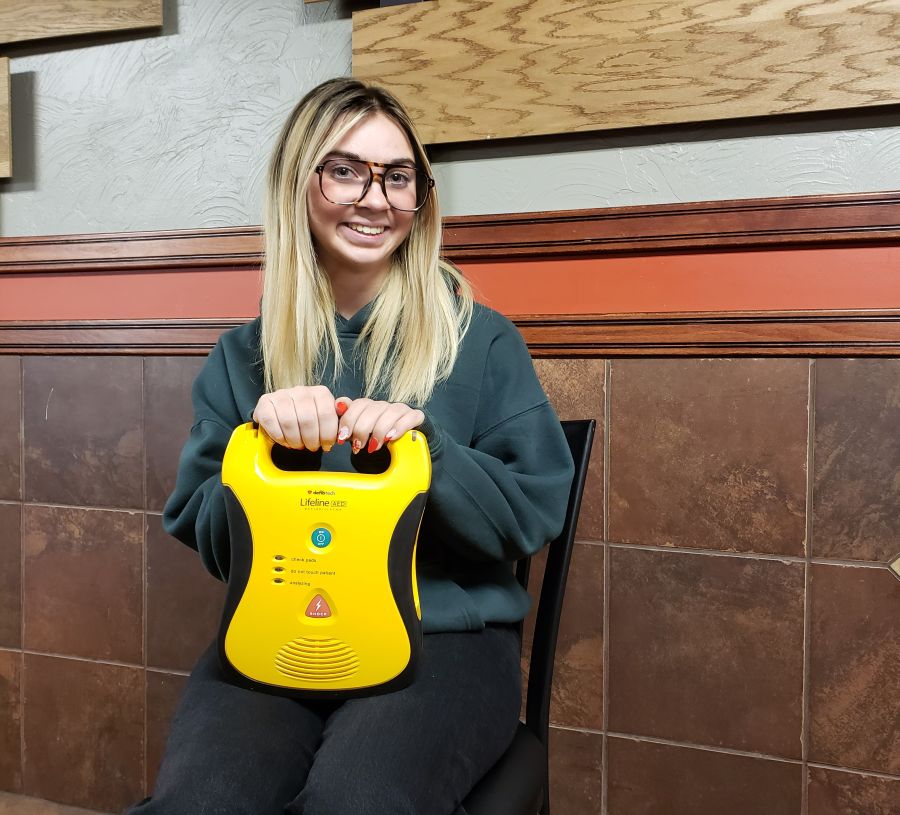
Addie now has her own AED in a backpack that she takes to all athletic events. The family has been certified in CPR/AED.
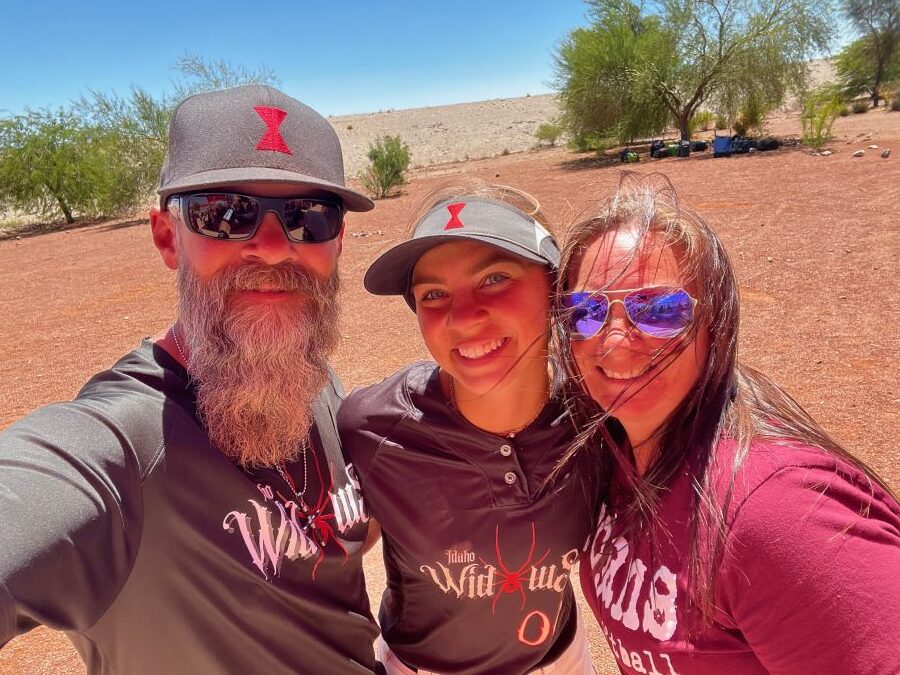
“But the flip side is I saw my daughter die. It is an image that will never leave me and if those (responders) weren’t prepared … because I wasn’t,” Karina said. “That’s why this is so important to me because I know how many moms and dads out there think they’re prepared, and they’re not.”
The Cox family decided they needed to get the word out about SCA.
“It is our mission to ensure sports organizations take it seriously to have their coaches get trained and are certified in CPR and AEDs. Schools must start sending teams who are off campus with an AED in case a SCA happens during say, cross country, golf, softball etc. Especially in our rural areas. We talk with businesses and events on the importance of these lifesaving skills and accessibility of defibrillators,” she wrote in an email.
The mission started with a Facebook page- Field of Hearts- Addie’s Mission.
The goal was to raise awareness about having AEDs available at athletic events and help set up CPR/AED training so schools and facilities would be prepared if another SCA event should happen.
At first, Addie wasn’t so sure she wanted to be the face of the mission.
She eventually decided she can share her story if it helps promote more awareness about SCA and the importance of learning CPR and have AEDs available.
And the best part for Addie?
She’s back playing softball. After three months of medical testing and poking and prodding, she’s back on the field.
“It’s awesome,” she said of her return. “I was really happy to be back with my team.”
Robert is still a coach.
“It’s a surreal experience, but at the same time relief, because I knew that that first time back had to happen,” he said. “Why not now? How much longer are we going to wait?
“We have to let her get back on the field and be the player she can be.”
“Every day I look at her and I’m so thankful,” Karina added.
Aside from having to carry around her backpack with the AED, Addie said she feels healthy and normal and there are no aftereffects from her experience.
Plus …
“It’s kind of a cool story to tell people,” she said. “How I came back from the dead. I died once.”
 Get more sports news here