



High-speed train crash kills dozens in Spain; many more injured
Published at | Updated at
Pau Mosquera, Tim Lister, Sana Noor Haq, CNN
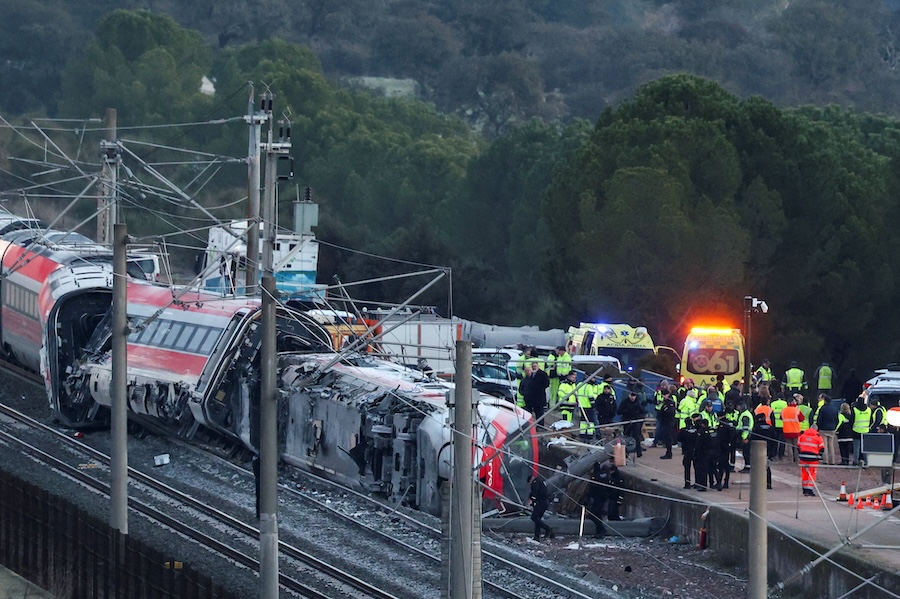
ADAMUZ, Spain (CNN) — — Survivors recalled haunting cries and blood-smeared passenger cars after two high-speed trains collided near Cordoba, southern Spain late Sunday – in one of the nation’s deadliest railway disasters in more than a decade.
At least 39 people were killed and dozens more injured after two express trains derailed close to the small town of Adamuz, about 360 km (223 miles) south of Madrid. That prompted both vehicles to overturn, with the front cars of the second train plunging down an embankment.
A northbound high-speed train, operated by private rail company Iryo, was traveling from Malaga to Madrid when its rear three coaches were struck by the front cars of the southbound train, operated by state rail company Renfe, en route from Madrid to Huelva.
After visiting the scene, Spain’s Prime Minister Pedro Sanchez promised Monday to “get to the truth” behind the causes of the crash. He announced three days of mourning.
“We will find the answer, and when it is known, with absolute transparency and clarity, we will inform the public,” Sanchez said at a press conference in Adamuz, near the site of the collision.
Sanchez – who cancelled his trip to the World Economic Forum in Davos, where he was set to hold a meeting with US President Donald Trump – added that the Spanish government would protect and assist the train victims “for as long as necessary.”
One survivor, Rocío Flores, who was on the southbound train, said: “We were thrown through the air. Thank God I’m okay; there were many people worse off than me.”
An initial report by Spain’s Railway Accident Investigation Commission said 39 people were killed, and 29 seriously injured.
‘Everything went dark’
In the aftermath, some passengers were seen scrambling out of the windows, while others escaped via the roof, according to video verified by CNN.
A woman who gave her name as Ana said the northbound train “tipped to one side… then everything went dark, and all I heard was screams.”
Her face covered with bandages, she told Reuters that she was dragged out of the train covered in blood through a window by other passengers who had escaped. Firefighters rescued her sister from the wreckage, she said.
She said many of the passengers were severely injured. “You had them right in front of you and you knew they were going to die, and you couldn’t do anything.”
The sound of passengers’ ringing phones echoed through the wreckage as their loved ones tried to contact them, according to a freelance reporter at Atocha train station in Madrid.
“A lot of families that are in distress, that are anxious, are calling their family members,” the local reporter told the BBC’s Today program on Monday. Emergency workers “can hear the phones… from inside the trains,” the reporter said. “But of course, people are not picking up.”
The streets of Adamuz – a small town of 4,200 residents – were quiet, according to a CNN reporter at the scene. Tables laden with dozens of blankets in the municipal building mirrored the spirit of solidarity among the community.
“The whole town rallied to help,” Mónica Navarro, a resident of the town, told CNN. “People even came from neighboring towns like Montoro and Villafranca to bring blankets and all kinds of aid.”
Another local, Rosa Molla, recalled the “horrible, horrible” collision. “Let’s hope they finish rescuing the people who are still trapped,” said Molla, who runs a tobacco shop.
Rescue hampered by ‘twisted’ passenger cars
The accident is the worst on Spain’s railways since the Galicia crash in 2013 when 79 people were killed and 144 injured after a train slammed into a well and burst into flames near Santiago de Compostela.
Spain’s Transport Minister Óscar Puente said the crash was “extremely unusual” as it happened on a straight stretch of track which had been recently renovated as part of a €700 million ($814 million) investment project and the train was relatively new.
“It is truly strange. All the railway experts who have been here today… and those we have consulted are extremely baffled by the accident,” Puente told Spanish TV channel Telecinco.
The president of Renfe, Álvaro Fernández Heredia, told Spanish radio that it was “too early” to know the cause of the tragedy and asked for patience.
But he said that the trains were going at a lower speed than the limit set for that part of the line and the signaling system prevents trains from exceeding that limit.
Fernández Heredia said the speed limit at that point was 250 kmph (150 mph). One train was traveling at 205 kmph and the other at 210 kmph.
Spain’s train drivers’ union, Semaf, has previously raised concerns about high speeds causing vibrations and subsequent wear and tear along high-speed railway lines, a source from the union told CNN.
In August, the union sent a letter to the national railway operator, Adif, asking for a reduction in the maximum speed on all high-speed train lines from 300 kmph to 250 kmph, after some stretches were vibrating and placing stress on the infrastructure, the source said.
The source could not confirm whether the warnings were specific to the area where the crash happened outside Cordoba, but did say that this stretch of track underwent maintenance in May.
The King and Queen of Spain said they were following developments “with great concern.” “We extend our deepest condolences to the families and friends of the deceased, as well as our best wishes for a speedy recovery to the injured,” they said.
A wave of tributes poured in from other world leaders on Monday.
“My thoughts are with the victims, their families and the entire Spanish people. France stands by your side,” French President Emmanuel Macron posted on X.
The EU’s foreign policy chief, Kaja Kallas, extended her “deepest condolences” to loved ones of those killed and injured. “The news of the train collision in Córdoba is devastating,” she wrote on X.
The-CNN-Wire
™ & © 2026 Cable News Network, Inc., a Warner Bros. Discovery Company. All rights reserved.