



ISU event turns summer fun into rocket science
Published at
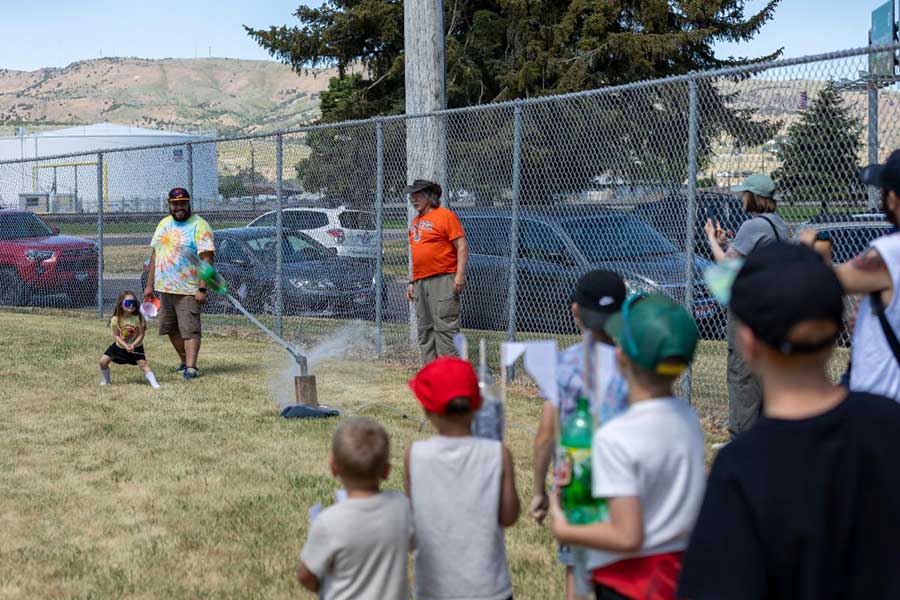
POCATELLO – Learn physics and have some fun at the same time at a community event this weekend.
On Saturday and Sunday, Idaho State University’s Department of Physics will hold its annual Water Rocket Festival at Tydeman Park — North 8th Avenue and East Young Street. The first 100 kids who arrive get to build and launch their own bottle rockets.
“The hope is to sneak some science into the summer,” said Steve Shropshire, the physics professor helping to organize it.
It’s free to the public and held in conjunction with the Kiwanis Club of Pocatello’s Bing Hong Pancake Breakfast fundraiser.
A competition will be held both days. The kid who builds the rocket that goes the furthest will be awarded with their own water-rocket launcher.
Shropshire, who’s been running events like this for nearly 40 years, started the Water Rocket Festival around 16 years ago. As a new member of the Kiwanis club, Shropshire noticed that the fundraiser only took up half of the park.
“I kind of piggybacked onto them, saying, ‘hey, you know, you’re not using this whole field over here. We could sneak some science into this,’ and I think it works well,” Shropshire said.
A student will greet each individual or group, and spend about 15 minutes explaining the physics behind building a rocket.
The kids will build their rockets, with some guidance and tips from students. All basic materials are provided.
Students will help fill the rocket with water and bring it to the launch pad, where Shropshire handles the countdown and launch. Once it’s finished, they can do it all over again.
“The kids are welcome to redesign, rebuild and launch again and again and again, or just keep launching until the thing falls apart,” Shropshire said.
The initial appeal of the event can be summed up by a short statement from Shropshire.
“Rockets are really cool. It certainly captivates the kids’ interest,” Shropshire said.
But beyond that, Shropshire says learning basic principles of physics and then applying them could spark a long-term or lifelong interest.
“The best way to learn is by doing. You understand the principles the best if you actually end up applying them, and seeing them in operation,” Shropshire said.
And Shropshire said the event goes even better when adults get involved.
“I would encourage parents and grandparents to get actively involved in helping their kids build the rockets because that’s kind of a bonding experience … ad I think the kids put better rockets together if they’ve got some parents to help them out,” Shropshire said.
But regardless of whether it sparks a child’s interest in physics or rocket-building, Shropshire said it’s still a worthwhile activity.
“There’s lots of fun, rewarding things that folks can do that are related to science and engineering, and having some awareness of that as the kids go through their schooling is a good thing,” Shropshire said.