



The vice president who came to eastern Idaho — then returned as president
Published at | Updated at
IDAHO FALLS – Vice President JD Vance’s recent visit to Jackson raised a historical question: Who was the first sitting vice president in modern times to visit eastern Idaho?
RELATED | Vance and son hike scenic Forest Service trail in Jackson Hole
The answer takes us back more than 70 years — to Richard Nixon, who came to Pocatello and Idaho Falls in 1954 as vice president and returned 17 years later as president.
RELATED | Presidents who have visited Idaho and the rise of ‘Imperial’ leadership in America
Vice President Nixon gave a speech in Pocatello in October 1954. The purpose of the trip, according to a 2016 report, was to campaign for Sen. Henry Dworshak, a Burley Republican seeking re-election during one of the most contentious political periods in Idaho history.
The backdrop was the Red Scare.
Idaho’s two Republican senators — Dworshak and Herman Welker — supported the fight against Communism. Welker, a Payette attorney, was closely aligned with Sen. Joe McCarthy of Wisconsin and became known as the “Little Joe from Idaho.”
By 1954, Welker had become one of the most aggressive voices in Idaho politics. His involvement in the campaign against Wyoming Sen. Lester Hunt — one of the darkest episodes associated with McCarthyism — would eventually contribute to his political downfall. But that was still ahead.
Dworshak’s political standing was different. A former newspaperman, he had served in the Senate since 1948 and had established himself as a conservative Republican. He was also seeking another six-year term against former Democratic Sen. Glen Taylor.
Taylor was a political lightning rod of his own.
He had served in the Senate from 1945 to 1951 and was one of Idaho’s most liberal senators. He had publicly criticized McCarthy and, during the 1950s, was repeatedly targeted by Republicans with accusations of Communist sympathies. Taylor had also been the Progressive Party’s vice presidential nominee in 1948 alongside former Vice President Henry Wallace, further cementing his reputation among Idaho Republicans as a left-wing politician.
Welker, who was not on the ballot in 1954, attacked Taylor as one of “the Communist Party’s most pathetic and willing dupes.”
Nixon joined the campaign, although his language was somewhat more measured. Speaking before a crowd of about 2,300 people in Pocatello, the vice president called Taylor “a dedicated left winger” and urged Idaho voters to return Dworshak to the Senate.
The strategy worked.
Dworshak defeated Taylor by a wide margin, winning 142,269 votes, or 62.8%, to Taylor’s 84,139 votes, or 37.2%, according to voting records.
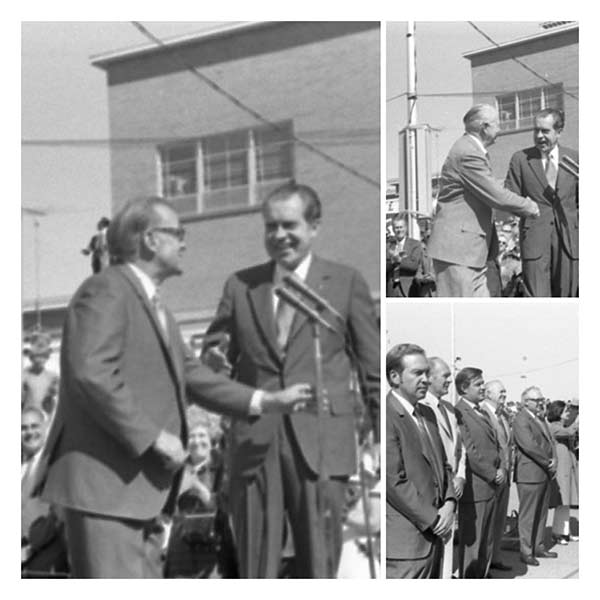
‘When I was here last time…’
Seventeen years later, on August 18, 1971, President Richard Nixon stood before an enthusiastic crowd at Fanning Field — what is now Idaho Falls Regional Airport.
It was one stop on a three-day cross-country trip, according to the daily diary from the Richard Nixon Presidential Library & Museum.
Historical records do not specify a specific purpose for the 1971 visit. Earlier that day during a stop in Springfield, Illinois, Nixon signed a bill that established Abraham Lincoln’s home as a national historic site. During his visit to Idaho Falls, he gave a brief address about America’s economic strength, Idaho’s agricultural economy, the qualities of the people who settled the West, and national unity and patriotism. His next stop on the trip out West was a visit to Grand Teton National Park.
During his remarks at Fanning Field, he referenced his previous visit. The second trip to Idaho Falls may have been tied to his familiarity with the area. It also could’ve been about political optics and public relations.
At 4:20 p.m., Air Force One landed at the Idaho Falls airport and Nixon was greeted by local, state, and Congressional delegates from both parties, a fact he noted in his remarks.
“I think it would be of very great interest to all of you … to meet some of the distinguished leaders from your State who are here, because I would like to have them stand up here … to show just what a bipartisan trip this is,” Nixon said to the crowd.
America’s 37th president introduced Gov. Cecil Andrus, U.S. Senator Frank Church, and Idaho Falls Mayor Eddie Pederson, all of whom were Democrats. He also recognized the Republican Congressmen — U.S. Senator Len Jordan and Rep. Orval Hansen. Also in attendance were Secretary of the Interior Rogers Morton and Nixon’s daughter, Julie Eisenhower.
RELATED | Former lawmaker from Idaho Falls was one of 3 brothers to hold public office
“We will have a chance to shake hands with some of you after I have made a few brief remarks. But I would like for all of you to know that as I looked down from the airplane and saw those cars parked for miles around, I realized what a chore it had been for you to come to the airport. I realized, too, that some of you must have been standing here quite a while. I am indeed most grateful,” the president said.
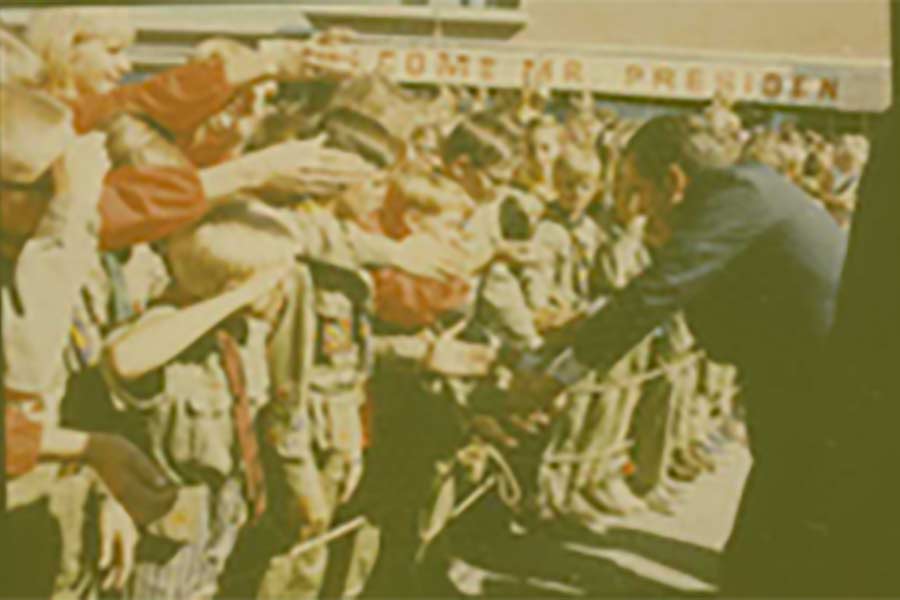
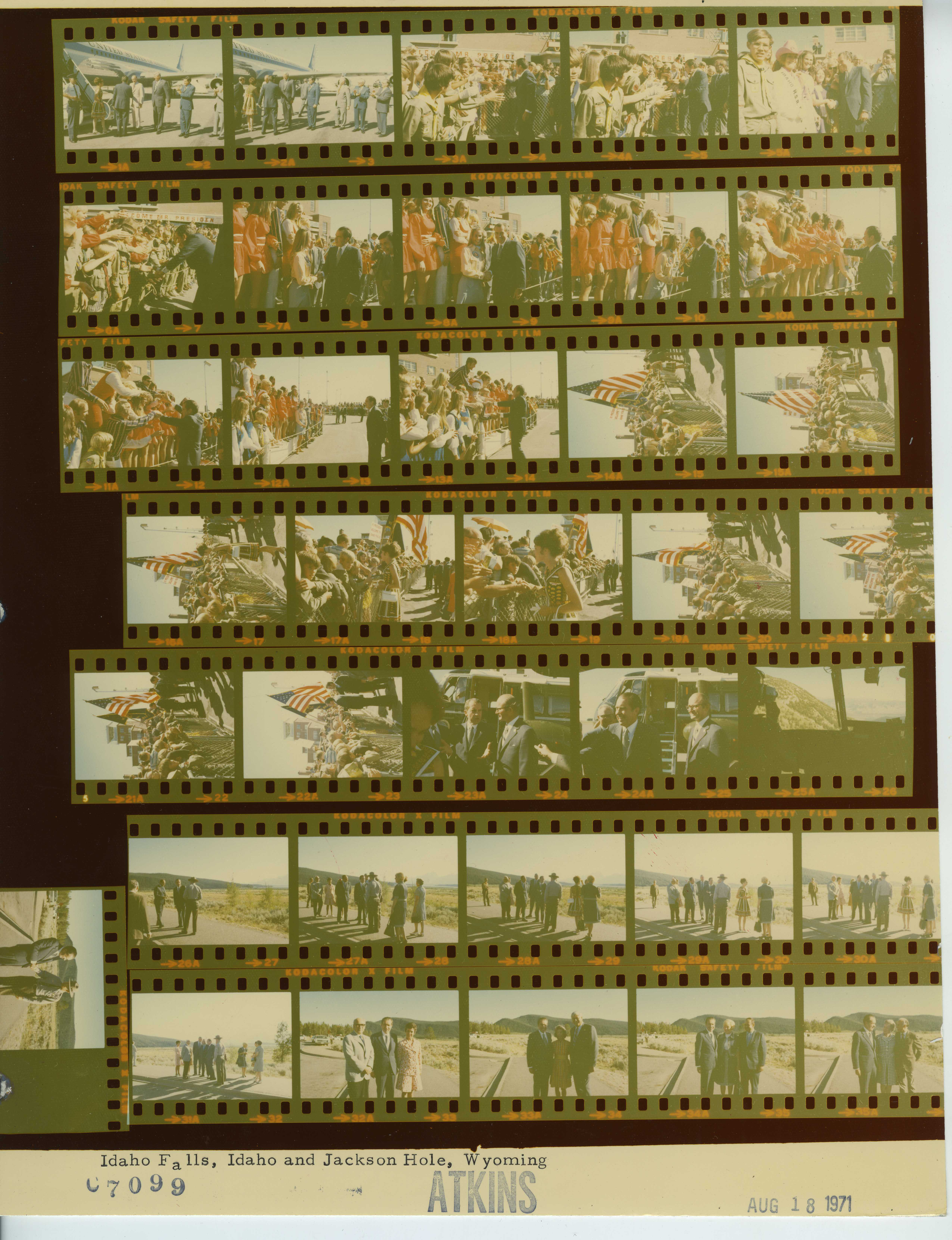
Nixon noted the size of the crowd and recalled his visit to Idaho Falls as vice president years earlier.
“I don’t think, incidentally, the crowd was near this big. That shows you the difference between being Vice President and President,” Nixon said. “I remember it was snowing, very heavy snow. Does it still snow in October in this time?”
While flying in that day, Nixon said he noticed the beauty of the mountains, and told those in attendance they were “very fortunate to live … where the air is so clean, where the scenery is so beautiful.”
The president continued with a message about the qualities of the people who settled the west and the value of the country’s frontier heritage.
“As I looked down on this country, I realized what kind of people it took to come here. It had to be a rugged people; it had to be a strong people to come across those plains, to come up those mountains, and then to find this valley and develop this State — a strong people, a competitive people, a frontier people,” Nixon said.
“That is the kind of people that made Idaho,” the president added. “That is the kind of people that developed the West, and that is the kind of spirit that America needs today and that you are going to help give America, I am sure.”
Nixon spent time shaking people’s hands following his remarks, which you can see in the video above.
At 4:58 p.m., the president left Fanning Field by helicopter for Willow Flats Overlook in Grand Teton National Park. He spent the night in Jackson Hole with his daughter and members of his staff.
The next day, Nixon spent time around Jackson Lake, including boating with Julie Eisenhower and other members of his party, before departing for Dallas.
Nixon reportedly noted in his diary that he appreciated the warm reception of the crowd in Idaho Falls.
Before Nixon’s visit to eastern Idaho in 1954, the earliest known visit from a vice president was Theodore Roosevelt. He paid a visit to Rexburg while on the campaign trail in 1900.