



Trump gives feds 90 days to consider removing endangered species protections for wolves
Published at
Clark Corbin, Idaho Capital Sun
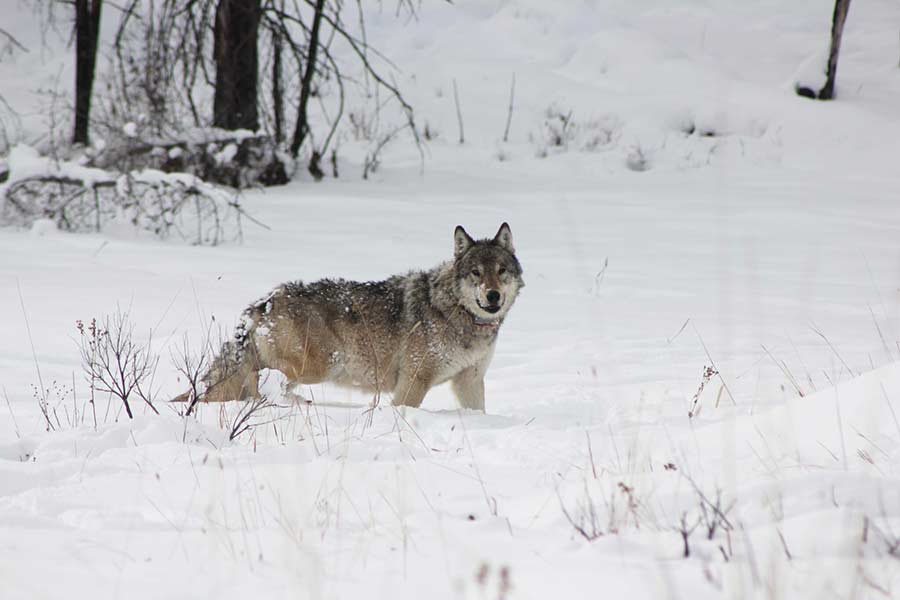
BOISE (Idaho Capital Sun) — President Donald Trump signed an executive order Sept. 4 giving the U.S. secretary of interior 90 days to decide whether to remove Endangered Species Act protections for gray wolves and Mexican wolves in the United States.
The Supporting America’s Ranchers executive order calls for Secretary of Interior Doug Burgum to decide within 90 days whether gray wolves and Mexican wolves have met their recovery criteria and to begin the process of delisting or downlisting them.
The executive order also calls for Burgum to prepare a legislative recommendation for Trump to fully delist or downlist wolves and, upon determination that recovery criteria have been met, encourage states to delist wolves and revise state standards for the killing of wolves in order to help ranchers.
The history of the near extermination of wolves in the U.S., and their recovery
Wolves are a native species that was almost completely eliminated in the Western United States by the 1940s through a widespread government extermination campaign backed by congressional bounties and the extensive use of poisoning.
After they were nearly killed off, wolves became one of the first animals added to the Endangered Species List in 1974. Then, the U.S. government reintroduced wolves into Idaho and Yellowstone National Park in 1995 and 1996 using wolves captured from Canada.
Wolves were removed, or delisted, from the Endangered Species Act in Idaho, Wyoming and Montana beginning in 2011, where they can be hunted and trapped.
But wolves are still protected under the Endangered Species Act in other parts of the United States. Those Endangered Species Act protections prevent hunting in places where wolves are still protected, but those protections could go away if wolves are removed from the Endangered Species Act as a result of Trump’s new executive order.
“While the Biden administration chose to villainize ranching and the rural way of life under the guise of radical environmental mandates, the Trump Administration continues to focus on rebuilding the Great American Cattle Herd,” U.S. Secretary of Agriculture Brooke Rollins said in a written statement. “For the past 19 months, USDA has worked tirelessly to defend and promote our nation’s ranchers. Through our Beef Plan and the Ranchers First Initiative we are working to continue increasing our nation’s heifer retention rate. Today, the President laid out tools to better equip farmers and ranchers to deal with dangerous predators threatening their livestock, provide more transparency for consumers on where their meat originates, and expand market opportunities while maintaining our world-class food safety standards. President Trump is focused on delivering an America First agenda and will do that by continuing to put our Ranchers First.”
Wolf advocates worry Trump’s order is premature, and that wolves have not fully recovered in the U.S.
Trump administration officials and several Republican elected officials support the executive order.
On the other hand, wolf advocates and some conservation groups oppose the move, which they say is premature because wolf populations have not met their recovery goals across the U.S.
Collette Atkins, senior attorney and director of the carnivore conservation program at the Center for Biological Diversity, said removing wolves from Endangered Species Act protections could be devastating because wolf populations have not yet received after nearly being completely wiped during the 20th century.
Atkins said also the Center for Biological Diversity would challenge any misguided delisting attempts in court.
“Trump’s new push to prematurely remove wolf protections will lead to yet another court decision that reinstates those protections while doing nothing to help ranchers,” Adkins said in a written statement. “Smart ranchers coexist with wolves by using commonsense measures like guard dogs and fencing to protect livestock. Trump should be funding these tools, not wasting taxpayer money trying to kill or illegally strip wolves of lifesaving protections.”
Carter Niemeyer, a former government trapper turned wolf advocate, called Trump’s executive order on wolves “a distraction,” saying it won’t help ranchers in Idaho, Montana and Wyoming – where wolves have already been removed from the Endangered Species List protections and can already be hunted and removed by government agencies for harassing livestock.
“This executive order, to me, is just a distraction from other bigger issues farmers and ranchers have,” Niemeyer told the Idaho Capital Sun on Thursday.
Niemeyer, who is retired in Idaho but previously worked for the U.S. Department of Agriculture Wildlife Services, said wolves kill about 200 livestock animals a year between the states of Idaho, Montana and Wyoming, where there are more than 6 million cows and cattle.
More livestock are killed in accidents and by vehicles each year.
“I remind people that livestock losses to wolves are less than one-tenth of 1% for cattle and sheep,” Niemeyer said. “I would think tariffs, the cost of gasoline and diesel and the lack of access to fertilizer and things like that should be way higher up the list of concerns for ranchers and farmers than wolves.”
Idaho Department of Fish and Game officials estimated that Idaho’s wolf population decreased to an estimated 1,129 wolves in 2025, a decrease of about 100 wolves compared to the year before. State officials attributed the decrease to aggressive hunting and trapping, and said the number of livestock killed by wolves is trending downward, the Sun previously reported.