




Incumbent Sen. Mark Harris to face Democratic candidate Marty Rotz-Kilhefner for District 35 Senate seat
Published at | Updated at
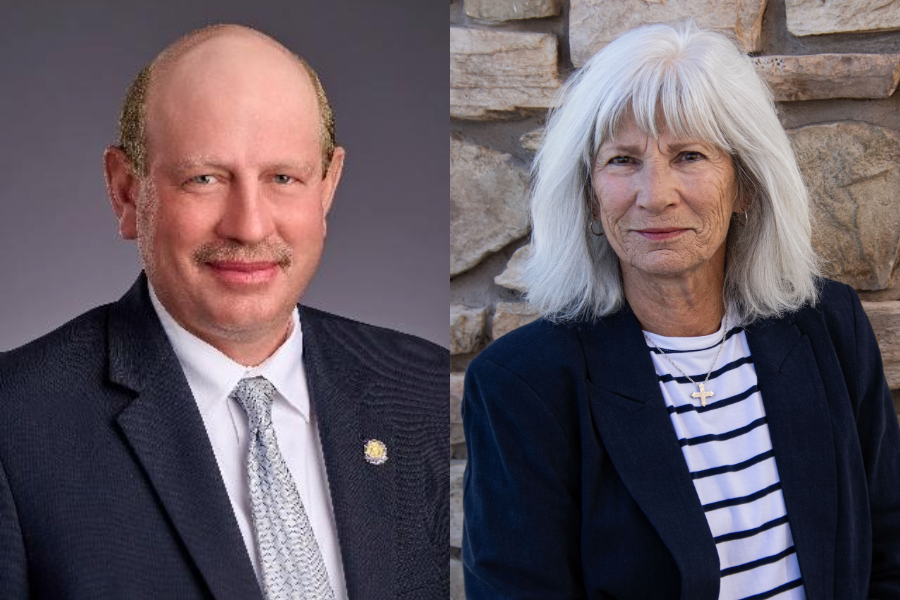
IDAHO FALLS — Looking to secure a third term, incumbent Sen. Mark Harris, R-Idaho Falls, will face off in the November midterm election against Democratic candidate Marty Rotz-Kilhefner to serve as District 35’s State Senator.
Rotz-Kilhefner, a retired nurse and state committeewoman for the Bear Lake County Democrats, is looking to unseat the veteran lawmaker Harris, who has served in District 35 since 2022.
EastIdahoNews.com sent both candidates the same questionnaire. Harris and Rotz-Kilhefner’s unedited responses are listed below.
The general election will be held on Nov. 3. Polls are open from 8 a.m. to 8 p.m.
For more candidate questionnaires and information about the midterm election on Nov. 3, check out East Idaho Elects. To learn where to vote or what’s on your ballot, visit VoteIdaho.gov.
Tell us about yourself — include information about your family, career, education, volunteer work, and any prior experience in public office.
Harris: My family and I own and live on a ranch in Bear Lake County. We raise hay, beef cattle and kids. My wife Cheryl and I have four boys that are 5th generation Idahoans. I hold a degree in Political Science from Utah State University. I have ranched my entire life.
I have served in many positions in the Republican party including Youth Committeeman for Bear Lake County, Legislative District Chairman, and as a Region Chair representing Region 6 on the state level. I have also served on the state board of the Idaho Farm Bureau as a State Young Farmer and Rancher Chairman and as a state director. I have also served on the board of the Idaho Cattle Association. I had the privilege of being on the Bear Lake County Planning and Zoning and currently serve as a trustee at Bear Lake Memorial Hospital. I also currently serve as the State Senator representing Legislative District 35. I have had the privilege of being selected by my senate peers to serve as the Majority Caucus Chair for four years and as the Senate Assistant Majority Leader for the last two years. I serve on the Senate Health and Welfare, the Senate State Affairs and the Senate Resources and Environment Committees. I have served previously on the Senate Agriculture Affairs and the Senate Transportation Committees.
Rotz-Kilhefner: I am married with 2 grown sons and 2 grandchildren. I am a retired registered nurse with a bachelor’s degree in nursing. I worked in nursing for 40 + years in numerous nursing positions. I have volunteered in many aspects from coaching little league baseball, working at church, organizing the Bear Lake County Democrats and helping with the Adopt a Highway program in Bear Lake County. I am currently the State Committee Woman for the Bear Lake County Democrats and past secretary/treasurer.
Why are you seeking political office within your community? Briefly explain your political platform.
Harris: The reason I am seeking another term in the Idaho State Senate is to be able to continue my work helping with the Rural Health Transformation Funds, Medicaid Task Force, and the Idaho health Insurers Working Group. Work in these areas will benefit the lives of Idahoans and especially those in our rural communities. During my time in the Idaho Senate, I have worked to defend rural health care and rural providers with a focus on Emergency Medical Services. I have been an effective legislator in defending and protecting private property rights including water rights. I support public education and see the need for it especially in rural Idaho. I want to keep Idaho the great state that it is for our kids and future generations.
Rotz-Kilhefner: The reason I am seeking office is to bring Democracy back to the Idaho legislature. Currently there are 105 legislators – 90 are Republican and 15 Democrats. This uneven balance strikes me as undemocratic and I feel the Republicans are not in touch with their constituents. My platform is: Protecting women’s rights to healthcare, Strengthening public education, Protecting and Caring for the Environment and Treating EVERYONE with dignity and respect.
With rising housing, fuel, and food costs facing Idahoans, can the state government help bring relief to Idaho citizens? Is it the role of the Idaho Legislature to help deal with these issues?
Harris: Idahoans are facing the challenges of rising housing costs, rising fuel costs, and rising grocery bills. While the whole nation is facing these challenges, I believe the Idaho Legisalture can help bring some relief to Idahoans. Legislation has passed in previous legislative sessions to help lessen local restrictions on housing. More work can be done in this area by allowing farmers, ranchers, and others to be able to sell ground to immediate family members without having to go through costly subdivision requirements. This would help keep our kids in our communities by making land affordable. Idaho State Government should also look at the fuel taxes that Idahoans are paying at the pump; what is being collected and if the amount can be reduced. The price of fuel affects the prices at the grocery store. State government can do some things regarding this issue, by reducing taxes and regulations where we can, but a lot of it rests upon supply and demand and policies enacted by the Federal Government. There is also talk about building oil refineries in Idaho. This is something that should be done.
Rotz-Kilhefner: Some of our affordability issues are caused by the current federal administration, however I do feel the state legislature does have a role in bringing relief to Idaho citizens. For example, housing regulations need to be updated (some regulations have not been updated since the 1970’s), eliminating the state sales tax on groceries, adjusting the state income tax so the wealthy pay more of their fair share and reviewing state income tax exemptions on big businesses.
How will you best represent the views of your constituents – even those with differing political views? How do partisan politics play into your role as an elected leader?
Harris: I can best represent the views of my constituents- even those with differing political views, by listening to them and respecting their opinions. I do my best to do this. I know not everyone agrees with me, but I carefully weigh each issue before I take a vote in the Senate. I take this responsibility seriously. Partisan politics do come into play in the Legislature, but my record shows I am not afraid to vote to support my constituents. For example, I have voted opposite of many of my republican colleagues on the issue of education tax credits. I do not let special interest groups dictate or decide my vote for me. That independence is important to me.
Rotz-Kilhefner: I feel the current super majority is not listening to many of their constituents. They seem to be following a GOP platform to remain in power. I want to be a leader for everyone regardless of the politics. I will listen to my constituents and support measures that help Idahoans. My goal is to be transparent in my decision making at all times.
What parts of the Legislative budget could use more funding? Where are places in the budget where cuts could be made?
Harris: One of the most important duties we have as a legislature is to pass a budget. Last year, many state agencies took a 3% cut. Medicaid took a 4% cut because of budget shortfalls. Where could we use more funding as a state? Certain areas of Medicaid could use an increase in funding, such as child services, and funding for our seniors. We are seeing senior citizen centers around the state suffer because of lack of funding especially for the “Meals on Wheels” program. Some of our more rural areas are seeing an increase in Alzheimer’s patients. We need to increase support throughout the aging communities.
Where could we cut? Again, Medicaid. There are areas in Medicaid that are being abused and we are looking at areas that we could cut back on. We must be careful; however, Idaho has a growing population, and we must be wise about what programs are benefiting our citizens and which ones are not.
We as a legislature are also looking at what departments and agencies, we can combine to make things more efficient and effective without compromising services. We recently studied ways to combine the Soil and Water Commision with the Idaho Department of Water Resources to benefit both departments. We can do more of this in the future.
Rotz-Kilhefner: More funding should be given to public education, Medicaid programs and water infrastructure programs. The state budget could be cut by removing the school voucher program and sales tax on groceries. A balanced budget could be achieved by changing the current flat income tax and replacing it with a tiered income tax, and changing the tax exempt status on major corporations.
In 2026, Idaho suffered a historic drought, leaving eastern Idaho’s reservoirs at an all-time low. As a result, crop yields were significantly impacted. What specific strategy or legislation would you support to protect groundwater and surface water resources, and what is your timeline for measurable improvements?
Harris: This year was an especially dry one and most of Idaho is experiencing a drought. Our reservoirs are historically low, and it was not a good year for our farmers. The Legisature has appropriated $30 million ongoing to work on water projects around the state. I would like to see these funds increase. The infrastructure that manages our water is aging and it will take an increase in funding to catch up on, and get ahead of, the improvements we need to make. We must look at more water storage and do what we can to use what we have more efficiently. Our farmers count on a certain amount of water each year when they plant their crops. We need to make sure that amount is there for them. This is for both the surface water users and the ground water users. The state is currently taking steps to manage both these entities together. We need to follow through but we must also be willing to be flexible to the changes needed. We need to listen to our farmers as they are experts on this issue. Drought is not an easy challenge.
Rotz-Kilhefner: Water is a huge problem, especially in the western states. Idaho is not immune. This year many ranchers and farmers had to decrease their amount of water usage because of the lack of snow fall from last winter. We need to stop reacting to seasonal changes in water levels and start building a long term groundwater management program, and update our aging infrastructure. We need to make sure that the Eastern Snake River Aquifer is maintained and water purity is assured.
One of the biggest issues on the November ballot is Proposition 1, a citizen-led ballot initiative that would repeal Idaho's abortion ban. Do you support Proposition 1? Why or why not?
Harris: On of the biggest issues on the ballot this year is Proposition 1, which is a repeal of Idaho’s abortion ban. I do not support this repeal. Idaho law already allows abortion in cases of incest, rape, and threats to the mother’s life. Can the law be more clear for our providers? I think it can, but proposition 1 is not the answer. Prop 1 goes too far. It would make all abortions legal before viability. This is understood to be 22 to 24 weeks of pregnancy. This change is too broad. Prop 1 would also allow girls under 18 to get an abortion without the consent of their parents. The legislature has a duty to clarify law. This issue should go through the process of hearings and find common ground to protect both mothers and unborn children. Legislators should work to pass a more narrow, clear health exeption so doctors can provide evidence-based care in the rare cases when a mother’s health is at risk.
Rotz-Kilhefner: I support Proposition 1. I feel this huge, life changing decision needs to be made with the woman, her partner and her healthcare provider. I feel the state legislature should not be interfering with personal healthcare decisions. Many healthcare providers have left the state due to the criminality of the current law. This has left Idaho with a severe shortage of OB/GYN healthcare providers, making pregnant women drive long distances or leave the state to get health care. Some women have died and some women have had complications leaving them incapable of having children in the future – all due to the current law. I encourage everyone to get informed on Prop 1 by going to unitedforyes.com.
Idaho House Joint Resolution 4 (HJR 4) is a constitutional amendment on the November ballot that would give the legislature exclusive authority to legalize or decriminalize marijuana, narcotics, and psychoactive substances. It would also ban citizen initiatives that would allow voters to directly have a say on the issue. Do you support the passage of HJR 4? Why or why not?
Harris: Another question on the ballot this year is House Joint Resolution 4 that would give the legislature authority to legalize or decriminalize marijuana, narcotics, and psychoactive substances. I support this change. The Idaho Constitution (Article III, Section 24) gives the legislature the repsonsibility to ensure the temperance and sobriety of Idaho’s citizens. We have been dealing with this issue with alcohol for years with sideboards such as making sure it was not available to minors. If marijuana, for example, becomes available in Idaho, Idahoans will want similar sideboards, so people do not become dependent on it or the supply is not manipulated to financially fleece those that use it. Citizen’s initiatives that would legalize marijuana or other psychoactive substances would not carry any such sideboards, they would not have any vetting process, public hearings, methods of administration, enforcement or appropriations. These are things that are a part of the legislative process.
I see HJR4 as an update to Idaho’s Constitution to address the psychoactive, addictive substances that we are seeing today.
Rotz-Kilhefner: I am extremely against HJR4. The arrogance of this joint resolution is beyond belief. This resolution would not allow for any further citizen initiatives that deal with marijuana, narcotics and psychoactive substances (that includes coffee). I do not feel that the state legislature should have the power to permanently control citizens initiatives over any topic.