



NTSB reveals what caused 2025 fatal helicopter crash near Ririe Reservoir
Published at | Updated at
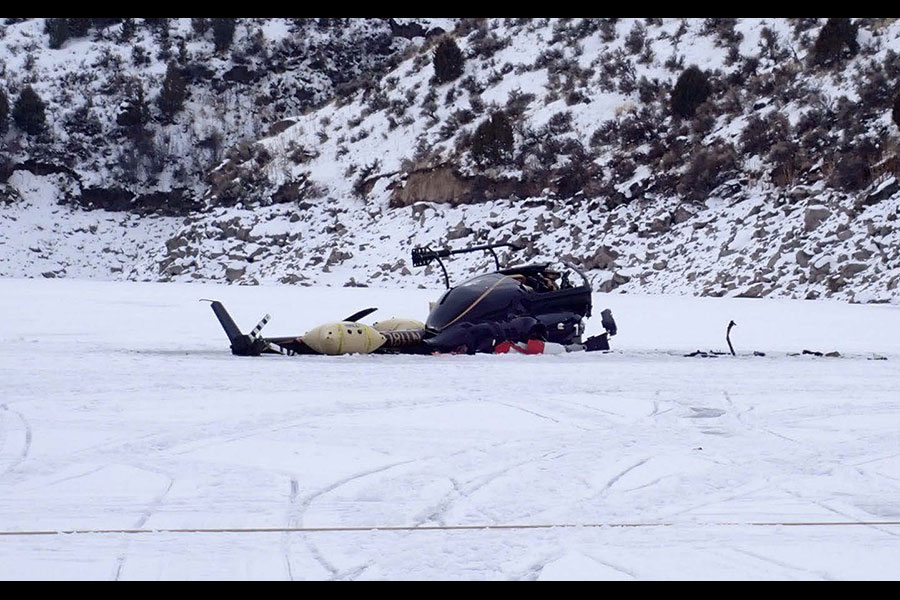
RIRIE — Nearly two years after a fatal helicopter crash claimed the life of a Utah CEO, the National Transportation Safety Board has released its final report on the incident.
The NTSB determined the probable cause was “the pilot’s inadequate preflight planning and decision to maneuver the helicopter at a low altitude and his subsequent failure to maintain clearance from power lines.”
Prior reporting
The crash happened on Feb. 20, 2025, at 4:40 p.m., when a Bell 505 Jet Ranger X struck a power line a mile east of the Ririe Reservoir.
RELATED | Utah CEO identified as man killed in Ririe Reservoir helicopter crash
Inside the helicopter were its pilot, Bradford Brown, 59, of Alpine, Utah, and the surviving passenger, Steve Houghton, of Dallas, Texas.

Brown was CEO and founder of ATL Technology in Springville, Utah, which manufactures medical devices.
Both men flew from Rexburg-Madison County Airport to film a large elk herd near Ririe Reservoir. Houghton sat in the rear seat with a harness on while Brown sat up front at the controls.
RELATED | Passenger, witness recount what happened during fatal helicopter crash on Ririe Reservoir
In a witness statement, Houghton told the NTSB that neither he nor Brown saw the power lines across the frozen lake until they were in front of the aircraft.
What the final report says
While the final report mirrors much of the preliminary report, it provides more detail about the incident.
This is more of Houghton’s witness statement, where he talks a bit more about Brown and his character.
In the statement, he said Brown got him into flying helicopters and described him as an incredibly safe pilot.
When both men saw the lines, Houghton believed they were poorly marked, and they didn’t notice the wire until they were right in front of it.
As Brown dove to avoid the wire, Houghton saw three more wires, and one hit the main rotor. He remembered the fall and the impact on the ice.
The report states that the lower power lines were about 160 feet in the air, and Houghton believes they fell only about 30 feet before colliding with the ice. He assumes that the collision slowed their descent.
Once on the ground, Houghton got out of the helicopter unaided and began pulling Brown from the wreckage.
The witness to the crash, whose statements are also included, said he was in the area with a friend when he saw the helicopter fly by. Later, he heard a twang and a bang and saw the aircraft on the ice.
He and his friend got on their snowmobiles and raced to the crash site. The witness hopped a fence and began to assist Houghton with life-saving measures on Brown.
Houghton and the witness determined that the injuries Brown had sustained were too great and that he had died.
An autopsy of Brown, performed by the Bonneville County Coroner’s Office, determined Brown died from blunt force injuries sustained in the crash.
During the NTSB’s examination of the crash, a visual flight rules sectional aeronautical chart for the area showed the power lines at the crash site.
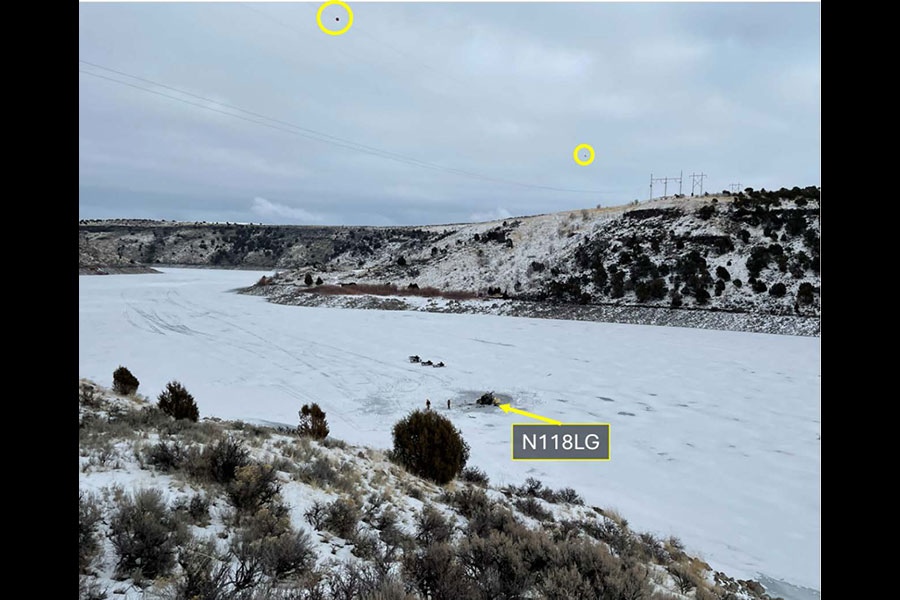
The report states that while it cannot determine whether the pilot reviewed the chart during preflight planning, it “would have made the pilot aware of the power lines’ and allowed the pilot to maintain clearance from them.”
A review of the crash area showed that two of the power lines were marked with orange visibility marker balls, while the lower lines were not.
Idaho Transportation Department Division of Aeronautics rules says that structures over 200 feet above the ground or water level must be plainly marked, illuminated, painted, lighted or designated in a manner approved by the department.
The lower lines were listed at a height of 160 feet above the ice. The upper lines were listed at a height of 230 feet above the ice.
A family man, a true Christian and a pilot
In a statement provided to EastIdahoNews.com earlier this year, Kelvyn Cullimore, CEO and president of BioUtah, spoke about who Brown was a family man and a pioneer in the medical community.
“He was a family man, a true Christian, and passionate about being a pilot, a skill he developed over decades. His loss is devastating to our Utah life sciences community where he served for years in executive leadership of BioUtah, the state trade association for life sciences. Our condolences to his wife, Shannon, his family, and the entire ATL team,” Cullimore stated.
