



Washington company takes autism detection tool to clinical trial on path to federal approval
Published at
Nick Gibson, The Spokesman-Review
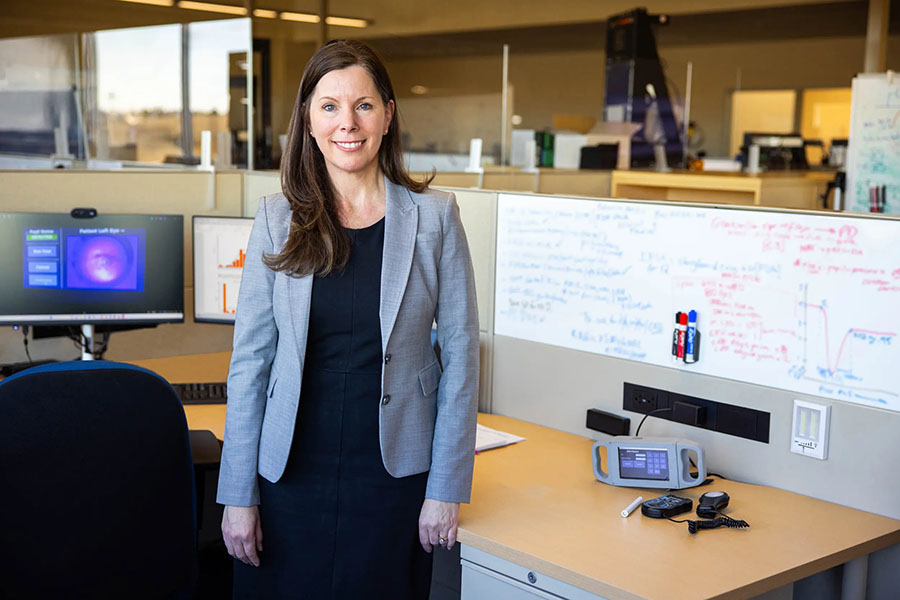
WASHINGTON (The Spokesman-Review) — Georgina Lynch and Schweitzer Engineering Laboratories are ready for the next step in a multiyear effort to speed up autism diagnosis in clinics across the country.
The Pullman-based company announced Monday the launch of a clinical trial for its first medical device, which Lynch – who is now principal scientist in research and development at SEL – developed while an associate professor at Washington State University. The device detects atypical reactions to light in a child’s pupils, which research has associated with individuals with autism.
“It’s really exciting to see this milestone being met,” Lynch said. “Words can’t describe.”
That research includes more than a decade of Lynch’s own, like a pilot study involving a penlight at the WSU Spokane campus in 2015, as reported by The Spokesman-Review. In 2024, SEL acquired the prototype and Lynch with the intent of bringing the device to market.
“It’s an exciting time both for myself as a researcher who cares so much about children and families with autism, but also the engineering team,” Lynch said.
The pupillary light reflex provides a window into a child’s brain activity, Lynch said in a 2025 interview. The efficiency of the nerves for the light reflex indirectly allows clinicians to measure the efficiency of the cranial nerves in the brain stem.
“It’s more than just looking at the eye and the response to light,” Lynch told The Spokesman-Review last year. “It’s more about understanding what happens in the brainstem and autism that is significantly different from typical development, and that’s a new understanding.”
The clinical trial is being conducted in collaboration with the SEL Health Clinic, Palouse Pediatrics and other pediatric and family medicine clinics in the Inland Northwest, according to a news release from the company. Lynch said the clinician teams were trained on how to use the device, as well as the study’s parameters, ahead of time.
“I’ve been really excited to see the clinical teams do this with ease,” Lynch said.
The purpose of the trial is two fold, Lynch said. Her team hopes to gain data to provide the Federal Drug Administration to assist in their decision of approving the device. They also hope to learn how well the device performs in a clinical setting.
Results of the device screening will be cross-referenced with a full diagnostic panel for autism, which Lynch said is an opportunity some families would not otherwise have.
“If we can bolster this screening process through adding this physical marker and making it easier in the process, if we can help prevent the wait time and get kids in more quickly, that’s the ultimate goal,” Lynch said.
SEL founder Edmund Schweitzer said in the release that the device could help “children and families access the support they need sooner.”
“Autism has touched my family and countless others. That is why this clinical trial is so important,” Schweitzer said. “By combining scientific research with our expertise in engineering and manufacturing at SEL, we hope to provide clinicians with a practical tool that supports earlier identification and, ultimately, better outcomes for children.”