



Trump’s Argentina beef buy riles local ranchers: ‘We are baring our souls to the market and hoping everything works out’
Published at | Updated at
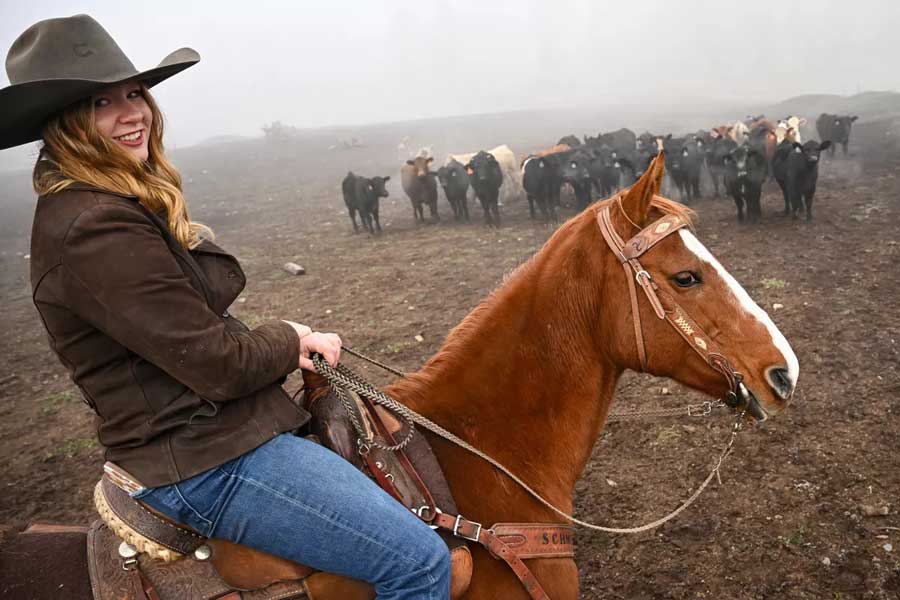
Rising beef prices helped Annabelle Schmidt to convince her grandfather that she could follow his footsteps and become the sixth generation of family to raise cattle on Green Bluff.
Schmidt, 21, said she first remembers working for her grandfather, 63-year-old Michael Schmidt, when she was 10 or 11.
“He needed a little extra help. I said, ‘Let me go with you,’ ” she said of her grandfather. “I spent the whole summer doing everything he was doing. We moved cattle, everything under the sun. I loved being around cattle – just every part of it.”
She attended high school at Gonzaga Preparatory School and started college. But she yearned for the early mornings and dusty afternoons.
“I went to college for a semester, but I just had a longing in my heart,” she said. “I wanted to be on the ranch. I just knew in my heart that that was my calling.”
When she informed her grandfather, whom she calls ‘Papa,’ that she wanted to follow in his footsteps, his answer was “No.”
“He said ‘Go work for this other ranch for a year,’ so I did. I was even helping remodel a house,” she said.
She returned to her grandfather and told him she wanted to know everything about ranching.
“He looked at me. He said, ‘OK. It’s really hard financially and really hard physically,’ ” she said.
Michael Schmidt then set up a meeting at the bank for Annabelle to get her first loan to buy some cows.
“I bought 32 head my first year,” she said.
She worked out a system of spreadsheets that allowed her to calculate the money she needed for future feed to know how much was left over for buying cattle.
This summer Annabelle raised 83 cattle that mostly have already been sold. She still has 18 head that will be sold to private buyers.
“I came into ranching when the market was in an uptick. That’s been a nice thing for me getting started. I’m definitely making money,” she said. “But I’ve never been naive to think that I’ll forever have this.”
Like her grandfather, she watched as the market took an immediate dip last week after a Truth Social post by President Donald Trump, who announced that he would start buying more cattle from Argentina.
“Just from a social media post. It’s kind of crazy how it dropped,” she said. “It’s insane. We were all aware that it could happen, but we didn’t know when.”
Social media crash
Fall is that time of year when most Washington ranchers take the calves to market after months of work to deliver, wean and fatten them. And the market has been roaring at a record pace.
That was until Trump announced a plan in a social media post last month to allow more low-tariff beef imports from Argentina to soften the record -high beef prices hitting Americans in the wallet.
“The Cattle Ranchers, who I love, don’t understand that the only reason they are doing so well, for the first time in decades, is because I put Tariffs on cattle coming into the United States,” Trump said on Truth Social on October 22. “If it weren’t for me, they would be doing just as they’ve done for the past 20 years – Terrible! It would be nice if they would understand that, but they also have to get their prices down, because the consumer is a very big factor in my thinking, also!”
While the market forces that have pushed beef prices higher didn’t change, Trump’s message sent markets down about 15%. While that drop didn’t directly hit Michael Schmidt, he said he feels for any rancher who chose this past week to sell cattle at market.

“It’s tough to have your whole year hijacked in a couple of days by some rhetoric or overblown reaction to something that is going on,” he said. “The guys who took calves to market that day, it’s just money directly out of their pocket.”
Condemnation of Trump’s plan to import more beef from Argentina has been strong and widespread.
Ben Tindall, executive director of Save Family Farming based in Everson, Washington, said in a statement last week that he was outraged by Trump’s Argentina comments.
“Temporary government manipulation of the global beef market won’t necessarily bring any significant benefit for the American consumer, but will almost certainly take money out of the pockets of hard-working farmers,” Tindall said in the statement. “Believing otherwise shows a fundamental misunderstanding of how our food system works.
“Not only did the President go back on his ‘America First’ promises by making a bad deal for consumers and farmers, but he added insult to that injury by belittling ranchers’ hard work and struggle that has kept nutritious food on Americans’ tables.”
Michael Schmidt agreed, saying that while prices for beef remain high at the store, the price had been static for years.
“It’s not his job to tell the market what is too high or not,” he said of Trump. “People will pay $8 for a coffee and not bat an eye. Protein is finally bringing what it should be to make it sustainable for family ranches.”
Like Tindall from Save Family Farming, the National Cattleman’s Beef Association also ripped the plan, noting that Argentina has shipped about $800 million worth of beef to the U.S. over the past five years while purchasing about $7 million of U.S. beef.
“The National Cattlemen’s Beef Association and its members cannot stand behind the President while he undercuts the future of family farmers and ranchers by importing Argentinian beef in an attempt to influence prices,” organization CEO Colin Woodall said in a statement. “If President Trump is truly an ally of America’s cattle producers, we call on him to abandon this effort to manipulate markets.”
Jack Field, who raises about 100 mostly black Angus cattle near Yakima, said the market drop following the social media post dropped local cattle prices about $40 to $45 a hundred weight.
That means a 600-pound calf sold between $240 to $270 less per animal than calves sold before Trump’s announcement.
“We are in the height of what the industry calls the fall run,” said Field, who is also executive director of the Washington Cattle Feeders Association. “This is when the vast majority of calves are weaned and shipped in our region.”
Having a price fluctuation at this time can have dramatic effects, he said.
“It isn’t just a year’s worth of work. It’s genetic investments and all the things you’ve done to produce the highest, safest beef product on the planet. Yet, when you go to sell them, we are baring our souls to the market and hoping everything works out,” Field said. “You don’t get that second opportunity. You don’t get a do -over once you’ve sold your calf crop.”
Market forces
Beef prices have steadily risen since Trump put in place a 50% tariff on Brazil, and the U.S. also put a halt on much of the beef coming from Mexico as it deals with an infestation of New World screwworm, a fly larva that burrows into living cattle and causes wounds that can be fatal if untreated.
Those beef imports dropped at a time when the industry reported some of the lowest cow counts on record.
As a result, the markets for U.S. beef kept setting new records for prices. That was until late last month, when Trump announced the plan to purchase more Argentina beef.
Grant Forsyth, chief economist for Avista Corp., said he could understand the beef producers’ frustration.
“The administration is sort of trapped by its own policy here,” Forsyth said. “They were trying to protect domestic producers. The downside of tariffs is that it does raise prices.
“Now the unhappiness is on the consumer side,” he continued. “I think it’s threading a needle, which is always hard.”
For farmers like Michael Schmidt, of Green Bluff, those higher prices provided a jolt of hope in an industry that has become nearly unsustainable, he said.
“It’s not a great business. It’s a great lifestyle,” said Michael Schmidt, a fourth-generation rancher. “We do it because we love the ranching. It’s who we are.”
Schmidt runs about 1,000 head, but he doesn’t have cows that he breeds.
He’s known in the business as a “backgrounder,” or someone who buys other ranchers’ calves and raises them on pasture and in a feed lot before reselling them at a higher weight.
“Before COVID, we were running about 3,000 head,” he said. “But the markets crashed and banks pulled their loans. It was pretty brutal. A lot of ranchers got crushed in that. Now, we have a shortage of beef.”
But the recent run in the market has made the local industry at least sustainable, he said.
“We are trying to build back,” Michael Schmidt said. “In most ranch families, the wives work somewhere else. We have to supplement the ranch to make living expenses. We break even more often than we make money.”
Despite those continuing challenges, Michael Schmidt said he reluctantly agreed, based on those rising prices, to help his granddaughter, Annabelle Schmidt, continue the family legacy.
“Finally ranchers are making money,” he said, referring to the record prices. “It could stimulate some people into the business. These kinds of markets are how we get people in and continuing to ranch. The only way we can do it is to have a profitable business.”