



Futuristic nuclear fuel shape mimics nature to dramatically improve performance
Published at
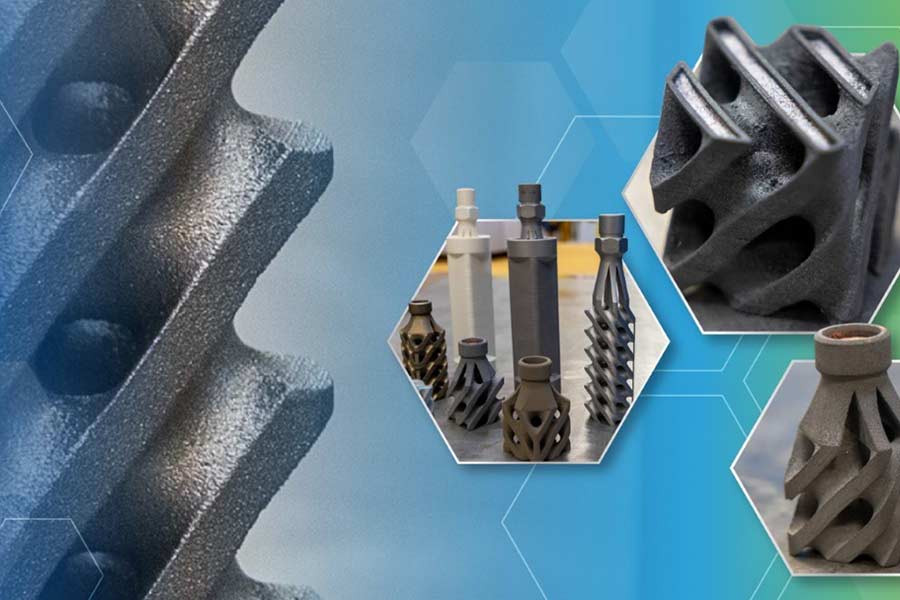
IDAHO FALLS – At the intersection of mathematics and nature, scientists have found intriguing and often beautiful designs. Pinecone scales and sunflower seeds spiral according to a curve derived from the Fibonacci sequence. Fern fronds and snowflakes are fractals — shapes seemingly repeat themselves whether you’re looking at the entire object, the smallest structure within that object or any scale in between.
One such mathematical phenomenon is called a minimal surface. These shapes have the smallest possible surface area within a boundary. When a child dips a bubble wand into a mixture of soap and water, the membrane that forms across the plastic disc of the wand is the minimal surface. The soap mixture will assume the smallest surface area within the boundary of the wand.
Minimal surfaces can curve and twist to assume all kinds of shapes. For example, if you form a wire spiral along a center rod and dip it into the soap mixture, the soap membrane forms a helicoid — a shape the looks like an auger or a screw. That auger shape still contains the smallest surface area possible within the boundary of the wire spiral and rod.
Minimal surfaces occur frequently in nature — butterfly wings, mitochondrial membranes, bone marrow and sea urchin shells are a few examples.
Now, researchers at INL are exploring how one type of periodic minimal surface, triply periodic minimal surfaces (TPMS), could help design a futuristic nuclear fuel shape that dramatically improves its performance. With a TPMS-shaped fuel, minimal surfaces form complex latticework that transfers heat to the coolant more efficiently than conventional fuel designs.
Complex geometries found in nature
The Intertwined Nuclear Fuel Lattice for Uprated heat eXchange (INFLUX) fuel design trades the conventional cylindrical fuel rod for a complex, three-dimensional shape — a TPMS — that mimics complex geometries found in nature. Such designs are impossible to manufacture with conventional nuclear fuel fabrication processes, but rapid advances in additive manufacturing (3D printing) are driving researchers to consider fuel designs that would have been unfathomable until recent years.
“TPMS is like a sine wave in three dimensions,” said INL researcher Nicolas Woolstenhulme. “The equations that define these things look like terrible trigonometry equations — they define a continuously curved surface that repeats, and you can create a lattice. This lattice will actually create these different volume domains that are intertwined with each other but don’t mix. We said, ‘Hey let’s put nuclear fuel in that.’”
1950s heat exchangers and 1950s fuel rods
In the 1950s, nuclear engineers based their fuel designs on 1950s heat exchangers, which basically looked like bundles of tubes due to the manufacturing limitations of the time. “Cylinders are actually a terrible shape for heat transfer,” Woolstenhulme said. “One of the things that inspired us was seeing what other industries were doing with additively manufactured heat exchangers that mimic complex geometries.”
“We saw heat exchangers that use triply periodic minimal surfaces and said, ‘It’s just perfect,’” Woolstenhulme continued. “It’s nature’s answer to the optimal geometry for nuclear fuel.”
First experiments
In a novel set of experiments, Woolstenhulme and his colleagues — including Mark Anderson, a professor of mechanical engineering at the University of Wisconsin — used additive manufacturing to create an electrically conductive polymer-composite version of the INFLUX lattice structure with embedded temperature sensors. The researchers passed an electrical current through the structure to heat the lattice, like a nuclear fuel would heat up in a reactor. They then measured the heat transfer characteristics of the structure with gas and liquid coolants.
“The bottom line is that this geometry does indeed triple the heat transfer coefficient compared to standard rod-type fuel,” Woolstenhulme said. “That’s a big deal. It has a direct impact on the power density of the fuel rod and thus the economics of a nuclear reactor.”
Computer modeling shows that improving the heat transfer properties of nuclear fuel not only increases the fuel’s ability to produce heat, but it reduces the fuel thickness and the temperature of the fuel itself.
Fabricating INFLUX with actual cladding and nuclear fuel materials presented researchers with yet another challenge. The same intertwined geometry that makes INFLUX a boon to fuel performance renders it unmanufacturable with current technology. Add in the stringent requirements for nuclear energy and even cutting-edge multi-material additive manufacturing is not up to the task. Using INL’s one-of-a-kind fabrication capabilities, a novel combination of commercially available additive manufacturing and hot-isostatic pressing was developed. With this process, the researchers were able to fabricate INFLUX in both ceramic/metal and metal/metal material systems. INL’s Laboratory Directed Research and Development program funded the program.
INFLUX verses conventional fuel rods
The INFLUX fuel design forces the coolant to take a circuitous path through a “smooth labyrinth” for better mixing to improve heat transfer without undue increase in hydraulic resistance. In conventional fuel rods, the centerline of the fuel rod gets relatively hot. That heat degrades the fuel faster and poses challenges during off-normal operating conditions because the rod retains and keeps producing heat long after fission has ceased. The continuous lattice of the INFLUX fuel provides better heat transfer. During a hypothetical loss-of-coolant accident, the design helps the fuel cool off faster, which could improve the safety and resiliency of nuclear reactors.
The fuel may have modest neutronics benefits as well (neutronics describes how neutrons behave within matter). The spaces produced by packing rows of conventional fuel rods together means that some neutrons can escape in a straight path up or down.
With INFLUX fuel, there are fewer line-of-sight gaps through the fuel, so neutrons more often interact with fuel rather than streaming out of the core.
Next steps
Because these concepts are so new, much more work is needed before reactor developers and regulators get on board with such a radical design. One such task is deciding what kind of reactor is the best fit.
“We need to figure out how to optimize the hydraulic resistance for a given plant design,” Woolstenhulme said. “We need to decide which plant type would benefit from this. We know that any nuclear reactor would benefit from this geometry. The question is, which one benefits most?”
Some good candidates for INFLUX fuel might be microreactors, which require compact cores with high power densities, or gas-cooled reactors where improved heat transfer can offer major gains.
In the meantime, a TPMS-shaped heat exchanger might help the nuclear energy industry in other ways. “There are heat exchange geometries in a nuclear reactor other than the core,” Woolstenhulme said. “There are heat exchangers that make steam. There are heat exchangers that cool the water or other coolant. Nuclear deployments of normal fluid-fluid heat exchangers in these geometries would be a really good steppingstone toward nuclear fuel applications.”
In the end, the research answers the question of whether a TPMS-shaped nuclear fuel design would help create an efficient and compact reactor core. “The research we’ve done today proves that hypothesis is true,” Woolstenhulme said.