



What would Little’s $275 million highway-spending cut mean to Idaho roads?
Published at
Rose Evans, Idaho Statesman
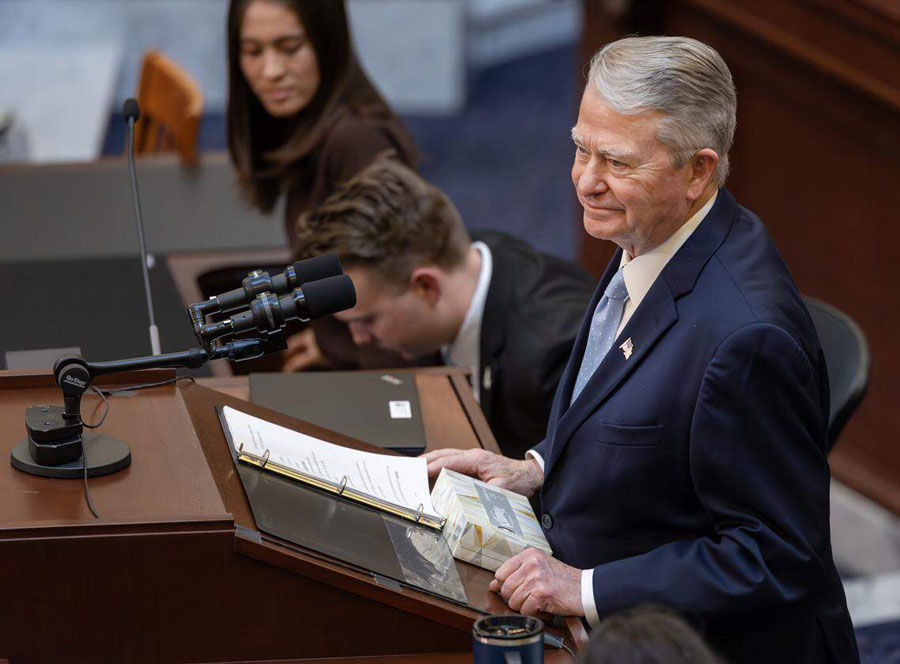
BOISE (Idaho Statesman) — Idaho must stare down a projected budget deficit of over $500 million, Gov. Brad Little said in his State of the State address.
It’s also facing continued challenges related to growth that shows no signs of stopping. In the world of transportation infrastructure, that means more cars traveling on roadways, more congestion and more crashes — including more deadly ones.
All of which cost money to mitigate.
Little proposed a one-time, $275 million cut to a state and local roads fund for the fiscal year starting July 1. That includes cuts of $165 million to the Idaho Transportation Department and $110 million to local highway districts.
It’s the largest one-time cut Little proposed.
Little also recommended that an additional $45 million dedicated for state highways be transferred to the state’s general fund to offset an immediate revenue shortage.
What effect would these cuts have on road projects state and local transportation agencies say are needed?
Not all agencies agree. According to John Tomlinson, a communications manager for ITD, the cuts could slow new construction on state highways and bridges and shift the department’s focus to maintenance. A spokesperson for the Ada County Highway District, meanwhile, contended that not receiving the funds would not “on its own” delay projects that have been planned.
And officials from the governor’s office argue that the absence of cash would offer a different kind of gift: “time.”
“Over the past six years, the state has invested over $1.8 billion in improvements to roads, bridges, pedestrian projects and congestion mitigation,” said Lori Wolff, Little’s budget manager, in a presentation to the Legislature’s budget committee on Jan. 12. “The funding pause this year gives ITD and local districts the ability to use these historic investments and catch up on the backlog of transportation projects.”
In a statement emailed to the Idaho Statesman, Joan Vargas, Little’s press secretary, doubled down.
“The Strategic Initiatives Fund was designed to flex with revenue changes, scaling up or down as needed,” Vargas said. Under the cuts, agencies would gain “the necessary time to advance and complete a substantial backlog,” and if revenues grow, the governor plans to restore the fund, Vargas said.
Big construction projects could be delayed if cuts pass, ITD says
In an interview with the Statesman, Tomlinson said that while already-funded work would continue unaffected, the cuts would “absolutely” impact the rate and priority of construction projects on ITD’s seven-year plan.
“If this does come to fruition and we don’t get those funds, we’re going to be going to more of an operation-focus,” Tomlinson said. “You’re not going to be seeing these big (congestion and mitigation) projects starting, because we’re going to be focused on pavement preservation. We’re going to be focusing on bridge repairs … filling potholes … doing all those things that are going to help maintain, operate and preserve the state system that we already have now.”
Congestion and mitigation-focused projects, like the Idaho 16 extension, are funded primarily through sales tax revenue, but the fund whose money Little proposed to cut can supplement that to accelerate work, Tomlinson said. In 2025, that fund made up roughly 18% of ITD’s revenue, according to data he provided.
Tomlinson noted that maintenance and employee salaries would not be affected. He added that ITD has contingency funds and other funds to keep high-priority work happening — though priority will be more limited to “what’s crucial.”
“We will just kind of see how far we can stretch that money,” and then “be ready” for more, he said. “Orange barrels are not going away.”
State funds saved local taxpayer money, ACHD says
Rachel Bjornestad, a spokesperson for the Ada County Highway District, was optimistic that work would continue ”with or without additional funding from the state.”
Bjornestad said the highway district, which manages roads in Idaho’s most populous county, doesn’t build its budget around state funds, so budgeted projects would not experience any delay.
But she said money from the fund Little is cutting has let ACHD accelerate “large-scale, high-dollar projects,” including on Ustick, Franklin and Linder roads, all roads expected to be impacted by Idaho 16.
Speeding up those projects, Bjornestad said, “ultimately (saved) taxpayers from deferred maintenance and other costs.”
That’s a take on the fund similar to the governor’s in 2023, when he rolled out $100 million to local highway districts for 48 projects.
“Investments in infrastructure is property-tax relief,” Little said at the time. “We’re taking the financial burden off local governments that would have raised taxes or fees on residents.”