



Christian nationalism a growing part of US political landscape, Idaho journalist says
Published at
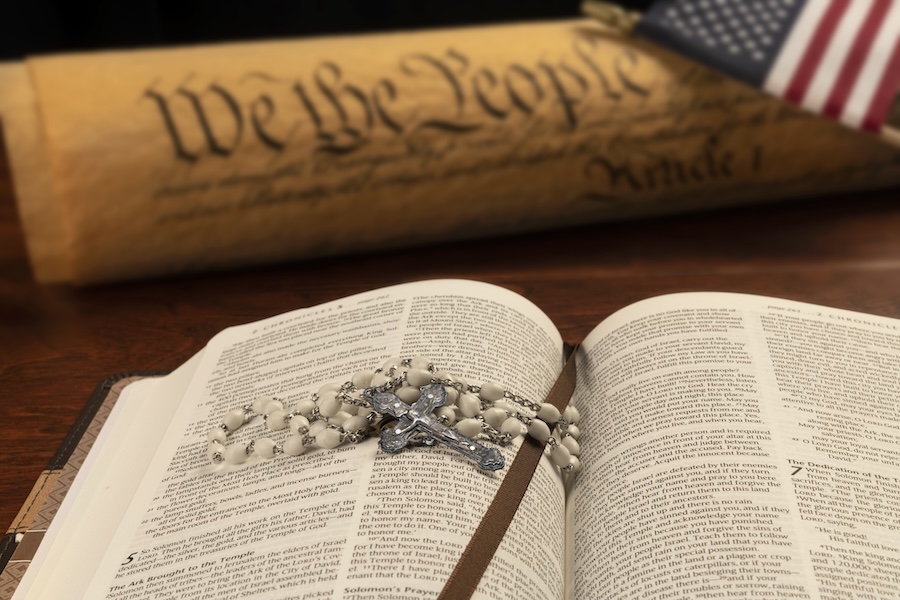
IDAHO FALLS — Christian nationalism is alive and well in America today, and journalist Heath Druzin wants Idahoans to be educated about what that means.
Druzin is a Boise-based journalist who has spent significant time studying the ideology and other political beliefs often seen as “extreme” by the general public. He is the host of “Extremely American,” a National Public Radio podcast which examines the intersection of far-right movements, politics and Christian nationalism.
The first season of “Extremely American” featured coverage of “militias and other far-right groups,” while the second focuses on Doug Wilson and Christ Church in Moscow, Idaho.
The Idaho Falls City Club invited Druzin to speak about Christian nationalism at a Tuesday night event at the Downtown Event Center and share his knowledge with he people of Idaho Falls.
The event was strictly informational, with Druzin fielding a wide range of questions about his experience with Christian nationalism both abroad and in Idaho.
What is Christian nationalism?
“As a journalist, I’m not here to help people organize protests or figure out how to defeat (Christian nationalism),” Druzin said. “We’re just here talking openly about things.”
Druzin defined the Christian nationalist movement as Americans who want a theocratic form of government.
“When I’m talking about Christian nationalists, I’m talking about people who want a theocracy in America,” he said. “They want the government to be explicitly run by Christian principles in the way that they interpret the Bible.”
Druzin explained several features of Wilson’s worldview, including strict religious standards that would prohibit Catholics, Latter-day Saints and Jews from holding public office.
“They don’t see (The Church of Jesus Christ of Latter-day Saints) as fitting into their vision of America,” Druzin explained. “They’re pretty clear about that; I asked Doug Wilson directly.”
According to Druzin, Wilson “considers people in the LDS church to be polytheists.”
“There is sort of anti-Mormon streak in Christian nationalism, but it’s strong, and that’s one of the groups that was identified as not being fit to run for office.”
Another controversial issue Druzin spoke of was gender roles and a Christian nationalist goal to take away women’s voting rights.
“Christian nationalists have, obviously, very traditional ideas about men and women’s roles,” said Druzin. “I had a number of moments … where people were pretty open about some ideas, like disenfranchising women. (That’s) certainly not something a lot of people would say out loud just a few years ago.”
Druzin also claimed that Christian nationalists “see empathy as really bad.”
“They think empathy is basically a path to hell, because you might empathize with somebody who’s not of their mind(set). … They often talk about (empathy) as a feminine quality. And they say, because women, in their mind, are more empathetic, that’s a reason that they shouldn’t be leaders.”
Engaging with the community
Audience members contributed their own questions to the event through 3-by-5 cards, read to Druzin by moderator Brian Johns.
“I think it’s good for people to be aware of (Christian nationalism),” Johns reflected after the event, which is the third forum he has hosted in the area with Druzin this year. “A lot of people don’t know very much about it. The goal is to be informative. People can learn about this and make their own decisions.”
Ann Bjorklund, an Idaho Falls resident and pastor of New Day Lutheran Church, said she didn’t know much about Christian nationalism before the event.
“I think it sounds very exclusive, and might eliminate the voices of a lot of the people in Idaho and throughout our country,” she said. “That gives me pause and causes concern.”
Mike Coulsen, chairman of the Bonneville County Republican Party, described the event as an opportunity for greater community dialogue.
“I think that getting viewpoints from across the spectrum is valuable for our civic discourse,” said Coulsen. “Any time that we can learn more about other points of view allows us, as interested citizens, to understand what other people are thinking.”
Coulsen also expressed concerns about Christian nationalism.
“There are some points (in Christian nationalism) where the constitutional order could be threatened, and I think that should concern all of us as Americans,” he said.
To learn more, you can listen to Druzin’s “Extremely American” podcast on NPR.org.