



LIVE UPDATES | Day 7 of Kouri Richins murder trial
Published at | Updated at
Kouri Richins, a Utah mother of three boys, is accused of fatally poisoning her husband, Eric Richins, in 2022. She is on trial in Summit County, Utah, on charges of aggravated murder, attempted aggravated murder, insurance fraud and forgery.
Today is the seventh day of the trial. It is scheduled to begin each day at 8:30 a.m. East Idaho News will be posting live written updates all day. Please excuse typos. You can watch the livestream here. The most recent updates are at the top of this page.
10:23 a.m. We are now taking a morning recess until 10:40 a.m.
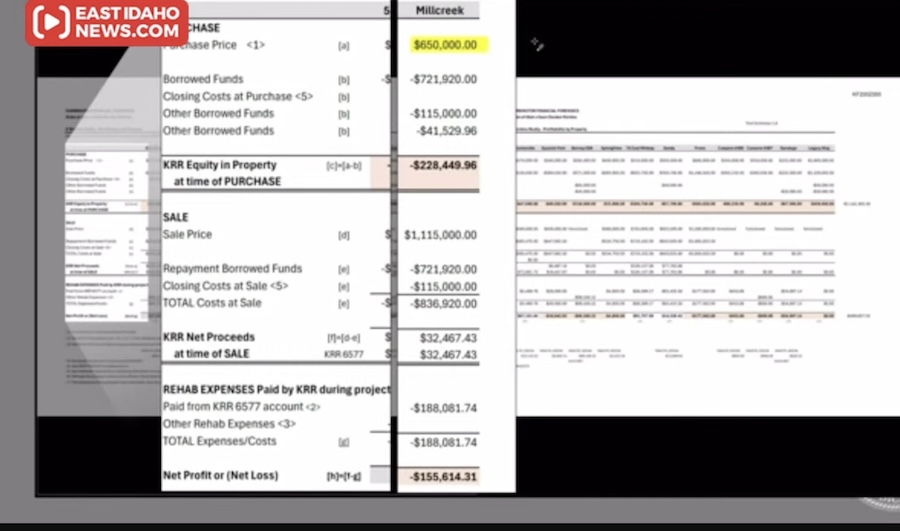
10:18 a.m. Bloodworth brings up one more example – the Millcreek house. She bought it for $650,000. Borrowed money for the home three times. She was $228,000 in the hole. She had expenses on the home, including closing costs and interest, and ended up losing around $-155,000. She lost “at least that, maybe more.”
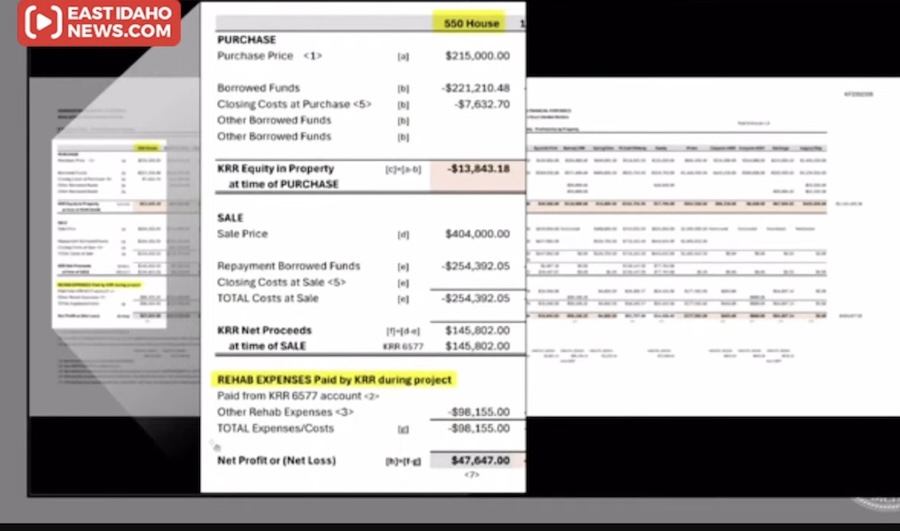
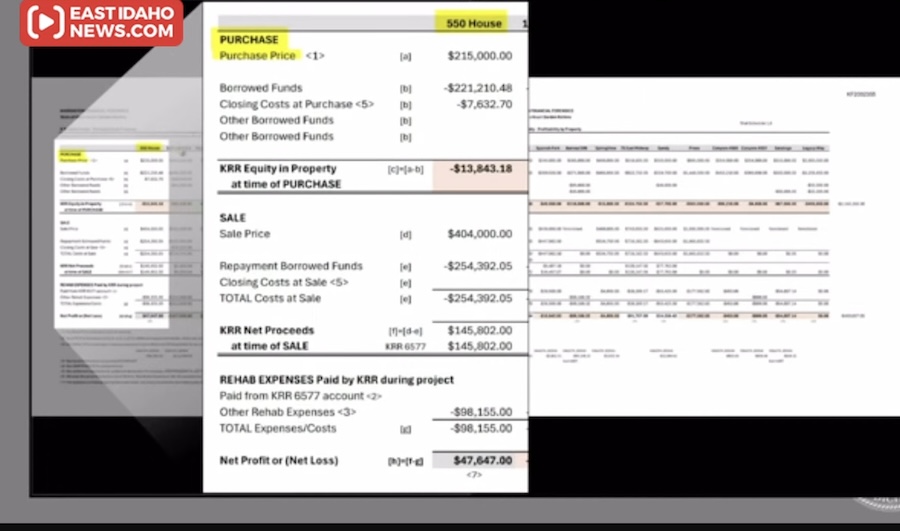
10:16 a.m. Bloodworth uses one home as an example to explain how the chart works – how much Kouri paid, how much she spent on rehab, and what she ended up selling the home for. She ended up making around $47,000 in profit, but “so much of the HELOC funds were used for this property,” Karrington says.
10:13 a.m. Sidebar over. Karrington says going through all of Kouri’s financials was a “sorting exercise.” In 2021, there was $400,000 of expenses that went to vendors or subcontractors, but Karrington couldn’t tell what specific homes that money went to. Many of the checks Kouri wrote included the name of the property the money was for.
10:12 a.m. Bloodworth asks Karrington why she didn’t use the documents Kouri prepared for her accountants about the properties. Karrington says, “Because they were incorrect.” Nester objects. Judge holding sidebar with Nester and Bloodworth.
10:07 a.m. We see an exhibit showing the property transactions. They show the purchase price of the home, closing costs, net proceeds at time of sale. We also see rehab expenses. Karrington compiled reports like this for each property.
10:04 a.m. We now see an exhibit showing a purchase timeline showing a purchase timeline of K. Richins Realty. It shows how many homes Kouri purchased over the years.

10:02 a.m. Sidebar is over. We see Kouri’s personal bank account statement from April 2019. It shows that on March 29, there was a deposit of $60,000 in the account. The money came from the TCF National Bank account check made out to Eric Richins.
10 a.m. Bloodworth moves to admit another exhibit. Nester objects. Judge asks attorneys to approach the bench for sidebar. White noise is played in courtroom.
9:57 a.m. Bloodworth admits an exhibit showing a $60,000 check from TCF National Bank made payable to Eric Richins on March 22, 2019.
9:55 a.m. Money was used from the HELOC to pay for rehab projects. There was no evidence or sign that Eric ever withdrew any money from the HELOC – it was always Kouri, Karrington says.
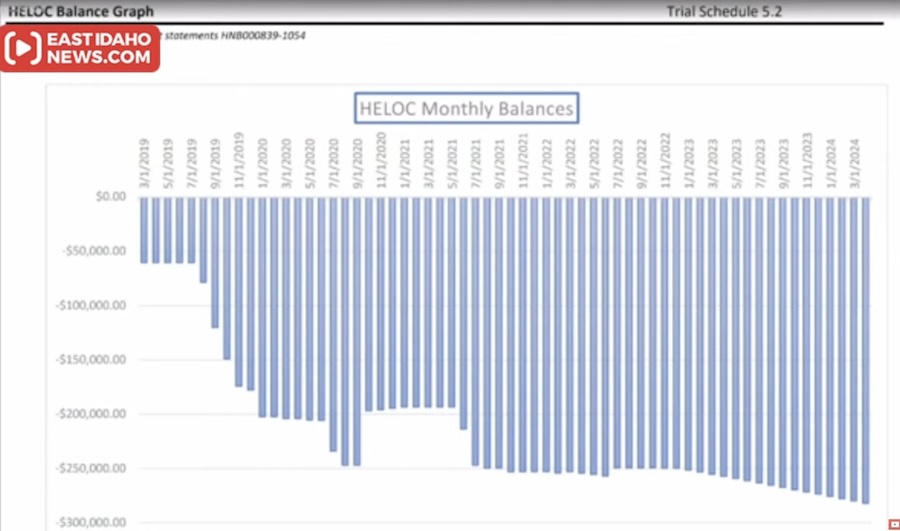
9:52 a.m. Bloodworth admits an exhibit showing the balance limit on the HELOC loan. At the time of Eric’s death, the loan was over its limit of $250,000. The payments on the account were interest-only payments with the exception of one payment made of $50,000 in October 2020.
9:48 a.m. Judge will allow the exhibit in. We see the home equity line of credit agreement on the screen. It outlines the terms of the loan. Eric Richins is the borrower. The credit limit on the loan is $250,000. The borrower is signed as Eric Richins and it’s signed by Kouri Richins.
9:45 a.m. Bloodworth admits an exhibit showing a warranty deed showing Eric’s sister and brother-in-law originally owned the property but transferred it to Eric and Kouri. Bloodworth moves to admit an exhibit. Kathryn Nestor says she objects based on 404b and objects to “all testimony that may flow from it.” Judge asks attorneys to approach for sidebar.
9:44 a.m. Kouri took out a home equity line of credit in March 2019. It’s an open line of credit and is based on whatever equity you have put into your home. The home equity line of credit was based on Kouri and Eric’s home.
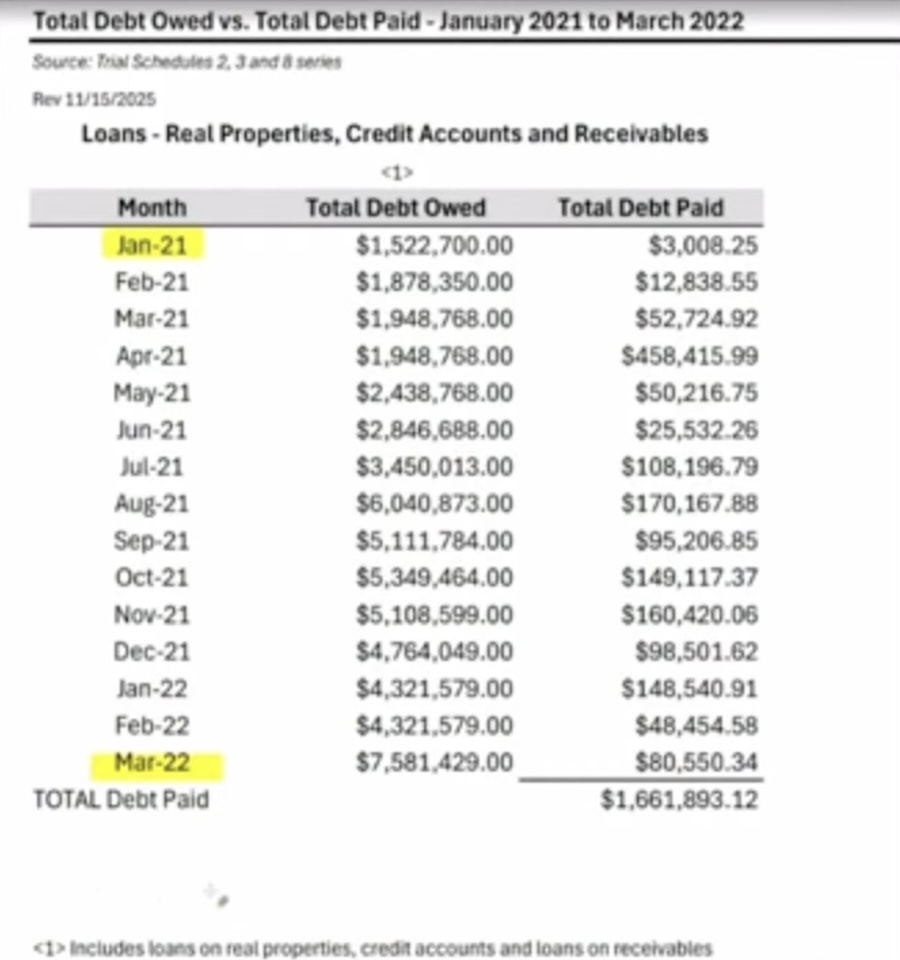
9:42 a.m. Most of Kouri’s real estate deals did not require monthly payments, Karrington says. The total debt owed seems to flatline in October 2021. Bloodworth asks why. Karrington says there are a lot of reasons. “It looks to me that she’s exhausted her funding sources and there are very few new funding sources coming in.”
9:37 a.m. Bloodworth admits exhibit showing total debt Kouri owed on properties, credit cards, payday loans and lines of credit. In March 2022, Kouri owed approximately $7.5 million and paid around $80,000 a month toward that debt.
9:34 a.m. Karrington tried to figure out where the money was coming from, where it was going, and what the end game was for Kouri. We just saw the October statement, and Karrington says the following months were very similar. Whenever she received funds into the account, she would deplete the money quickly.
9:30 a.m. The balance history on the account fluctuates greatly depending on the day and week. One day there is $2,000 in the account and then it jumps to $19,000 and two days later it jumps to $70,000 but then there are big withdrawals every day. She uses a lot of the deposits to pay debt and new payday loan vendors are introduced. On Oct. 22, she had $77,000 deposited into the account after Kouri sold a property. That money did not last. It went to pay vendors and she incurred more and more debt, Karrington says.
9:29 a.m. Jurors are looking at the screen during this explanation. Many are taking notes – looking up from the screen and back to their notebooks in their laps. Karrington explains money going in and out of the account. Every week Kouri has to come up with money to stay current and avoid default to the payday lenders. They have high interest rates but if they go into default, the interest rate almost doubles.
9:24 a.m. We see a list of transactions. Delta Bridge, Bluebridge, Fairmont and Zahahva are four payday lenders that Korui was committed to pay $2,100 a day, Karrington says. There are debits daily on her account.
9:22 a.m. Karrington walks through her process. She begins by looking at the header then scrolls down and sees a negative balance. She then goes through the transactions and checks the posting dates on the transactions. Kouri is taking notes as Karrington speaks.
9:18 a.m. Karrington says between October 2021 and March 2022, there was an increase in overdraft transactions. Bloodworth admits an exhibit showing a bank account statement from America First Credit Union. Karrington leaves the witness stand and approaches the TV display facing the jury. Bloodworth asks Karrington to show how she analyzes the bank statement.
9:17 a.m. In one example, Kouri wrote a check for $10,000 and another for $4,000 from an account that had -$51 in the account. She wrote another check for $10,000 the next day. These checks were written to herself.
9:15 a.m. A lot of the money went to debt payment or vendor bills. She also tried to pay herself. Bloodworth admits an exhibit showing checks Kouri wrote from her Navy Credit Union to herself that were returned unpaid. She wrote approximately $60,000 in checks to herself from August 2021 through May 2022 that bounced. She wrote the checks from an account with a negative balance.
9:12 a.m. Bloodworth admits an exhibit showing overdraft and nonsufficient fund transactions from the main account belonging to Kouri between January 2021 and March 2022. From October through the end of March, there was a drastic increase in funds and transactions that did not clear the bank without a fee. In December, she had 77 overdraft or nonsufficient fund transactions totaling $91,000 with $2,000 of fees.
9:10 a.m. In October 2021, many transactions didn’t clear the bank. The account was perpetually in the hole. Money was coming in, but it was going out at a very exhaustive pace, Karrington says. Lots of overdraft fees, insufficient funds, etc.
9:07 a.m. The business was originally registered in Eric Richins’ name. Four days after the business was registered, it was changed to Kouri Richins. Bloodworth asks what an alter ego is in relation to forensics and accounting. Karrington says K. Richins Realty and Kouri Richins are alter egos. Their use of funds, transfer of funds, money going back and forth between different accounts show they are the same person.
9:03 a.m. Bloodworth asks to admit Kouri Richins’ real estate business registration for K. Richins Realty. It was registered April 26, 2019. Kouri was mostly in the business of buying and selling real estate for the purpose of flipping the properties. The registered agent is Kouri Richins with the business address being the family home. There was an additional business address for a PO Box in Kamas. Eric was listed as a member of the company.
9 a.m. Sidebar over. Bloodworth asks Karrington to explain her methodology when it comes to her investigations. Karrington began her investigation in this case by starting with Kouri’s bank accounts. Kouri had a business bank account at America First Credit Union. She also had a personal checking account at America First that was opened when she and Eric got married. There was no indication that Eric ever used the account. Kouri also had a Navy Union checking account. There was also a family account at America First Credit Union. Eric also had a business account and a personal account.
8:58 a.m. Karrington interviewed insurance companies, bank representatives, lenders, owners of the Midway house, Wasatch County Building Department and more. Kathryn Nestor asks if attorneys can approach. White noise is played in the courtroom.
8:56 a.m. Karrington says she reviewed “tons” of emails for many different purposes. She looked over leasing documents, premarital agreement, loan documents, letters, real estate transactions, contracts, property transactions, etc.
8:54 a.m. Karrington worked for the estate of Eric Richins. There was a civil lawsuit between Kouri and Eric’s sister Katie Richins-Benson. The estate paid her around $14,000 for her services. After she was paid, she had no further involvement with the estate. During this investigation, Karrington reviewed hundreds of thousands of documents.
8:51 a.m. Karrington has testified in trials before. Some of the jurors are taking notes. Others are focused on the witness. Kouri Richins is reading over papers at the defense table. The state hired Karrington to do an investigation into the Richins case. Summit County is paying Karrington at her regular rate.
8:49 a.m. First witness is Brooke Karrington. She is a forensic accountant. She’s been in the business for 38 years and has a firm based in Salt Lake City.
8:47 a.m. Courtroom is fairly full. Nine journalists on the media row. Additional reporters in an adjacent media room. Many members of the public are here. Jurors have been seated. Judge says court will begin tomorrow morning at 9:30 a.m. There will be no trial tomorrow.
8:42 a.m. Defense attorney Kathryn Nester says they have many objections about this upcoming witness. Judge Mrazik is discussing how to handle the objections.
8:39 a.m. In the courtroom. Summit County Prosecutor Brad Bloodworth says there will be one witness today – an accountant – who will likely take most or all of today.