




Idaho Secretary of State Phil McGrane talks campaign finance and reform ahead of Tuesday Primary
Published at | Updated at
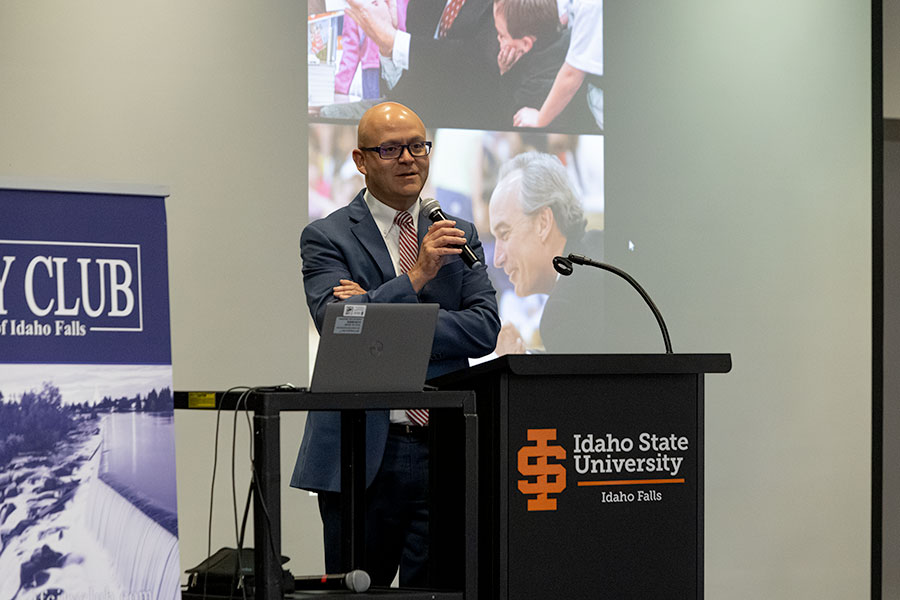
IDAHO FALLS — Heading into next week’s primary election, Idaho Secretary of State Phil McGrane says this election cycle has been a bit topsy-turvy.
In Idaho Falls, he said the mayoral election last November drew more interest than any race in this year’s primary.
“The primary should be way more active with way more money than a local mayor’s race, but that race was … very heated here,” McGrane said. “There just isn’t the same races or money that we’re seeing (in this primary election).”
As secretary of state, McGrane oversees Idaho’s elections, campaign finance reporting and business services. He was at the City Club of Idaho Falls on Thursday afternoon to discuss the state’s election system and the role money plays in today’s political landscape.
Outside funding and PACs
McGrane said in years past a candidate would typically raise $10,000 in an Idaho legislative race, but that figure has now skyrocketed to three or four times that amount.”We’re now starting to see $100,000 races and more, and the competitive ones,” he said.
A lot of that money is starting to trickle in from out-of-state political action committees, he said.
“Probably the most expensive legislative race in state history will occur down in the Pocatello area, with Guthrie versus Worley,” McGrane said.
In Bannock County, Idaho National Guard infantry officer David Worley is taking on Republican state Sen. Jim Guthrie in the primary election.
According to IdahoEdNews.com, the race has raised nearly half a million dollars in donations heading into the primary. The outlet reported that political action committees had spent $375,107 in support or opposition for both candidates. Add to that the $128,545 each candidate has spent, and the total amount raised is $503,652.
“What does this mean?” McGrane asked, rhetorically. “One of the things that means is we need campaign finance reform.”
State data shows the combined total of campaign and independent spending in Idaho’s 2024 elections was $17,308,232. Of that money, McGrane said $7,673,805 was raised directly by candidates, with nearly $10 million by PACs to support or oppose candidates.
A majority of the $2,843,904 spent in opposition to a candidate came from out-of-state sources, McCrane said. On the other hand, the $6,790,524 spent on ads supporting candidates came mostly from in-state sources.
The VoteIdaho.gov website details which funds came from out-of-state PACs. McGrane said the biggest push in 2024 was for school choice.
The top spender in Idaho in 2024 was an out-of-state PAC called Make Liberty Win, which spent $716,686; the second biggest spender was Idaho Liberty PAC at $711,364.
Make Liberty Win spent $107,473 alone on the race between former President Pro Tempore Chuck Windor and Sen. Josh Keyser; Windor ultimately lost to Keyser.
Another example McGrane pointed to for showing how PACs impact elections was a race in Kune involving former Rep. Melissa Durant in District 23A.
“It was one vote that Rep. Durant made on school choice,” McGrane said. “She was a kind of a no-name legislator just in her first term, and wasn’t somebody drawing a lot of attention — but her race was intense.”
Nearly $100,000 was spent on the race by two PACs — Idaho Federation for Children PAC and Make Liberty Win — ultimately changing constituents’ minds to vote for Rep. Chris Bruce, who had raised only $2,731 on his own.
Looking at this year’s races, McGrane said PAC money is out there, but there aren’t as many key races to spend it on as in years past. He said that money is either being redirected toward other races or just not being spent at all.
Campaign finance reform
Going back to the need for reform, McGrane said he’s been pushing for an option that looks at campaign finance limits.
Currently, Idaho law sets donation limits of $1,000 for legislative races and $5,000 for statewide races. The issue McGrane sees is that with these limits in place, extra money is going into PACs.
The last time the donation cap was raised was in the 1990s, he said, and with PACs, the donations are limitless.
However, there is a limit to what can be done, as McGrane says that donating any amount of money to whomever you want is a matter of freedom of speech.
“The answer is the money can come in. You can’t stop somebody from spending. You can require transparency,” he said.
Another solution that has been suggested, McGrane said, is to add numbers to each organization and PAC to help identify the donors. This would allow voters to more easily track where that money came from when they see these campaign ads.
Another idea is to increase fines for any campaign finance violations reported to the state.
Currently, candidates who violate campaign finance laws are fined $250; PACs found in violation are fined $2,500. McGrane said the issue here is that because the number is so low, some organizations pay the fine without addressing the issue.
Looking at Idaho’s neighbor to the south, McGrane said any candidate who commits a campaign finance violation in Utah can get kicked off the ballot.
“They have way higher compliance rates than we do,” McGrane said.
While he agrees that Utah’s law might be too extreme, McGrane says Idaho has other options to make it more proportional, depending on whether the violation stems from a Facebook ad or a TV ad.
Friday is the last day you can vote early in Idaho. Primary Election Day is on Tuesday, May 19. To check your voter registration status or find a voting location, visit VoteIdaho.gov.
For more information about the candidates and issues at play in this year’s primary election, check out our East Idaho Elects page.