
Update: The mission continues as a Rigby family pushes for life-saving Automated External Defibrillators at sports facilities
Published at | Updated at
Note: As a bonus to our readers who have followed us into Year 2, the East Idaho Sports staff will post a special story on Sundays – It could be a column, opinion, feature, or just something fun and goofy. Hope you enjoy and thanks again for coming along on this journey.
RIGBY – The numbers don’t lie.
1
According to both the American Academy of Pediatrics and the Centers for Disease Control and Prevention (CDC), sudden cardiac arrest is the No. 1 cause of death among young athletes in the United States.
2,000
It’s estimated that 2,000 people under the age of 25 die from sudden cardiac arrest in the U.S. each year.
So what’s being done about it?
Unfortunately, not enough.
For nearly a year, Karina and Robert Cox have been on a mission to bring awareness about sudden cardiac arrest (SCA) and promoting the importance of learning Cardio Pulmonary Resuscitation (CPR) and how to use an Automated External Defibrillator (AED).
It’s a mission that’s extremely personal for the Cox family after their daughter Addie suffered SCA during a softball game last summer in Montana.
According to the American Heart Association, among athletes experiencing SCA during competitive sports, only 43.8% survived to hospital discharge.
Addie was lucky.
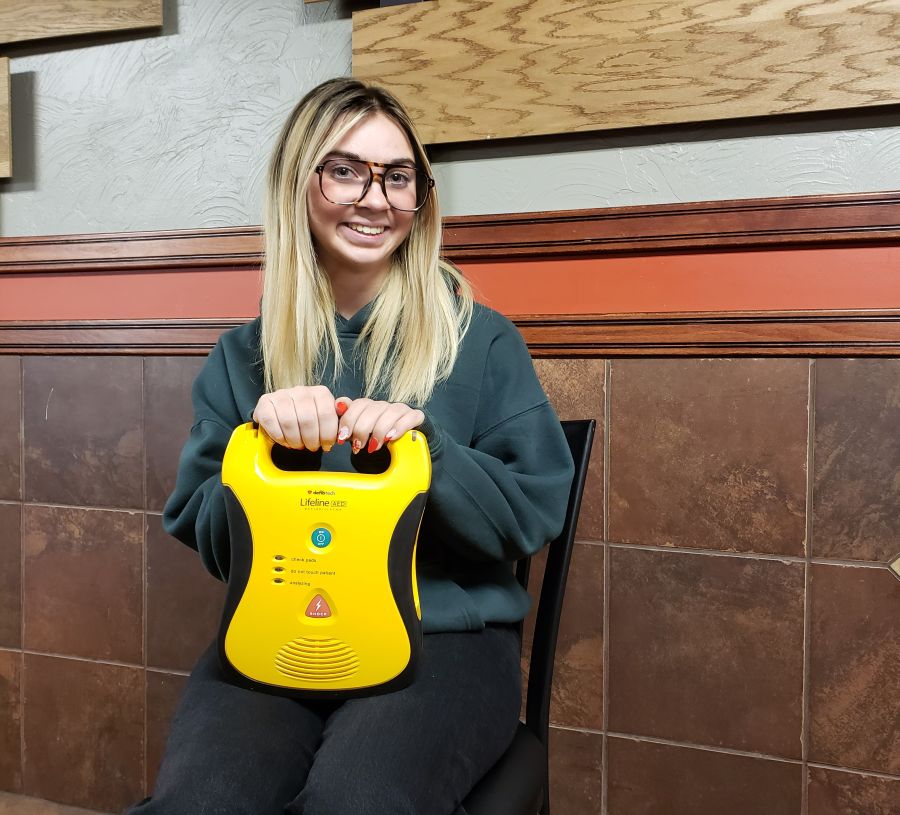
There were two nurses in the stands that day who immediately rushed in to start CPR and made sure 911 was called. A paramedic, who happened to be at the softball complex, located an Automated External Defibrillator and used it to shock Addie’s heart back into rhythm before the ambulance arrived.
Addie’s road to recovery has been well documented.
RELATED |After teenage softball player nearly died, she and her family are on a mission
RELATED | Saving a life: Here’s a quick lesson on performing CPR and using an Automated External defibrillator
She’s been medically cleared by doctors and is back on the softball field.
It’s a happy ending to a horrific event, but that’s not how the story ends.
That’s where the mission begins.
The Cox family started the Facebook page Field of Hearts – Addie’s Mission, to help raise awareness about the importance of having AEDs available at sports facilities and the need for CPR training.
Cardio Pulmonary Resuscitation and Automated External Defibrillators can be a life-saving combination.
“We want to make people understand that this is a serious thing and we need to approach it in a serious manner,” Karina said. “Breaking that myth that it’s not going to happen to your child.”
1
It’s a start.
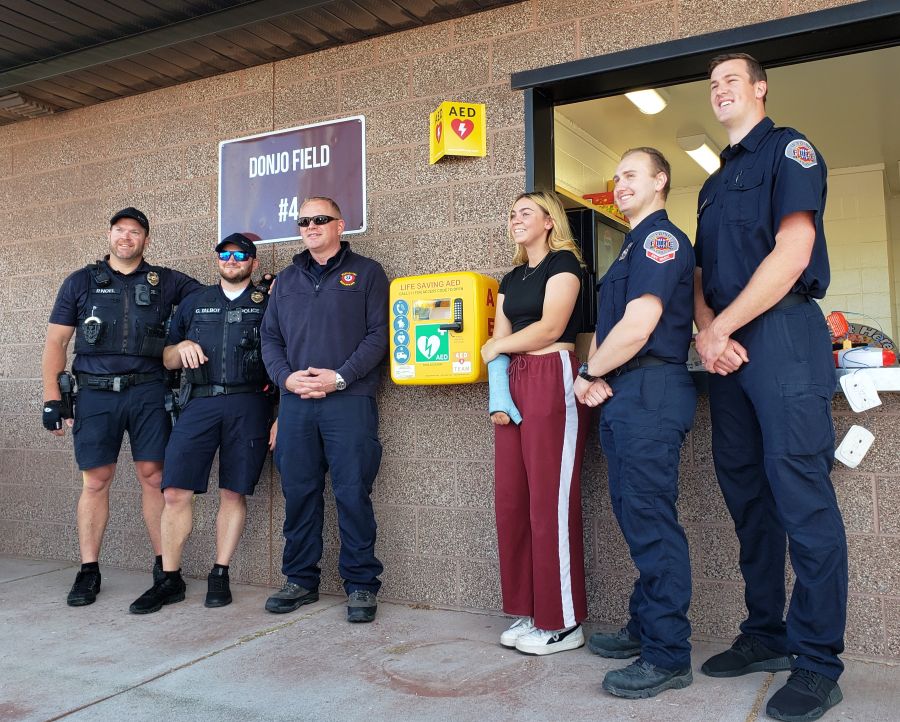
On this day, the Cox family, including Addie, are at the Donjo Sports Complex in Rexburg to celebrate the new AED that’s been installed.
It’s taken some time, but the $2,500 unit was paid for by a donation.
Karina and Addie talk to area medical personnel at the event.
One AED can save lives.
So why aren’t there more?
“We’re very thankful,” Karina said of the new AED. “We are getting traction. We have people who are very supportive of the mission and the cause, people who are willing to donate and help, it’s just getting the city leaders involved and the community.”
“We want to ensure we get as many people trained in CPR as possible and there is access to AEDs at community gathering spaces,” said Erin Bennett, who is the Government Relations and Advocacy Director for the American Heart Association in Idaho. “So if a cardiac event happens there is someone who is able to jump in before the medics are able to get there.”
2026
This was the first year that advocates like the American Heart Association proposed legislation to Idaho lawmakers to update school emergency codes to include cardiac response plans on high school campuses.
“We want to put the plan in school codes like any emergency action and make sure people are prepared for cardiac events,” Bennett said. “We prepare for fires, we prepare for weather disasters, but we somehow don’t prepare for cardiac arrest, which is probably more common than those other things. Heart disease is the No. 1 killer in the state and country.”
Bennett noted that while everyone seemed to agree that planning and having the resources for cardiac events was important, getting an action plan proved challenging.
“Because we’re in such a tough budget year as a state, that adding any extraneous funding to anything was difficult … That’s where we hit some obstacles. Schools don’t want to put a plan in place that they’re not sure they can fund.”
2027
Bennett said they will try again at the next legislative session in January.
“We want to make sure the plan is there and the resources are there,” she said. “We know communities are very generous, and businesses offer AEDs, and then it’s just making sure there’s a pocket of funding for the maintenance. Which isn’t all that expensive, but when you’re looking at the school budget, everything is a cost.
“Last year they were just a little cautious. We don’t have the widespread education as to why it’s necessary. That’s what we’ve been working on for the last year and a half.”
Several states have implemented cardiac emergency plans which require AEDs at all school-sponsored events, and making sure AEDs are in prominent locations on campus (allowing a three-minute response time).
The level of training varies from state to state.
In Idaho, high school coaches are trained in CPR and take a National Federation of High Schools course on Sudden Cardiac Arrest, which includes how to use an AED. High school students are required to learn hands-on CPR in health class.
Mike Federico, an assistant director at the Idaho High School Activities Association, said that each school should have at least one AED after the National Federation of High Schools provided funding years ago to help provide the units throughout the state.
He noted that schools and school districts are responsible for maintenance, training, and how they implement the AEDs into their action plans.
And that’s where the disconnect comes in.
“Our biggest challenge is that most schools probably do (have AEDs), but there’s no collective resource that makes sure they’re up to date and getting maintenance and making sure the batteries are charged on a regular basis,” Bennett said. “We don’t have that information, so we’re not quite sure what that looks like. So that’s one of the things I’ve been talking to the Idaho High School Activities Association over the last year, along with the school boards, is to find out what’s actually happening on the ground so that we can make sure every school has the number of AEDs they need.”
Karina and the Cox family have been actively talking to school districts, first responders, and other organizations, sharing information with others focused on the same mission.
The Field of Hearts – Addie’s Mission page regularly posts stories of people suffering cardiac events. Like Addie’s, some stories have a happy ending. Some do not.
“We just got lucky that day,” Karina said.
So the mission continues with the main goal of getting legislation passed to add Idaho among the states that have a comprehensive cardiac event plan in place for every high school.
“I think everybody is going to say, on paper, it’s a good idea, you’re not going to run across anybody who’s going to say a life-saving device is a bad idea,” Karina said. “But what they do with that information and the time they take … to actually ensure that schools have them is another story.”
“It does no good to have an AED in place if no one knows where it is or knows how to use it,” added Bennett.
00
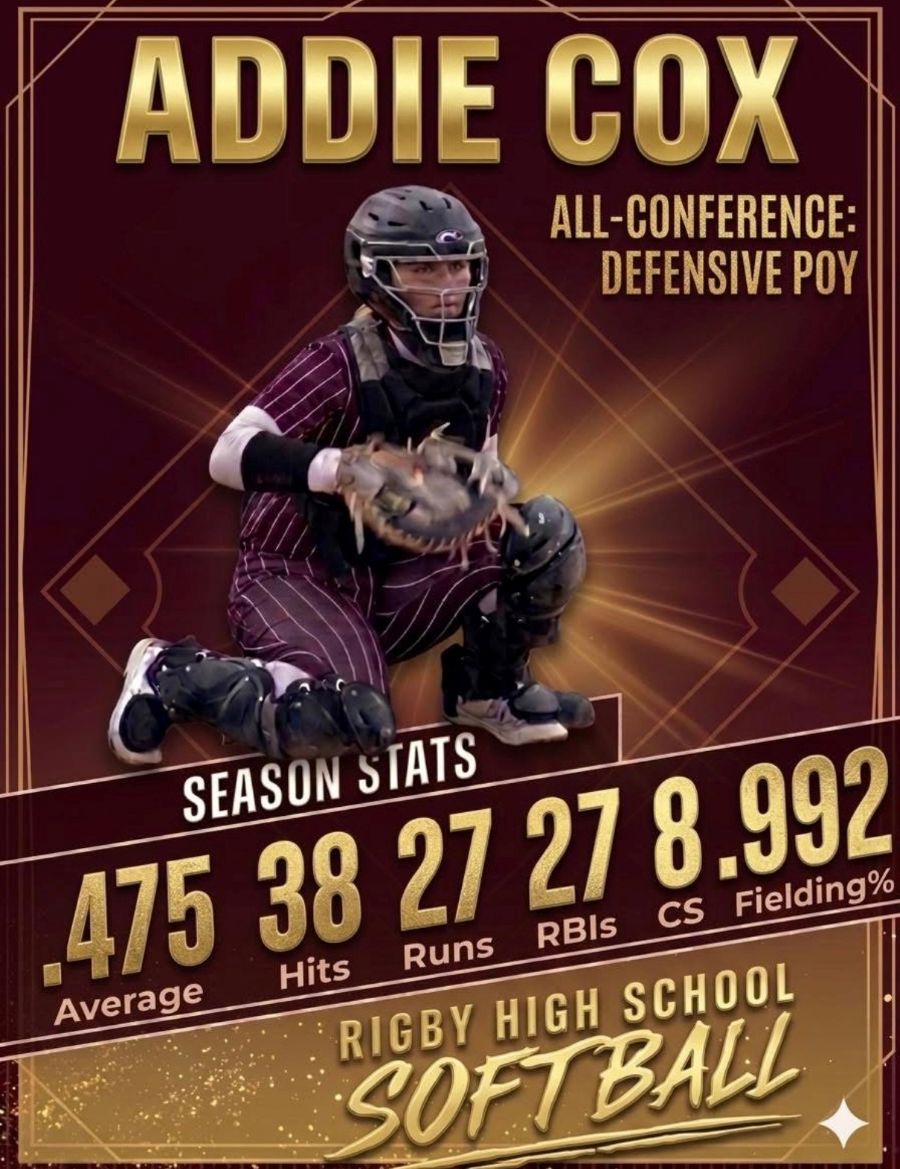
After months of doctor’s visits and testing, Addie Cox, sporting her No. 00 jersey, rejoined her Rigby High softball team this spring.
She wasn’t sure initially if she wanted to be the face of the mission, but she knew her story was important and it could save lives.
Addie said she doesn’t think about her SCA event when she’s playing. She does carry a portable AED to games even though she’s been medically cleared to play.
Doctors eventually concluded that Addie likely suffered Commotio Cordis, which is rare, but described by the American Heart Association as a “phenomenon in which a sudden blunt impact to the chest causes sudden death in the absence of cardiac damage.”
She collapsed after a head-first slide into third base, which likely triggered the SCA.
“It’s easier to talk about it now,” Addie said. “It’s almost been a year … I’m a lot more comfortable.”
On the field, Addie, a senior-to-be, was among the top players in the Trojans’ lineup and was also named the 6A District 5-6 Defensive Player of the Year after sporting a .992 fielding percentage at catcher.
Off the field, the mission has become, well, a mission.
“I think that people think it could never happen to them or their child,” Addie said. “I don’t think people understand how common cardiac arrest is and how life-threatening it can be if you don’t get medical help almost immediately. I think people should know it can happen to anyone.”
Addie said she sometimes feels she has to prove herself to people who don’t believe she can come back as strong as she was a year ago.
“I feel I have to show people that the cardiac arrest does not define me and it’s not my whole story,” she said.
Earlier this month, an AED was installed at the South Park in Rigby with the help of the Aliver Foundation and Field of Hearts – Addie’s Mission, in partnership with the City of Rigby.
Karina said the organization is looking to expand locally past Rigby and has reached out to Idaho Falls officials, but has not gotten a response. Tautphaus Park would be a prime location for AEDs, she said.
“It’s great that there has been some traction,” Karina said. “We’re trying to make all the communities as safe as possible. That’s my gratitude and that’s the part of my mission. If there weren’t people to jump in right away she might not be here. We’re just trying to pay back the favor.”
 Get more sports news here