



Tort claim, vandalized cameras and eastern Idahoans up in arms about Flock cameras
Published at | Updated at
EDITOR’S NOTE: The following is the second in a two-part series examining Flock cameras in eastern Idaho. Read the first article here.
POCATELLO – Awareness has been spreading of a technology new to the region that, at the time of its adoption, attracted barely any public attention at all.
In recent weeks, that has changed.
Flock cameras, which use an Automated License Plate Recognition (ALPR) system to track the license plates of passing vehicles, were implemented across a number of cities in eastern Idaho last year. While local law enforcement agencies have praised the technology for its ability to help officers solve cases, many residents see it as a violation of their rights and privacy.
One of these people is Pocatello City Councilmember Hayden Paulsen.
“I think it’s fundamentally a privacy violation,” Paulsen told EastIdahoNews.com.
This article is a continuation of EastIdahoNews.com’s coverage of Flock cameras, which began with an article on how the camera system works and why law enforcement supports the technology. This article will focus on the public reaction to the camera system.
Controversy surrounding Flock cameras
When the Pocatello City Council first voted on Flock cameras in December 2024, Paulsen was the only council member who voted against the motion. This was prior to the council members elected in November and Mayor Mark Dahlquist taking office.
Pocatello Police Lt. Akilah Lacey said that there are 36 ALPR cameras within Pocatello city limits. According to a map provided by DeFlock — a group opposed to the use of these cameras — the larger Pocatello Metro Area has 46 ALPR cameras.
Since the City Council first went forward with the camera system, Paulsen has seen more and more people take notice.
“Just in conversation — I’ll be at a coffee shop, and someone will be like, ‘Oh my gosh, what’s up with the Flock cameras?’ … It’s a couple times a week, I would say, whether it’s a call, an email or in person,” Paulsen said.
Paulsen offered some explanation for why there’s been increased attention.
“Part of it comes from this massive push for everybody to adopt AI,” he said, pointing out how Flock utilizes artificial intelligence in its ALPR system.
Lacey expressed understanding of privacy concerns but also argued that some of the information being shared about Flock cameras — such as claims that the system uses facial recognition technology — isn’t accurate.
“First thing I think we have to just address here is to voice empathy and concern for somebody worried about their privacy being violated,” Lacey said. “I think something that’s very unique about the situation is that some of the information being put out by people is not accurate.”
While part of the increased awareness can be attributed to Flock cameras’ link to AI, there have also been organizers working to raise awareness of them.
One of these organizers is Brian McKellar, who recently ran for a seat in the Idaho Legislature.
McKellar first became aware of Idaho Falls’ use of Flock cameras while attending a City Council meeting on a different issue entirely. After someone at the meeting spoke out against the city’s acquisition of them, he began to research the cameras as well.
The way McKellar sees it, a combination of local organizing and statewide news coverage has brought Flock cameras to the forefront of the conversation.
“I mean, (the issue) is exploding in Idaho on the social media scene. People are pissed, and it’s clear that we don’t want these in our state,” McKellar said.
Idaho Falls Police Chief Bryce Johnson says he sees the increased opposition to Flock cameras as part of the culture of the country at large.
“People who are worried about privacy, I get it. I’m a red-blooded American like everyone else that’s worried about this, and we have a distrust of government that’s kind of baked into American culture,” Johnson said.
The effort to ‘DeFlock’ Idaho
McKellar said his research led him to become a primary organizer for DeFlock Idaho in east Idaho.
On the national level, DeFlock is an open-source mapping project that allows people to view and report the location of ALPR cameras. As with cities across the country, the DeFlock website identifies ALPR cameras in both Pocatello and Idaho Falls.
EastIdahoNews.com counted the cameras documented by DeFlock in both cities and found that the larger Pocatello and Idaho Falls Metro areas have 46 and 19, respectively.
Locally, Deflock Idaho is a decentralized organization of citizens who aren’t happy about the cameras being installed across eastern Idaho. McKellar explained that while they had recently filed paperwork to officially become a nonprofit, local DeFlock organizations are run independently, and DeFlock Idaho doesn’t coordinate with the national group.
“We’re not coordinating anything with them. We just appreciate the open source projects that they’ve created,” McKellar said. “Great place to learn about why this tool, in particular, is bad for society.”
And beyond being bad for society, McKellar argues that the contract signed by Idaho Falls and Flock makes them illegal.
McKellar first learned this from Tyler Cain, who has filed tort claims against the cities of Caldwell and Wilder for their Flock contracts.
Idaho law dictates that ALPR cameras “shall not be used for any non-law enforcement purpose.” Essentially, McKellar and Cain argue that cities that signed terms and conditions with Flock, allowing the company to “use customer data to support and improve Flock’s products and services,” were in violation of the law.
In Wilder, the City Council voted to amend its contract with Flock in response to these concerns, KTVB reported earlier this month.
After learning about this, McKellar decided to issue an ultimatum to the City of Idaho Falls in early July. After addressing the City Council, he asked them to cover up the cameras by July 29, which was Wednesday, or he would file a tort claim against the city.
“It is within your power to cover up these cameras … until we can figure this out,” McKellar says in a video of his statement to the Council, which he posted to Instagram.
McKellar also said he would release his template of the tort claim so that anyone who’s driven their car through the city could file one as well.
On Thursday, the city issued a statement confirming that McKellar filed a tort claim.
Additionally, after EastIdahoNews.com field a public records request, Idaho Falls sent us a copy of McKellar’s tort claim, with some redactions. A reading of the claim shows that McKellar is seeking damages for “invasion of privacy,” not for physical damage.
And while McKellar is claiming $100,000 in damages, he said that a monetary reward wasn’t what he was after.
“I don’t want the money. I don’t. I want these cameras taken down, is what I want, but they’re not listening,” McKellar said.
The City of Idaho Falls is in the process of taking similar action with its Flock contract as Wilder did. The City Council plans to discuss an action item to amend its Flock contract on Thursday evening to prevent Flock from continuing to use its data for software improvement.
“While the City of Idaho Falls does not believe the current contracts with Flock go against Idaho Code or other applicable law, the city has heard residents’ concerns over how data collected by Flock is used. In response, the city has been in the process of amending the Flock contracts so that the company cannot use data to train its artificial intelligence systems,” the statement reads.
The police department also issued a statement, expressing support for amending the contract.
“The Idaho Falls Police Department is committed to obeying the law in all things and also aligning our efforts with our community’s values. We believe automatic license plate reader technology is both an incredible benefit to public safety and compliant with the Constitution and State and Federal law. We support the amendment to the contract with Flock Safety scheduled to appear before the City Council tonight. IFPD, as part of the city, will participate in the legal process initiated by this tort claim and comply with any decision made by the courts,” the statement reads.
A unifying issue
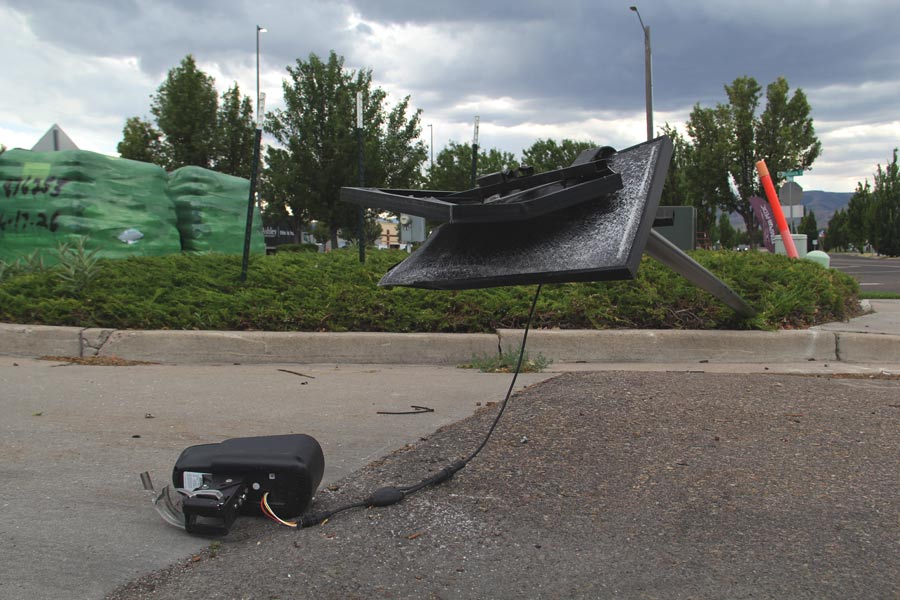
Earlier this month, two Flock cameras in Pocatello were knocked down, less than 150 yards apart.
Both of the cameras were placed along Bullock Street, next to Lowe’s Home Improvement. One is located next to the Lowe’s parking lot south entrance, and was tipped towards the building. The other camera is next to the southwest entrance and was bent towards Bullock Street.
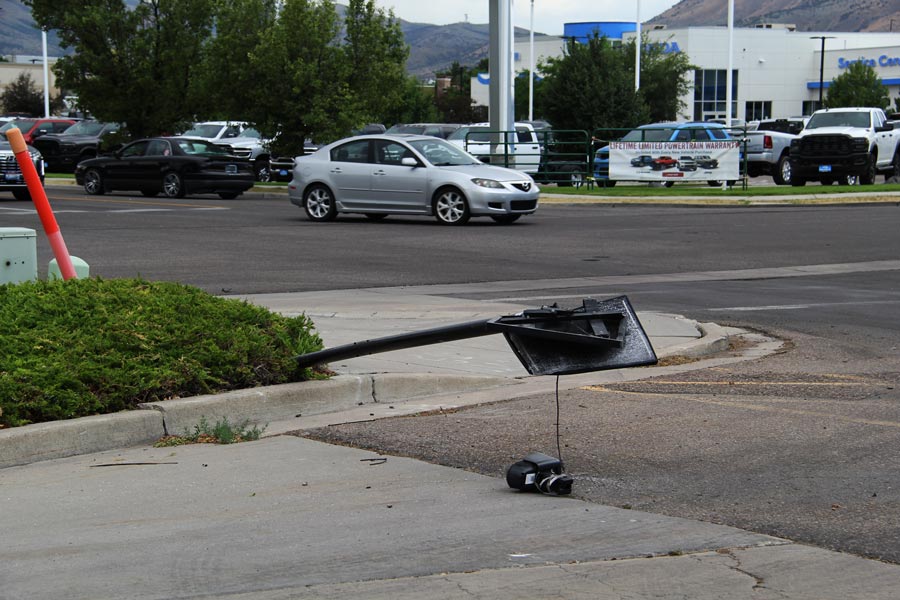
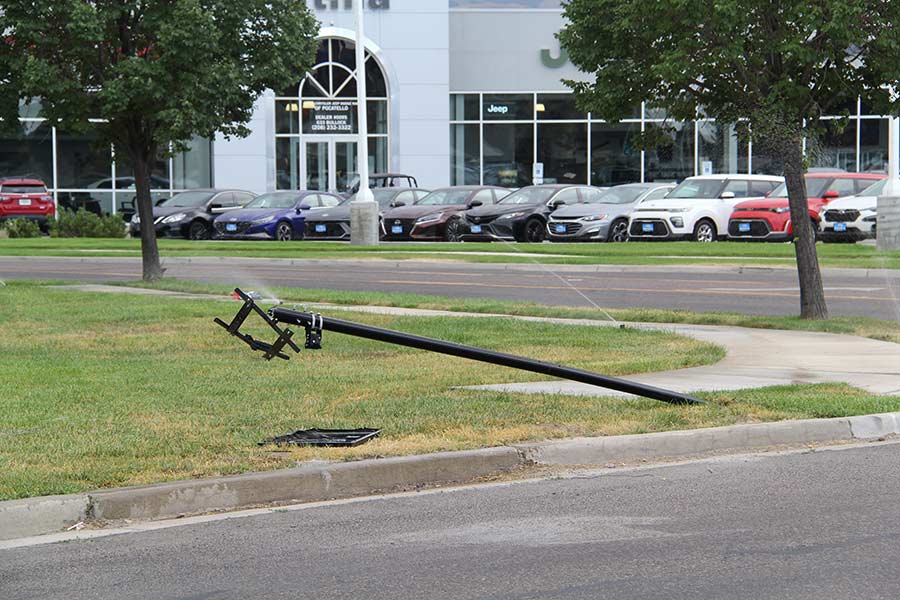
Police officers have made one arrest in connection with this incident. Allyn James Carter was charged on July 8 with one count of malicious injury to property and one count of failing to notify after striking fixtures. If found guilty, he could face up to five years in prison and/or a $1,000 fine for injury to property, and up to six months of jail time and/or a $1,000 fine for failure to notify.
According to the arrest report, Chubbuck police responded to the area on July 7 after a report came in at 11:53 p.m. that a Dodge Ram truck had run over two Flock cameras. Officers said they found Carter and his truck in the Costa Vida parking lot, which is about 190 yards away from where the second Flock camera was knocked over.
Officers said they interviewed two Lowe’s employees who told them they heard the truck hit the first camera.
“They said that they kept eyes on the Dodge Ram truck, where it parked at Texas Roadhouse for a brief time, and then (watched as it) deliberately hit the second Flock camera on the southwest entrance. Both witnesses kept visual of the truck until CPD arrived at Costa Vida,” the report states.
The report says that officers found Carter changing his tire. One officer said he believed the truck’s front bumper “had damage that could be consistent to hitting a pole.” Another officer said they recovered a piece of rubber near the second Flock camera, consistent with a missing piece of the truck’s tire.
Just because Carter has been accused of this crime doesn’t necessarily mean he committed it. Everyone is considered innocent until proven guilty in the eyes of the law.
According to Lacey, this wasn’t the first instance in which cameras have been damaged in the Pocatello area. There have been 14 other instances of camera vandalism since the cameras were installed, he said. It ranges from simply being moved out of place to damage to the wiring, with some cameras requiring full replacement.
But the only two cameras that have been fully knocked down are the two along Bullock Street.
This incident got a lot of attention two days later when a Facebook user posted photos of the knocked down cameras to the Life in Pocatello page. The post received around 3,700 reactions, 405 comments and was shared 85 times.
EastIdahoNews.com reviewed 70 of those comments and found that 44 of them expressed support for the action in some way, 12 showed their opposition, and 14 didn’t seem to take a stance either way.
When asked about this post, McKellar expressly stated that DeFlock Idaho does not condone vandalizing or destroying Flock cameras. “We don’t condone that. We don’t want to do that. We want to do this the right way,” he said.
However, McKellar said he does believe there are people out there who are angry enough to take similar action.
“I’m not one of them. We’re not condoning it,” McKellar said. “Neither is Tyler Cain. Neither is anybody else that’s officially part of our nonprofit, but there are people that are furious.”
Paulsen also does not condone the Flock cameras being knocked down, but said that it’s one example he’s seen of growing opposition to them. He also offered further explanation of why people seem to be turning on the camera system.
“It’s big brother. Even though (people) may not explicitly say that, that’s what the sentiment is,” Paulsen said. “People are really creeped out by that.”
Johnson expressed sympathy for the viewpoint of people opposed to mass surveillance, but he said that was why he thought the legislature did a good job of responding to those concerns.
“We’re all sympathetic to the surveillance worries, and so when the Legislature came up with 30 days (until files are deleted), I actually thought that they did a really good job trying to balance everyone’s concerns,” Johnson said.
Lacey addressed anyone who has thought or is thinking about taking their anger out on Flock cameras.
“You have to let the courts and/or city ordinances do their part,” he said. “If they want them to be removed or not used, then that’s something that can do it, but if you take it in your own hands to remove them, then unfortunately it could be a criminal charge.”
Both Paulsen and McKellar told EastIdahoNews.com that they see this opposition to Flock cameras as a unifying issue for Republicans and Democrats.
“The people I’ve talked to, from Republicans to Democrats to river hippies to Independents; everyone’s like: ‘Wait, what? I hate that,'” Paulsen said.
“Nobody likes these except for the people that are now going to get in trouble for putting them in place,” McKellar said.