



Meta turns on its $1.2B Idaho data center with promise of water efficiency
Published at
Mark Dee, Idaho Statesman
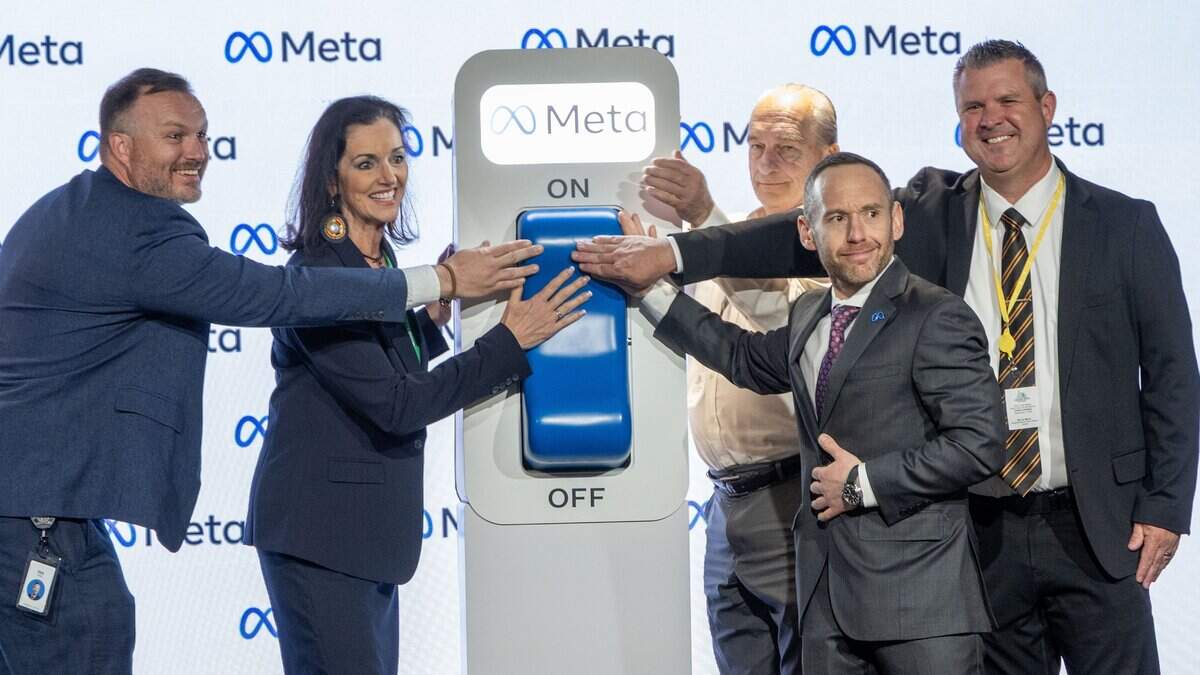
KUNA (Idaho Statesman) — Meta formally turned on its newest data center Thursday in Kuna with the flip of a giant blue switch — and a promise that its latest design will consume a fraction of the water typically associated with the massive processing hubs popping up nationwide to feed the artificial intelligence boom.
The parent company of Facebook, Instagram and WhatsApp capped its four-year, $1.2 billion build with a ceremony alongside Kuna officials and local educators, marking its 28th American data center and first in Idaho.
The 750,000-square-foot Kuna plant, though, is just the second to use a new “closed loop” cooling system to slough off the heat generated by the servers inside. The design, which functions like an enormous version of a car radiator, allows the complex to run without extra water for cooling for much of the year, according to Meta Director of Global Economic Development Brad Davis.
“You fill up the system one time, and it’s good for seven to 10 years,” Davis said.
The ribbon-cutting comes amid backlash against data centers. A May Gallup poll found that seven in 10 Americans would be opposed to seeing a data center constructed in their area. A greater percentage of respondents would rather have a nuclear power plant nearby than a server farm, according to Gallup data.
Much of the backlash stems from the resources such projects devour. A large data center using evaporation to cool its processors can consume up to 5 million gallons of water per day, according to the Environmental and Energy Study Institute, a climate advocacy nonprofit, though most reports suggest fewer.
Meta’s Kuna facility plans to use far less for most of its operation, according to Scott Stillings, a critical operations manager at the plant. After using about a million gallons to flush the system and get it online, Meta’s sealed cooling pipes carry around 200,000 gallons, he said — about a third of the water in an Olympic-sized swimming pool.
“The water that is used today to cool this facility is the same water that will be used tomorrow, and for the next 10 years,” Stillings said.
The actual lifespan of the cooling water depends on contamination. Davis said he did not know how much water the facility would require when it needs ancillary cooling, or how many days of the year that might be. It does, however, plan to start releasing that data in annual sustainability reports, he said.
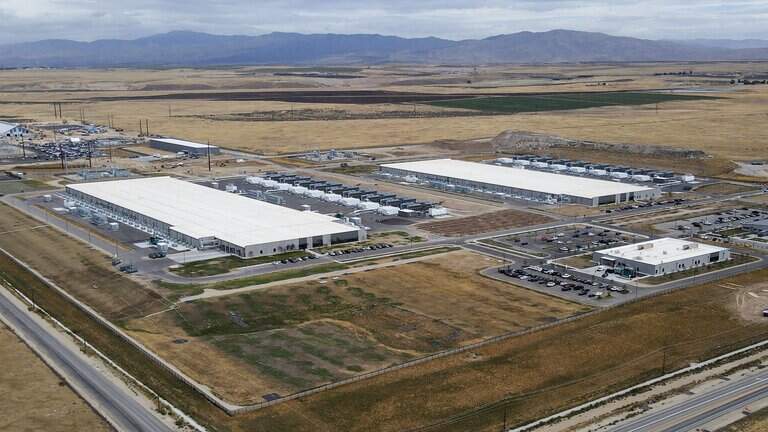
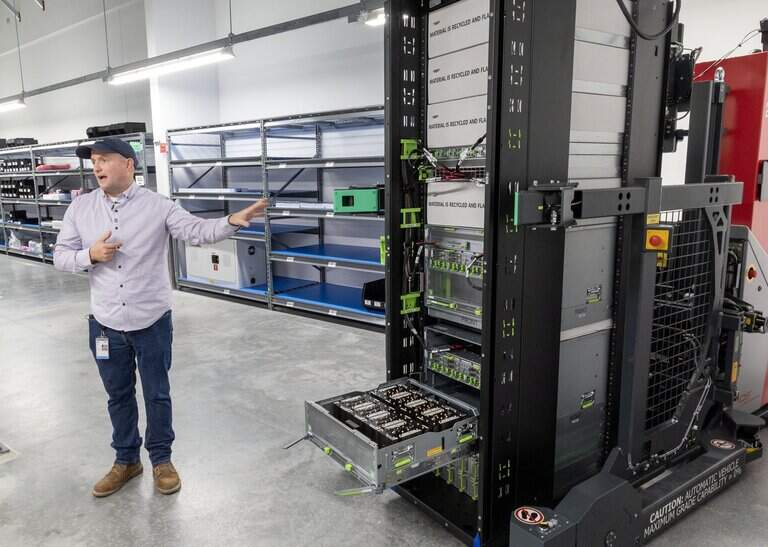
The inside of the two server warehouses at Cole and Kuna-Mora roads are warmer than your average office, running around 85 degrees Fahrenheit. They’re louder, too: Employees provided ear plugs to enter the server halls, where the fans at the back of each rack of computers drone like a jet engine at idle. Meta won’t disclose how many servers are inside the two buildings, but there must be tens of thousands arrayed on refrigerator-shaped racks about 8 feet tall. The buildings are large enough to eat up most of the sound trapped inside. They’re low — one high-ceilinged story — and can appear smaller than they are from outside.
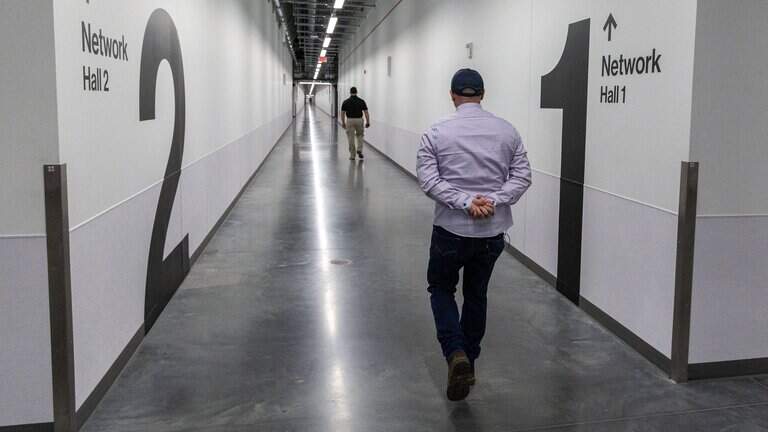
Inside, they appear endless. The largest building on campus is 350,000 square feet, the width of one football field and about three fields long, bisected by a single 900-foot hallway.
While Meta adorned communal areas with tech-culture flourishes — think foosball, local art and free snacks — the heart of the server farm is spartan. The floors are gray, the walls white. The computers themselves look little like a consumer desktop; for better cooling they’re not covered by a shell, so server rooms are all exposed green switches and flashing blue lights. When one is taken out of position, a cardboard box that looks fit for a deep dish pizza slots into its place.
Facades “might be pretty, but they serve no purpose,” Davis said. “We’re all about efficiency, no vanity.”
Set in the open fields of Kuna, with the closest industries gravel pits and rangeland, the data centers almost look like giant milking barns, if you ignore the coils of galvanized wire running to and fro.
The wires give away the location as you drive in. Meta worked extensively with Idaho Power to electrify the site, Davis said. The company is backing three solar projects that Meta expects to add 645 megawatts to the grid to offset the data center’s power consumption.
That figure is complicated to translate. Electricity production and consumption is measured in megawatt hours, not by what a source can put out at its peak capacity, and solar panels don’t generate power 24/7. Collectively, though, that topline figure of 645 megawatts is the equivalent to just about 17% of Idaho Power’s all-time record load demand, which came during a heatwave at 7 p.m. on July 22, 2024, according to company data. Per the terms of its deal with Idaho Power, Meta cannot pay to produce more than 110% of its energy requirements, since it can be paid back for power it adds to the grid but doesn’t use, Idaho Power spokesperson Sven Berg previously told the Idaho Statesman.
Under a contract with Idaho Power, Meta will pay to buy all of the electricity produced by the three new solar plants, plus a share of the systemwide costs of transmitting power to the data center, Berg said in July. The combined output is expected to “meet or exceed” the data center’s energy requirements, Berg said. Meta on Thursday once again stated that electricity for its data center’s electricity use will be “matched with 100% clean and renewable energy.”
Idaho law allows the utility to strike approved standalone deals with large energy users, and Idaho Power does not disclose how much power individual customers use, Berg told the Statesman.
Solar power is one piece of the infrastructure built to back the data center. The company also paid $100 million to build a new water and wastewater plant, which it has since transferred to Kuna, Davis said. The plant has capacity beyond what Meta might need “to help Kuna grow beyond us,” he told the Statesman. Meta also paid Kuna directly to add police and fire, and donated money to fund preschool and STEM education in the Kuna School District, according to the company.
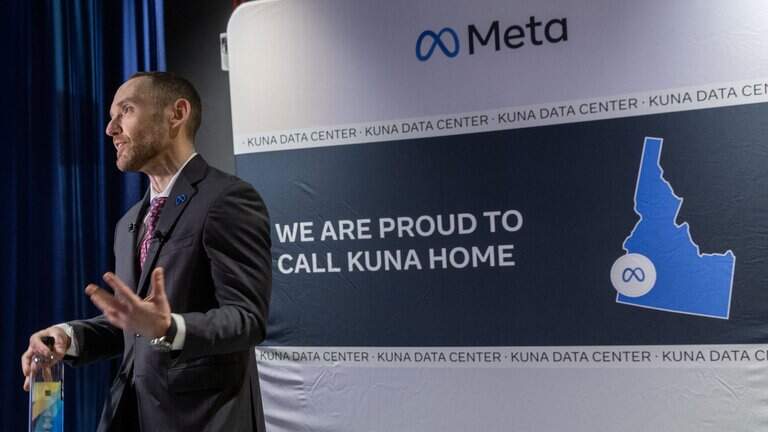
“To us, these are forever assets,” Davis said of the data center.
“This is a forever relationship,” he added.
The May Gallup poll found that just 7% of respondents were “strongly” in favor of a data center next door. If asked, Kuna Mayor Joe Stear would likely be one of them.
In 2022, Lisa Holland, the city’s economic development director, came into Stear’s office with news that Meta was considering Kuna.
“They want to do what?” he remembered saying. “In Kuna, we’ve never had a project anywhere near that scale,” he said Thursday. “When they came out, there was nothing here. They had to start from scratch, basically.”
At its peak, the project employed 1,600 tradesmen. Around 100 people will staff the data center full time once construction is done, Davis said. So far, 75 or so have been hired in jobs ranging from building maintenance and security, to cafeteria work, to engineering and system maintenance jobs.
In his speech at the ribbon-cutting, Stear gave Meta credit — and vice versa. The mayor’s hand helped flip the microwave-sized light switch that marked the facility “on.”
“Meta has done everything they said they’re going to do,” he said. “Sometimes, you get into these deals, and as they say, ‘If it sounds too good to be true, it probably is.’ In this case, I can say something that sounds too good to be true can really be true.”