




Idaho’s early voting numbers driven by ‘fired up’ electorate
Published at | Updated at
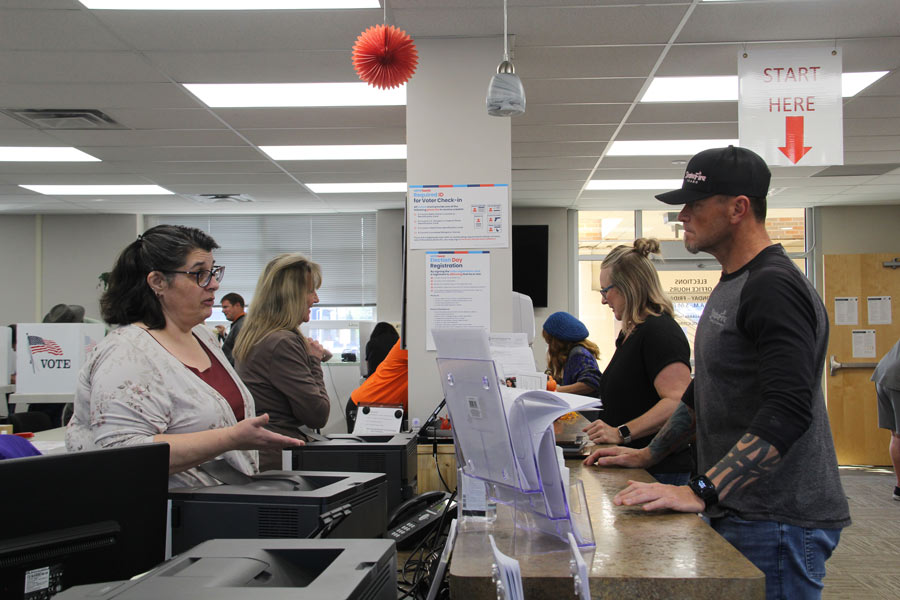
POCATELLO –- With just a week remaining until the general election, and three days left of early voting, well over an eighth of Idaho’s total electorate has already cast their ballots.
In fact, so many Idaho voters have turned in absentee ballots and voted early that on Wednesday, the amount of votes cast in the 2026 election exceeded the entirety of absentee and early voting in 2022, with two more days of early voting to go and tens of thousands of absentee ballots still to be received. Jeffrey Lyons, Ph.D., says that while the turnout doesn’t offer a clear indication of how people will vote, it does show the mood of the Idaho electorate.
“There’s a lot of folks who are fired up, and they’re showing up to vote — and past that, we end up kind of speculating a lot about who they are (or) why exactly they’re doing this,” said Lyons, an associate professor of political science at Boise State University.
How has Idaho historically voted?
Currently, the national electoral environment is favorable to Democrats, with VoteHub’s official forecast giving them a 60% chance of winning control of both the House of Representatives and the Senate.
But this might not make much of a difference in Idaho, as it’s one of the most consistently conservative states in the nation, with a long history of voting Republicans into office by wide margins.
The last time a Democrat won an election in Idaho’s 1st Congressional District for the House of Representatives was when Walt Minnick won in 2008, and before that, it was Larry LaRocco in 1992. In its 2nd Congressional District, the last Democrat to win was Richard Stallings in 1990, and before that, it was Ralph Harding in 1962.
The last time a Democrat was elected to represent Idaho in the Senate was in 1974 when Frank Church was re-elected to his fourth term. The last Democratic governor was Cecil Andrus, who was last re-elected in 1990.
And today, the Idaho Legislature is dominated by a Republican supermajority, with Democrats holding nine of 70 seats in the Idaho House of Representatives and six of 35 seats in the Idaho Senate.
And in recent years, Democrats in Idaho have commonly struggled to reach even 40% of the vote, said Jeffrey Lyons, an associate professor of political science at Boise State University.
“For the most part, Democrats are kind of stalling out,” Lyons said. “Like, mid to high 30s is pretty common.”
Early and absentee voting data for 2026 from the Idaho Secretary of State’s office reflect Idaho’s partisan divide, with registered Republican voters far outnumbering registered Democrats.
But Lyons also cautioned against reading too much into this, pointing out that some Democrats register as Republicans to vote in closed Republican primaries.
“It just kind of convolutes the whole picture of looking at registration data as a measure of party affiliation,” Lyons said.
What do the numbers show?
Regardless of party affiliation, Idahoans are voting early and by absentee ballot at rate far higher than they were in 2022, the last midterm election.
From the beginning of early voting, Bonneville County elections director Helena Welling said this year, “has been much better attended, from the get-go.” Bonneville County currently has the fourth most votes cast among Idaho’s counties.
For Julie Hancock, Bannock County elections director, this year’s general election has been “a little bit reminiscent of a presidential (election).” So far, Bannock County has the fifth most votes cast.
Election data for this article was taken from VoteIdaho.gov, the official website of the Idaho Secretary of State, along with raw data provided by the Secretary of State’s Office.
In 2022, 125,846 people voted by absentee ballot, while 61,727 voted early, for a total of 187,573 ballots cast before election day.
In 2026, 192,796 people have already voted, which is already over 5,000 more votes than in 2022. As of Wednesday, 94,297 people have voted early, and 98,499 have voted by absentee ballot.
There have been 156,738 absentee ballots issued, so there are 58,239 ballots yet to be returned. Around 63% of the ballots have been returned so far, and in 2024, 97% of them were returned in total.
And Hancock said the high turnout has kept both election workers and the equipment they use busy.
“We have replaced the toner in every single printer out there,” Hancock said.
What are the potential factors bringing people out to the polls?
The way Lyons sees it, there are a variety of factors bringing people out to the polls this year, including the cost of living, disapproval of President Donald Trump, the initiatives on the ballot and the presence of several active campaigns pushing their messaging out to the public.
But Lyons said that all of these reasons will not speak to every Idaho voter.
“There are going to be people for whom cost of living is the story. There are going to be people for whom the ballot initiative is the story,” Lyons said.
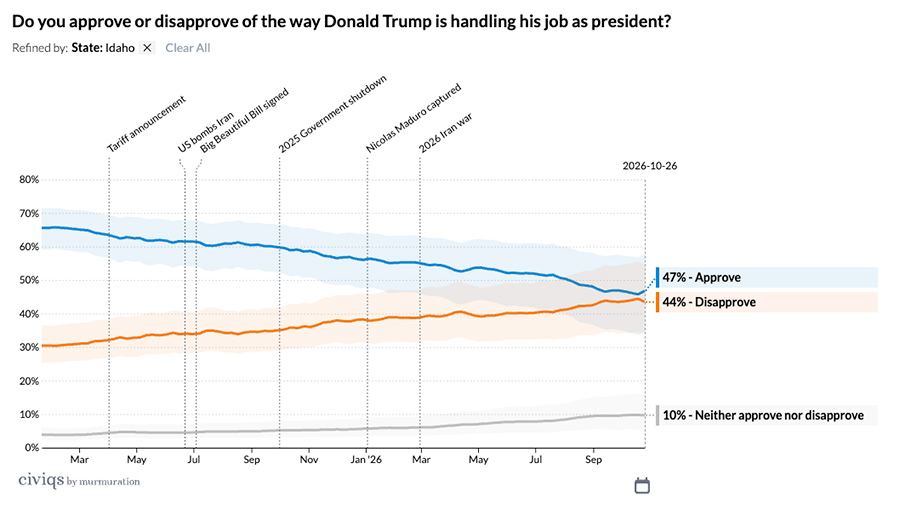
And while Idaho is one of only eight states where Trump still holds a net approval rating, according to polling data from the California-based polling firm Civiqs, Lyons still thinks the president could be one of the factors bringing people out.
“Generally speaking, my take on midterm elections is that it is largely a referendum on the president,” Lyons said.
According to Civiqs, Idahoans currently hold Trump at a 47% approval rate, with 43% disapproving and 10% neither approving or disapproving.
While he still holds a majority in the state, Trump’s approval rate has fallen in Idaho since he took office on Jan. 20, 2025.
At the beginning of his second term, Civiqs had Trump at a 66% approval rating in Idaho, meaning that the president’s approval rating has fallen by 19 points over the course of two years.
But it remains unclear if this will translate into any Democratic victories, or thinner margins of victory for Republicans than would be expected in a state like Idaho.
Like previous election years, registered Republicans still far outnumber Democrats. A total of 102,693 registered Republicans have voted in 2026, compared to 35,770 unaffiliated voters and 32,654 registered Democrats.
The Secretary of State’s office did not have the partisan makeup of absentee and early votes in 2022 for comparison, but early and absentee voting data shows a slight Democratic gain in the proportional share of Republicans and Democrats voting from 2024 to 2026.
In 2024, around 62.1% of early and absentee voters were registered Republicans, with 22.3% unaffiliated and 14.7% registered as Democrats. In 2026, the proportional share so far is 59.8% registered Republicans, 20.9% unaffiliated and 18.6% registered Democrats.
But Lyons makes it clear that voter registration doesn’t necessarily indicate how a person will vote.
“It’s hard to know what their beliefs are (based on voter registration),” Lyons said.
‘We sure need a change’ or more of the same?
What is clear from the data, Lyons said, is that voters’ emotions are high, and that may be the main factor driving turnout.
“Anger is something that really motivates people to participate. And so I think some of what you’re seeing here is more about emotion than it is about specific issues,” Lyons said.
Hancock also sees it as likely that it’s a combination of factors driving turnout.
“Maybe it’s a combination of all of those issues, what’s on the ballot, and cost of living, and groceries, and rent and interest rates and all that stuff. People are mad,” Hancock said.
But oddly, Hancock said she has noticed a little less “chatter” than normal.
“(With) the little bit of chatter that you hear out there, most of the time you hear a little bit more, but right now people are coming in, they’re getting their ballot, going to the booth, putting it in the can and leaving,” Hancock said.
But Hancock has heard some chatter from early voters.
“Some of the talk that there is, is, ‘We sure need a change. We sure need a change,’ and then they’ll say ‘There’s some important issues on the ballot.’ Whatever side of the aisle you’re on, there are important issues for both sides,” Hancock said.