



‘We feel betrayed,’ Pocatello residents speak out at Flock town hall
Published at
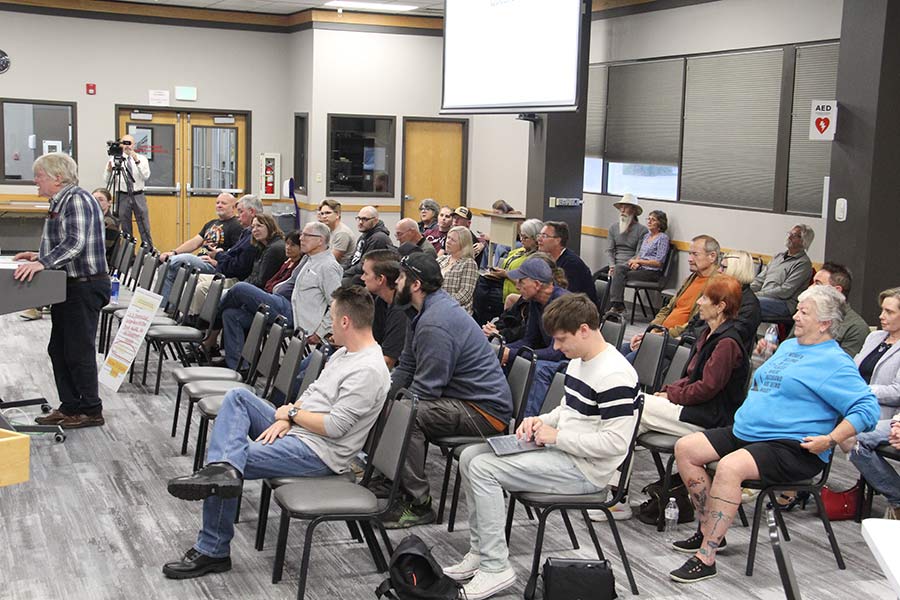
POCATELLO – A majority of speakers at an at–times contentious town hall meeting expressed opposition to a controversial technology that has made its way to eastern Idaho.
On Wednesday evening, the city of Pocatello held a town hall meeting on Flock cameras, attended by about 30 to 40 people. The meeting, which took on a heated tone at a few points, saw a majority of speakers express opposition to the cameras and fear of how they could be used in the future.
“Once these cameras are there, once the precedent is set that it’s okay to have them, what comes next?” asked Joyce Bybee, who introduced herself as a Pocatello resident and a Navy veteran.
Flock cameras, more officially known as ALPR cameras, first arrived in Pocatello in December 2024. The cameras are distributed by a company based in Atlanta, Georgia, called Flock Safety, and they function as license plate readers, recording vehicles as they pass through intersections.
During his opening presentation, Capt. Zac Bartschi of the Pocatello Police Department worked to correct misconceptions about what ALPR cameras do.

“These cameras are not facial recognition. They do not identify the driver. They do not track cell phones. They do not issue speeding tickets or red light citations. … They do not record conversations. They do not replace officer investigation or discretion, and they do not provide automatic probable cause,” Bartschi said.
Bartschi showed attendees a screenshot of the view a Flock camera has of the roadway, showing it’s not pointed at surrounding buildings. Bartschi didn’t specify which intersection this camera is pointed at, and it wasn’t clear from the picture, which only showed the roadway.
RELATED | Tort claim, vandalized cameras and eastern Idahoans up in arms about Flock cameras
Bartschi also specified that the data collected by Flock cameras is owned by the Pocatello Police Department and that the department conducts monthly audits of its officers’ use of the database.
When the city council authorized the use of Flock cameras, council members Dakota Bates, Ann Swanson and Stacy Satterfield were not on the council, and Mayor Mark Dahlquist hadn’t been elected yet.
The only council member who voted against authorization was Hayden Paulsen.
At one point during the town hall, Paulsen interjected.
“Is this a Flock sales pitch or is this a town hall? No, for real. I’m genuinely asking,” Paulsen said.
This followed comments from Stephen Adams, who raised the point that using Flock cameras could be unconstitutional, citing a case in Oklahoma. According to the Maryland Daily Record, a federal judge ruled in early August that police search of ALPR cameras amounted to “indiscriminate mass surveillance.”
After Adams’ comments, Bartschi said that Pocatello is within the United States Court of Appeals for the Ninth Circuit and is subject to Ninth Circuit court case law.
In response to Paulsen, Bartschi said, “I’m here to answer questions. He brought up that there was case law in reference to Oklahoma, and I was mentioning that we’re the Ninth Circuit in Idaho.”
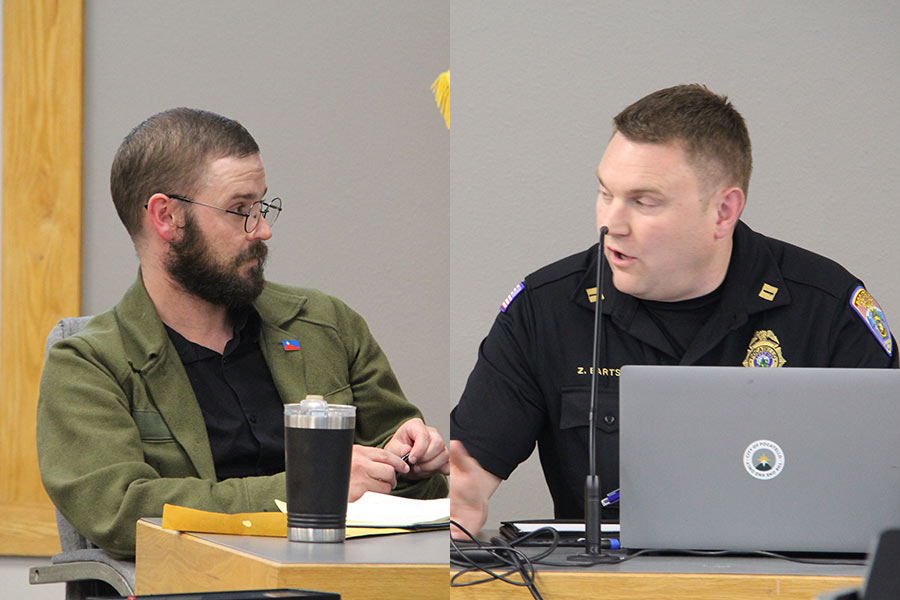
Dahlquist weighed in and said that, “I do think it was an appropriate rebuttal.”
“I don’t want there to be any kind of misunderstanding that the city of Pocatello is breaking federal law or state law,” Dahlquist said.
During public comment, around 14 people spoke in opposition to the cameras, while two signaled support and five were not clearly on either side.
In reference to the people speaking in opposition, Paulsen didn’t feel they were clearly from either side of the political aisle. And he said that wasn’t the case at his September town hall on Flock cameras either.
“We had DSA, we had milquetoast Democrats, we had MAGA, we had old-school don’t tread on me conservatives. We had literally the entire spectrum of ideology, so I’m not going to peg anyone there onto a specific ideology,” Paulsen told EastIdahoNews.com after the meeting.
The first speaker, David Nelson, said he was supportive of Flock cameras. He referenced how he was hit by a vehicle while riding his bicycle on Main Street, and said that it would’ve been nice to have ALPR cameras assisting officers in finding the driver.
“I think a camera system would have been nice to have,” Nelson said.
Another speaker, Dave Turnmeyer, said he was “supportive in general” of the cameras, but “with some caveats.” He said that he was supportive of the audits, but requested that the city council establish rules for the department to follow.
“It takes a little bit more effort to change policy at the city council level than it does at the local police department level,” Turnmeyer said.
But during her remarks, Meyer raised a point that had more to do with Flock Safety than with the police department, asking who, if anyone, is auditing Flock’s use of the data it collects.
“When it comes to what happens with the data that’s collected and what exact data is collected, you have no way of knowing if Flock’s telling the truth,” Meyer said.
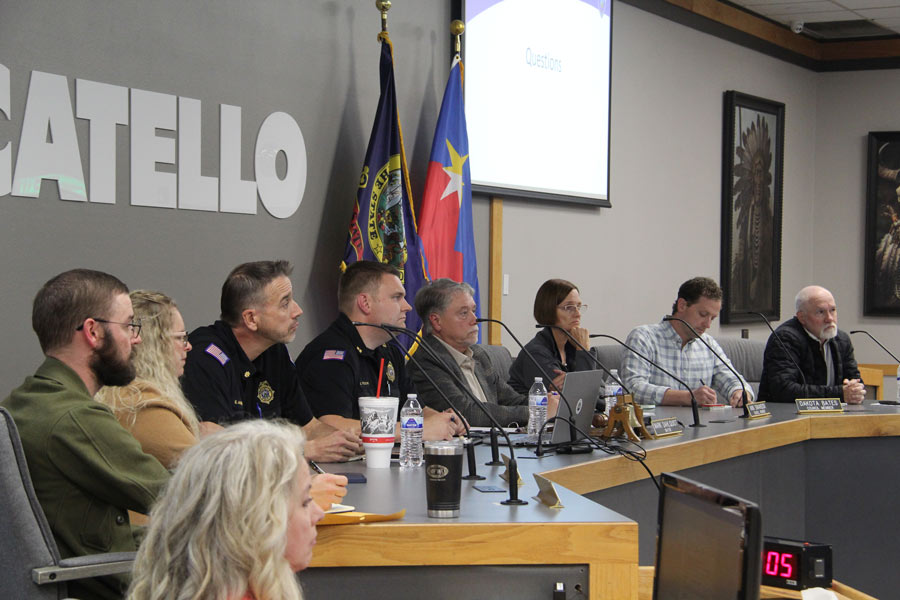
Major Eric Anderson handled this point, saying that he didn’t have an answer to that. This prompted a question from an audience member.
“That’s not a question we ask them in a meeting?” the audience member said.
“What’s that?” Anderson asked.
“That’s not a question we ask them in a meeting, is who’s auditing you? We’re just following them blindly,” the audience member said.
“I don’t want to say that. I have not asked them who’s auditing them,” Anderson said.
After some more back-and-forth, Dahlquist ended the exchange.
“We’re taking this in, and sure, we’re not perfect,” Dahlquist said.
In response, Pocatello resident Trent Hess, who was sitting in the audience, said, “I appreciate your candor in admitting that. I mean that.”
After that, Hess took the stand to share his comments. He and a number of other speakers also expressed fear about how the technology could be used in the future, arguing that following proper procedures now doesn’t mean they will always be followed.
“What problems do you see if your political enemies were tyrannical and had this?” Hess asked.
After the meeting, Paulsen spoke with several attendees and took down their information if they wanted to volunteer to assist with his upcoming ballot initiative to ban Flock cameras in the city.
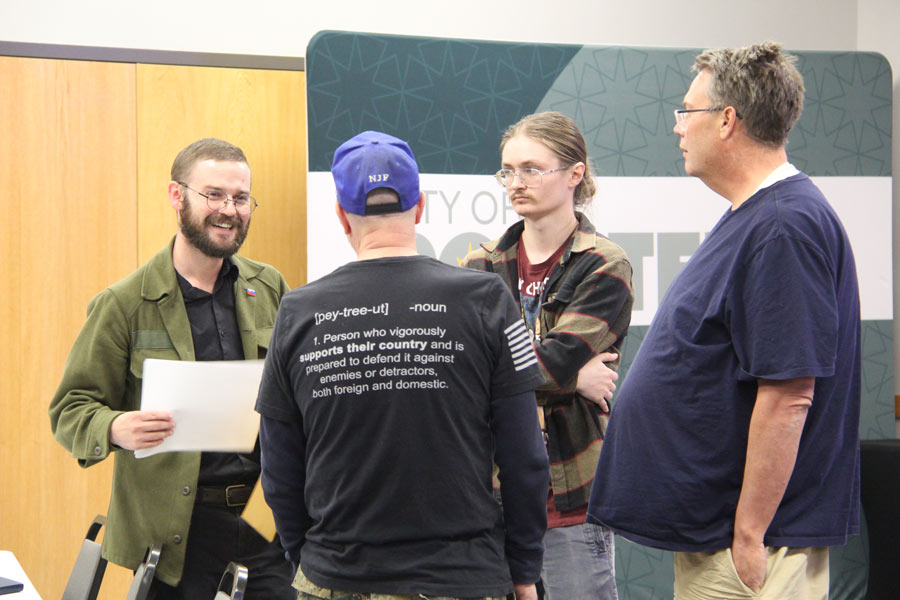
Paulsen said he won’t be able to gather new signatures until the initiative is authorized, which will take roughly 1.5 weeks. But currently, he has 41 signatures from the first batch and has collected information from around 30 people who may volunteer for the effort.
To get the initiative before the Pocatello City Council for a vote, and then on the 2027 election ballot if council members vote to keep the cameras, Paulsen has to gather roughly 2,500 signatures. But he is aiming to hit at least 3,000 to allow for a margin of error when signatures are validated.
And in the long run, Paulsen hopeses that the opposition he’s seen to Flock cameras translates to a more broad opposition to mass surveillance in general.
“Everywhere across the country, from Flock to data centers, it’s not anti-technology; it’s anti-surveillance and anti-manipulation. We just want a fair shake and not be constantly surveilled,” Paulsen said.