



First of it’s kind, INL receives $7 million grant to test next-generation nuclear fuel
Published at
IDAHO FALLS — U.S. Department of Energy’s Advanced Research Projects Agency-Energy program announced early Monday morning that the Idaho National Laboratory will be awarded $7 million to test chloride fuel salt for future use in molten salt reactors.
A molten salt reactor is an advanced nuclear reactor, according to the INL, which uses low-pressure, high-temperature fluoride or chloride salts as liquid fuels and coolants. A 2023 U.S. Department of Energy presentation indicates that molten salt reactors offer a number of possible advantages over traditional reactors, including better safety, lower-cost components and more efficient energy generation.
ARPA-E’s High-performance Optimized Recycled Nuclear Isotopes for Gen IV Reactors is a $50 million investment for eight projects that aim to advance the development of next-generation nuclear fuels, according to ARPA-E’s website.
INL was one of the eight projects selected and was awarded $7 million to fund the Irradiation of Molten Plutonium Actinide Chloride Fuels and Testing, also known as IMPACT. The goal of this project would be to test chloride fuel salts containing recycled transuranic elements in molten salt reactors.
INL Industrial Relationship Manager Toni Karlsson said the project will start in 2027 and last three years, with a potential extension after 2030.
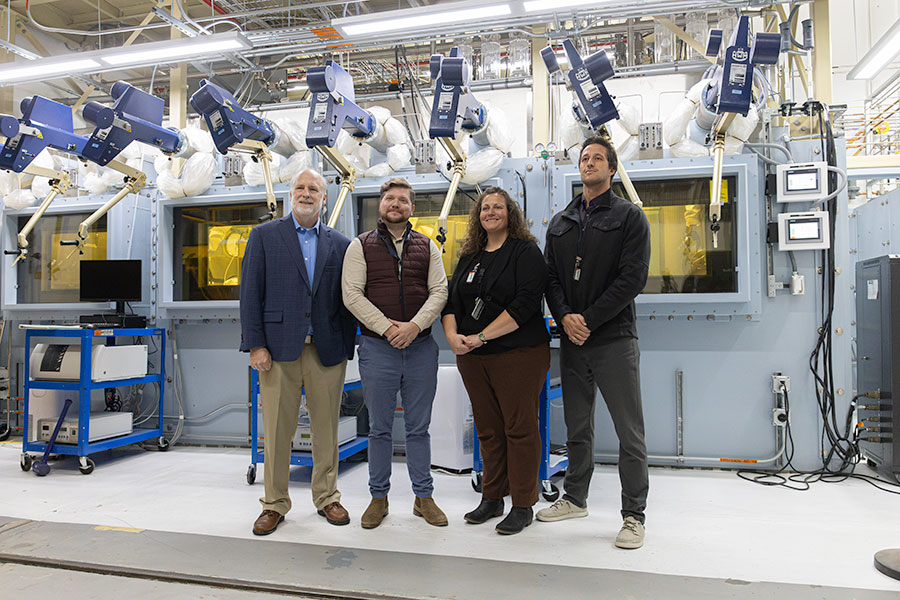
IMPACT will be tested at INL’s Materials & Fuels Complex at the MSTEC facility. MSTEC stands for Molten Salt Thermophysical Examination Capability. This project aims to determine how chloride salt performs in a radiation environment and help develop an understanding for future reactor development.
“That’ll be the first time any such experiment has been done,” Jess C. Gehin, Associate Laboratory Director, Nuclear Science and Technology, said.
Gehin said this type of technology, both reactor and fuel, is still in its infancy, but both have high potential to produce up to 100 times more energy.
“That’s why National Laboratory and DOE are funding research and development,” Gehin said.
INL Industrial Relationship Manager Toni Karlsson said the new facility can fabricate transuranic-based fuel in a much smaller footprint. As the experiments are ongoing within the hot cell boxes, researchers at INL can manipulate them with either the robotic arms or with their own hands in specialized gloveboxes.
With about 15 people helping on the project, Karlsson said that once work starts and the group understands the properties, that data will be fed into different models of advanced test reactors.
Experiment Manager Matthew Arrowood said the project aims to see how the salt looks before, during and after it has spent time in a reactor to see whether it’s meeting the temperature, burnup and safety requirements.
Nuclear reactor experiment design engineer Calvin Downey said they aim to ensure that the data obtained from MSTEC is as useful as possible for their industry partners.
Other partners on the project include Argonne National Laboratory, Moltex Energy USA LLC and Southern Company.
Gehin said that with INL, the other national laboratories, the Department of Energy and the U.S. Government are there to help enable the commercial development of nuclear energy.
“The whole reason these labs are in place is to help industry get past what they cannot do. And so, INL and the other national labs are perfectly situated to handle these types of nuclear materials where industry cannot,” Karlsson said.