



Designing for the short season: Creating year-round appeal
Published at
Editor’s note: In this series on the principles of landscape design, we will be focusing on correcting common design flaws, while accounting for East Idaho’s climate. Each week until February, we will take a detailed look at a couple of principles and how you can apply them to your property, elevating its aesthetic.
In many parts of eastern Idaho, we look at our landscapes longer in winter than in summer. A garden without structure can feel flat and lifeless for nearly half of the year. When a garden is designed with winter in mind, it can improve the curb appeal and create visual order when the plants are dormant. The two design principles rhythm and emphasis can make all the difference.
Rhythm
Rhythm in the landscape is created by repeating elements that lead the eye through space. In summer, flowers and foliage do this naturally. In winter, repetition must come from the structure. In practice this looks like repeating one distinct form or texture that contrasts with another form or texture in the garden bed.
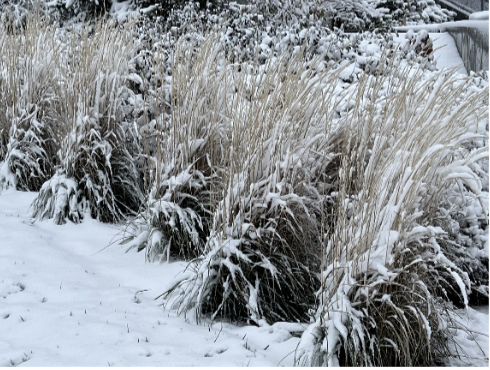
Vertical elements also add rhythm and prevent the winter garden from feeling flat and one dimensional. Decorative trellises, brick fences, or upright ornamental grasses like ‘Karl Foerester’ feather reed grass maintain their form through winter and catch light snow. These upright shapes guide the eye and add dimension to the space.
Emphasis
While rhythm guides the eye through the landscape, emphasis gives it a place to land. Colorful foliage can also emphasize and add winter appeal. Perennials like Yarrow (Achillea) overwinter with a low lying rosette. Other plants like English lavender and thyme can hold their foliage late in the season also. A focal point draws attention when color and texture are limited during the winter months.
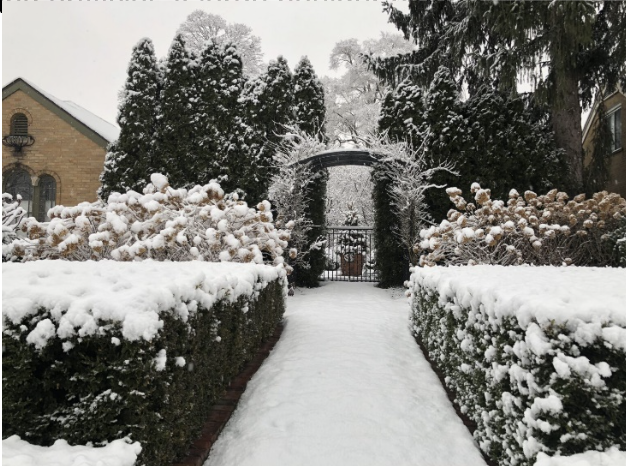
Winter hardy focal points can be both natural and artificial. A large boulder placed Figure 2 Pathway Emphasizing winter hardy focal points and foliage with snow caught on the leaves, Photo Credit Deborah
Silver
Figure 2 Pathway Emphasizing winter hardy focal points and foliage with snow caught on the leaves, Photo Credit Deborah Silver
Design Your Garden for All Seasons
A winter-ready garden doesn’t require a complete redesign. Start small by adding evergreen elements to one area or identifying a single focal point that works year round. Leave ornamental grasses standing until spring and think about how your garden looks when flowers are gone.
When rhythm and emphasis are part of your design, your garden no longer shuts down after summer. Instead, it becomes a landscape that offers structure, beauty, and interest in every season even in the quiet months of winter.