



Idaho struggles to recruit doctors, provide adequate care due to abortion law, doctors say
Published at
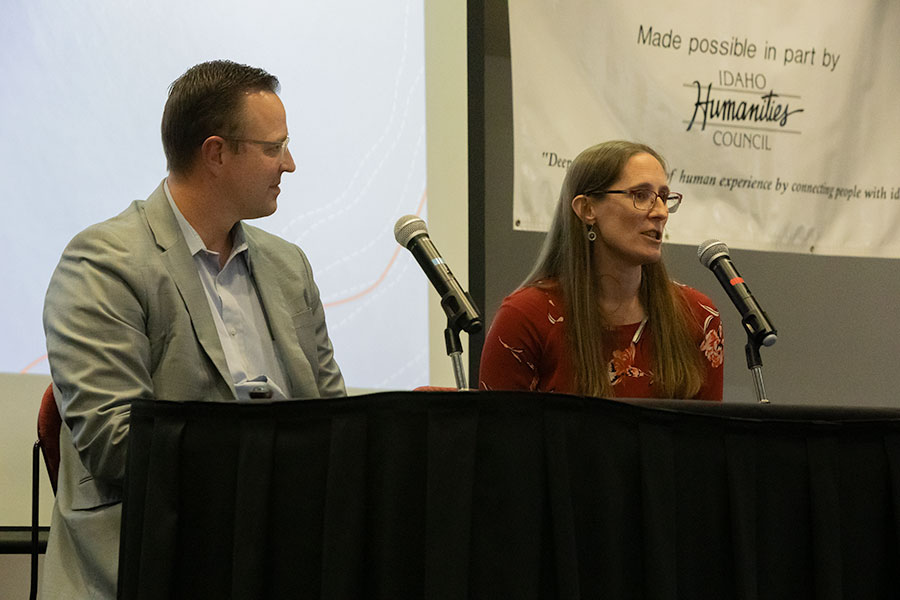
IDAHO FALLS — The health care landscape in Idaho looks vastly different from what it was four years ago, some Idaho medical professionals say. And they attribute the changes to the state’s near-total ban on abortions.
Bingham Health Care CEO Jake Erickson and Dr. Heather Pugmire, an OB-GYN practicing in Bingham Memorial Hospital in Blackfoot, were at the Idaho Falls City Club Thursday afternoon to discuss the issues they and other medical professionals now face since the controversial “trigger law” took effect.
The law, dubbed The Defense of Life Act, was passed by the state Legislature in 2020 and took effect in the months after the U.S. Supreme Court overturned Roe v. Wade.
Among Erickson’s and Pugmire’s main concerns is the state’s inability to retain and recruit doctors — particularly OB-GYNs.
Hemorrhaging physicians
Before 2022, Erickson said OB-GYNs were often easy to recruit and hire; his hospital in Blackfoot regularly had three to four full-time OB-GYNs, he said. Now the hospital is short two full-time physicians, and has been for a while. It regularly flies in three OB-GYNs to assist Pugmire with obstetric services to ensure community members have access to care.
But it’s not just a shortage of OB-GYNs they’re seeing; Idaho is dealing with an overall shortage of health care professionals. Erickson said there is a need to add 1,400 new medical professionals at the current population rate for the Gem State.
Looking at OB-GYNs, the need is at least 275 statewide. Right now, there 201 — and Erickson said the number is not rising.
Meanwhile, Pugmire says an active effort by out-of-state companies to entice Idaho physicians has made retention difficult. She said she often gets emails and texts from out-of-state recruiters with wording that highlights a purported “protection” from legislative processes.
Pugmire is also a teacher for four different medical schools that send students to Blackfoot to learn about obstetric services. She says school administrators have told her that abortion laws are now a deciding factor on where students decide to pursue medicine.
“They’re putting Idaho and Texas at the bottom (of their list),” Pugmire said.
And it’s not just Bingham Healthcare struggling to hire, but statewide. Erickson said that since Idaho’s abortion law took effect, he knows of five hospitals that have closed their labor and delivery services. These include cities in Sandpoint, Emmett and Caldwell.
The Idaho Capital Sun, reports a higher number, saying 14 rural hospitals in Idaho stopped their labor and delivery services in 2025. Sixteen rural hospitals are still offering these services, the outlet says, and account for 53% of all rural hospitals statewide.
Erickson added that there are “about eight to 10 more hospitals” he is aware of that are nearing a halt of labor and delivery services.
“Now, in over 50% of the counties in Idaho, you cannot deliver a baby,” he said. “So there’s more counties in Idaho where you can’t deliver a baby in the local hospital than where you can.”
Politcs of the abortion argument
While Erickson said his personal beliefs lean anti-abortion, he knows there are some situations beyond the control of the mother and her doctor in which an abortion is the likely best option.
“Right now, it’s you flip a coin (in deciding) whether or not you want to take care of that or intercede, because the fact is you’re worried about going to jail and losing your license,” he said.
Since 2022, a law has been enacted allowing family members of individuals who get an abortion to receive up to $20,000 in damages in lawsuits filed against the doctor who performed that abortion.
“I know that the way I practice doesn’t cross the lines of this law, but there are so many holes in it that the uncle of the lady I’m taking care of can come and sue me for that, and he doesn’t have a clue as to what actually was going on,” Pugmire said.
When it comes to her profession, Pugmire says just because she can perform an abortion doesn’t mean that’s what she’s doing.
“We want doctors to be able to practice how they’re trained — some people feel like that means that I was trained to do abortions all the time,” Pugmire said. “I do know how to do them, but I specifically came to Idaho because the culture here was that we didn’t routinely do abortions if someone just didn’t want a pregnancy.”
She said Idaho law has also affected the way she and her colleagues treat pregnancies where the baby develops ectopically or has a lethal anomaly that results in its death.
She says there are many women who opt to continue these types of pregnancies, and her role as the physician is to monitor the pregnancy and ensure the mother does well. However, there are times when ending the pregnancy would be a benefit to the mother, but Idaho’s law prevents that type of treatment.
“I could help them through that traumatic experience in their community, at the hospital they had instruments at, with their support team from their family,” Pugmire said. “I can’t do that now.”
When she met with the hospital’s lawyers, Pugmire said she was told to stop doing “that” unless you want to go to jail.
Pugmire said when she met with women who had unwanted pregnancies, there were other options presented that would help them avoid abortion. While some chose to end the pregnancy, she wasn’t starting the discussion with abortion.
However, she said with the laws that are now in place, “we are telling Idahoans that they can’t trust their physicians.”
“That’s the problem. Abortion wasn’t the problem to me. We weren’t doing abortions,” Pugmire said. “They had to go somewhere else anyway, but yet we would still help them with the mental health things,”
Meeting with lawmakers
Over the past two months, Erickson said he has met with 28 legislators in east Idaho to discuss the need for something to change.
Possible changes could mirror Utah’s abortion law, he suggested. “Health of the mother, rape and incest … are the three exceptions that they give in Utah,” Erickson said.
Currently, Idaho law prevents abortions from taking place in all three of those circumstances.
However, in speaking with legislators about abortion law reform, Pugmire said it baffled them to learn that she doesn’t want to perform abortions and isn’t being paid to promote that type of procedure.
“On the other hand, they say, ‘Well, we can’t talk to you because you’re biased,’” Pugmire said. “Yet they don’t didn’t understand that that’s not how we were practicing.”