



‘Joseph Smith Jr. was Lincoln before Lincoln’: Prophet honored in Martin Luther King Jr. International Chapel
Published at | Updated at
Alexa McFadden, ABC4
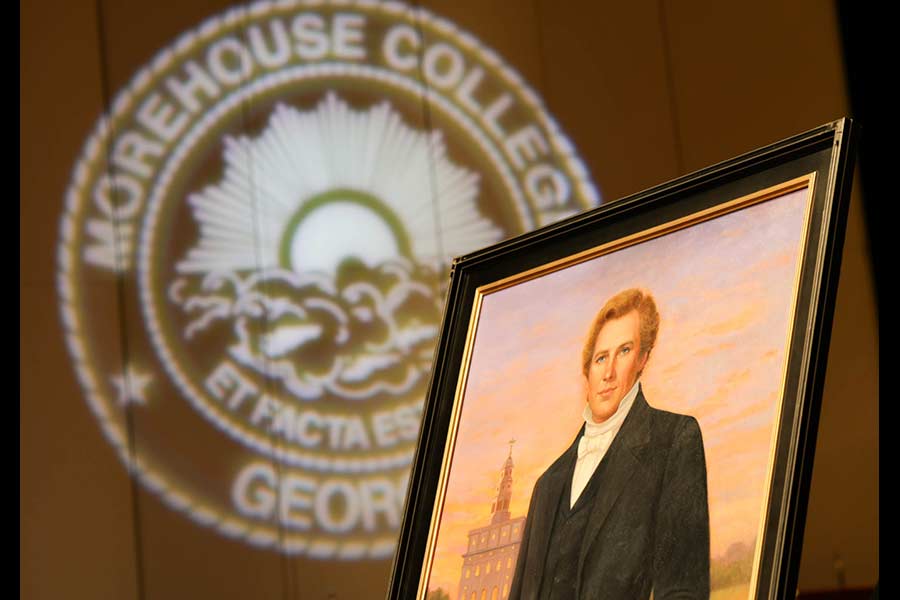
ATLANTA, Georgia (ABC4) – A portrait of the Church of Jesus Christ of Latter-day Saints Prophet Joseph Smith was added to the International Hall of Honor in Morehouse College’s Martin Luther King Jr. International Chapel.
On Feb. 1, the hall, which holds more than 300 oil portraits of global leaders of the international civil and human rights movement, included a portrait of the first prophet and president of The Church of Jesus Christ of Latter-day Saints.
A portrait of previous prophet, President Russell M. Nelson, was added to the hall in 2023. The portrait of Smith will hang between President Nelson and Abraham Lincoln.
Dreams of social justice
Joseph Smith advocated for basic rights for everyone during his presidential run in 1844. Rev. Dr. Lawrence Edward Carter Sr., dean of the Martin Luther King Jr. International Chapel, claimed Smith’s plan to abolish slavery was, “among the most morally ambitious proposals of the antebellum era.” Additionally, Carter called the Prophet’s actions “moral courage” and noted it was a “death warrant.”
“He knew what he was doing. It didn’t stop him,” the Carter said. “Think of the implications. If he had won, look at all of the lives that would have been saved that were lost in the Civil War.”
Carter continues by saying, “We were not ready, as Lincoln said, to be guided by our better angels, to do what Christ said we should do. Joseph Smith Jr. was Lincoln before Lincoln.”
In Smith’s campaign pamphlet, he said when people “petitioned to abolish slavery in the slave states, I would use all honorable means to have their prayers granted and give liberty to the captive.”
Church Historian Spencer McBride explained while the Prophet’s presidential campaign was unlikely, his platform was a “wonderful exposition” of problem-solving at that time.
Although the Prophet’s dreams of social justice were not achieved then, Carter said, “it endures as a prophetic witness to what America might have been — a testament to the belief that freedom is not merely a political achievement, but a sacred obligation, owed to every human being fashioned in the image of God.”
‘Sunset on Nauvoo’
The portrait of the Prophet is titled “Sunset on Nauvoo.” Reflecting on Smith’s legacy, artist Connie Lynn Reilly shows Smith standing in front of the Nauvoo Temple and holding a copy of the Book of Mormon. An Illinois flower, Jacob’s Ladder, is shown in the foreground to the right of Smith.
Explaining the purpose of the flower, Reilly stated, “The sacred flowers are symbolic of our progression and going rung by rung to the very top as we go through and make sacred covenants.”
Craig Ballard, a third great-grandnephew of the Prophet and chairman of the Joseph Smith Sr. and Lucy Mack Smith Family Foundation and Association, celebrated his family pride by saying, “The fact that Morehouse College wanted to and was excited about having a portrait of the Prophet is really meaningful to us. I think on the other side of the veil there are a lot of smiles tonight. The painting was beautiful.”
Black Latter-day Saints celebrate new portrait
William Kennedy, one of the Black Latter-day Saints to witness the portrait’s unveiling, said the Prophet’s inclusive teachings should be remembered. Kennedy observes, “Joseph Smith talks about every kindred, tongue and people to be taught the gospel. Unfortunately, it took a little bit longer than expected, but I think it’s still something that we should celebrate as Black Latter-day Saints — that we’re pressing forward. That’s what matters.”
Atlanta resident Cassie VanDyke describes how difficult it is for her son to reconcile his identity as both a Black man and a Latter-day Saint and hopes the portraits in the hall will help him feel more comfortable as he attends school at Morehouse.
She explains, “For him to have that opportunity here to see someone that represents who he is, to see he can be a college student at Morehouse and an active member of The Church of Jesus Christ of Latter-day Saints — that is everything. I’m excited for him. I’m also, as a mother, extremely grateful.”
When questioned about why Joseph Smith was the historical figure chosen, Carter replied, “I think he deserves to be lifted up, and I feel him calling me to lift the veil. And that’s what I intend to do.”
Kennedy is enthusiastic that Sunday’s event can help remind people to not stay focused on the past, but look to the future. He said, “What we can do as members of the Church is seek after those that don’t look like us, that don’t share the same faith, and seek after those that we can find common ground and become true peacemakers.”
Carter reflects the same message by saying, “We have got to think about everybody’s humanity, irrespective of our nationality, our race, ethnicity, culture, economics — all the things that labels we use to divide ourselves,” he said. “We have got to think holistically, comprehensively, inclusively.”