



Little pitches Idaho to lead America’s nuclear future. Critics fear a ‘waste dump’
Published at
Mark Dee, Idaho Statesman
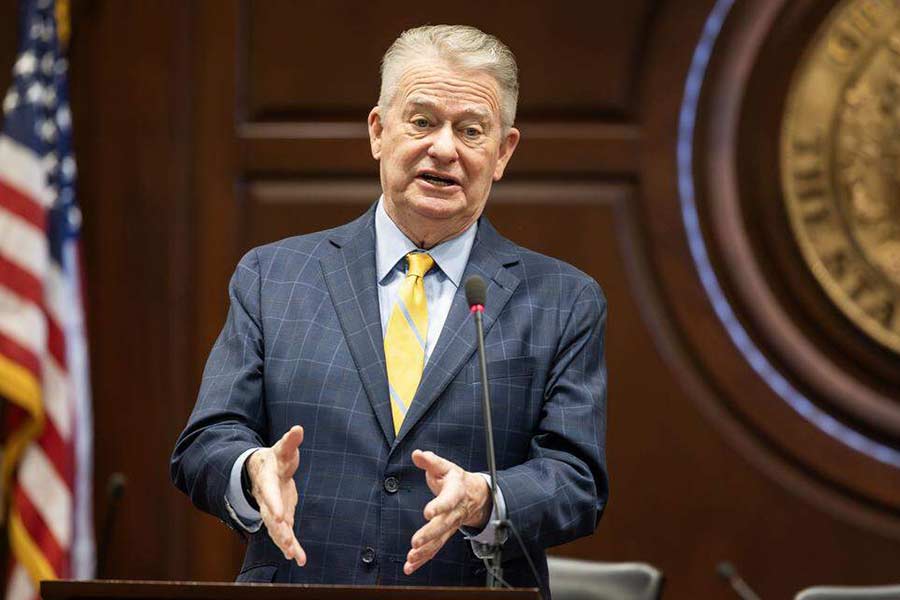
IDAHO FALLS (Idaho Statesman) – Idaho played a key part in America’s atomic history. Now, Gov. Brad Little hopes to see his state take the lead in its nuclear future.
In late March, Little and his staff pitched Idaho as a candidate to host a national nuclear hub for the Department of Energy — a move that would bring more money, jobs and, critics fear, radioactive waste to the state’s rural center.
“For us, it’s the next step in really demonstrating that we’re a great place for the nuclear industry to expand,” Cally Younger, administrator of the Idaho Governor’s Office of Energy and Mineral Resources, told the Idaho Statesman. “It’s all about bringing that business here.”
The directive, Younger said, stems from the state’s Advanced Nuclear Energy Task Force, which Little formed last year to “usher in President Donald Trump’s Nuclear Renaissance,” strategizing and spurring nuclear development in Idaho.
At the center of that discussion is the Idaho National Laboratory, a Department of Energy research mecca in the high desert west of Idaho Falls. Nuclear energy has deep roots in that part of the state: Arco, Idaho, was the first town lit by atomic power in 1955. Today, the compound spans 900 square miles in Butte County, roughly twice the size of Los Angeles. Research at “the Site,” as locals call it, remains on the cutting edge of its field, hosting government scientists and private companies working on nuclear energy.
On Wednesday, Younger said that she had not heard whether Idaho had been shortlisted for consideration.
From here, though, expect things to move fast: The federal government wants to launch its Nuclear Lifecycle Innovation Campus in 2027, according to a letter from Little to Secretary of Energy Chris Wright.
“The State of Idaho is committed to working in close partnership with the U.S. Department of Energy to propel the Nuclear Lifecycle Innovation Campus concept from vision to reality,” Little wrote. “With unparalleled nuclear tools and deep-rooted mission alignment, Idaho is equipped to meet the challenges of nuclear leadership with determination and excellence.”
“Together,” he added, “we can cement the United States’ position as the global leader in nuclear energy.”
Idaho National Laboratory key to nuclear pitch
Details around the prospective Nuclear Lifecycle Innovation Campus are scant and depend on what applicant states propose, according to the Department of Energy’s request for information. The idea is to foster “voluntary Federal-State partnerships designed to advance regional economic growth, enhance national energy security, and build a coherent, end-to-end nuclear energy strategy for the country,” the Department of Energy said in its request.
“Unleashing the next American nuclear renaissance will drive innovation, fuel economic growth, and create good-paying American jobs while delivering the affordable, reliable and secure energy America needs to power its future,” U.S. Energy Secretary Chris Wright said in a statement accompanying the request. “Nuclear Lifecycle Innovation Campuses give us the opportunity to work directly with states on regional priorities that support President Trump’s vision to revitalize America’s nuclear base.”
The campuses could “support activities across the full nuclear fuel lifecycle,” according to the Department, from making and enriching material, to “reprocessing” it for other uses, to, finally, disposing it on site.
That last piece has been a bright line in Idaho since 1995, when then-Gov. Phil Batt negotiated a unique deal with the Department of Energy to keep the state from becoming a de facto dumping ground for nuclear waste.
The 1995 Settlement Agreement remains a “critical tool,” giving Idaho leverage to determine what projects — and radioactive material — enter the state, Younger said. It also requires that byproduct to leave at some point.
The state’s response to the Department of Energy suggests that Little is open to revisiting that deal in exchange for “significant financial consideration” and “reaffirmations of DOE’s commitment to human safety, environmental protection, and regulatory rigor.”
“Future modifications will be discussed when relevant and appropriate,” the document states.
Little has already approved waivers to the agreement for “really good projects,” Younger said. A year ago, for example, he allowed a cask of spent fuel from Virginia into Idaho for research. If Idaho is tapped for the new campus more would likely follow.
Little’s vision for the project would bring in more private ventures and investment to the site, rather than building more government infrastructure, Younger said.
“We’re going to see commercial fuel generated for commercial use,” Younger said.
The INL “is a natural fit for a lot of these projects,” Younger said, with the workforce, infrastructure and security necessary to attract nuclear enterprise. It also has name recognition and a long track record, which Little’s application states gives Idaho a level of comfort with atomic energy rare in other parts of the country.
Securing the future or ‘selling Idaho out’?
The INL also sits on a porous bed of basalt over the Eastern Snake River Plain Aquifer, an underground reservoir about the size of Lake Erie. Its water is one of Idaho’s most precious natural resources and a major engine of the state’s $44.5 billion agricultural economy. The risk of contaminating the aquifer is a long and sincerely held fear among critics like Leigh Ford, executive director of the Snake River Alliance, a nuclear watchdog.
“Without the aquifer, life wouldn’t be possible for us here,” Ford said. “Any amount of nuclear waste is inappropriate for Idaho, and it makes no sense at the INL. … That water is precious, and we need to keep it safe for future generations.”
Younger says that the state has “stood firm” against landfilling nuclear waste indefinitely.
“We have been very clear that Idaho, particularly at the Idaho National Laboratory, is not an appropriate place for permanent disposal of waste,” Younger told the Statesman.
The state’s proposal to the Department of Energy echoes that point, citing the 1995 Settlement Agreement.
It does contemplate building “long-term storage” options while nuclear recycling and repurposing operations gain footing nearby. It also says that Idaho is “possibly” open to deep borehole storage “in exchange for significant financial consideration.” That involves drilling a corridor for waste two-to-three miles underground into dense rock and capping the hole with a massive plug, according to the MIT Energy Initiative; while research suggests it is possible, it has not been tried to date.
While the application calls this storage, the deep borehole method is typically considered as a permanent disposal option. Two Idaho academics in the field contacted by the Statesman declined to comment on nuclear storage.
To Ford, “interim” storage translates to “forever” anyway, because there’s no national endpoint to send spent fuel. Saying otherwise “is selling Idaho out,” she said.
“Every nuclear reactor is a de facto nuclear waste dump, because there’s no national repository,” Ford told the Statesman. “Temporary means permanent as far as we’re concerned.”
Younger, though, sees changes in modern nuclear fuel that necessitate new attitudes. Oklo, a California company already partnering with INL, is working on ways to recycle material so less goes to waste — and what does is less radioactive, she said.
“The Settlement Agreement was of its time, and fuel has changed since then,” she said.
In 1995, the goal was about “wrapping things up and shutting the INL down,” Younger said.
Today, Little’s goal is the opposite. Any details on what that looks like — and the policies that could facilitate them — “require more conversation,” Younger said.
“Our view is, we’re raising our hand. We’re always open to having a discussion.”