



Box Elder County official faced death threats amid contentious data center debate
Published at
Tim Vandenack, KSL
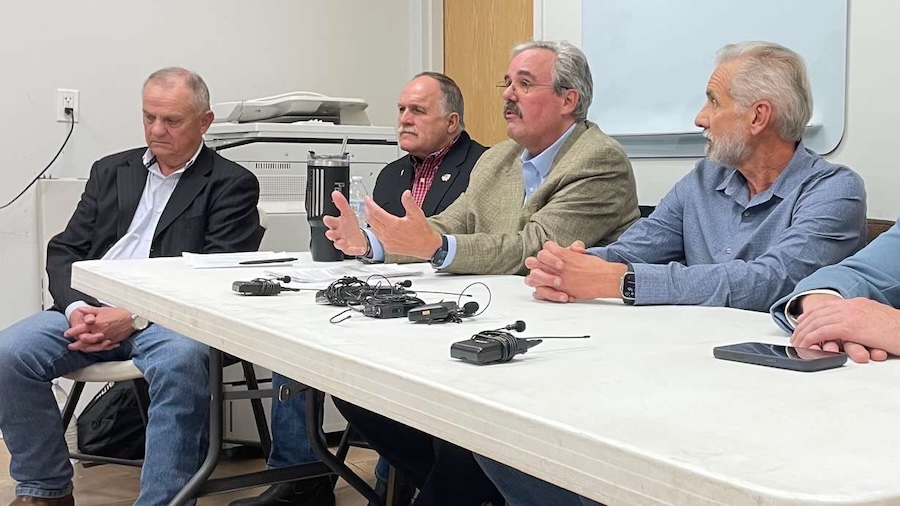
BRIGHAM CITY, Utah (KSL) — It’s been a stressful week for Box Elder County Commissioner Lee Perry and the two other commissioners on the body.
On Tuesday, a day after the three commissioners approved a pair of measures allowing a controversial data center project proposal to move forward, he said deciding what to do was a gut-wrenching process.
“In fact, I’ve been physically sick for over a week, trying to reconcile and try(ing) to figure out how we could resolve this in the best interest of the people of Box Elder County,” Perry said in an interview with KSL.
On top of that, he and the other commissioners have received death threats and been targets of false accusations. The proposal has sparked demonstrations and intense backlash from opponents who worry about the potential environmental impacts of the project, notably on availability of water and the already-low water levels at the Great Salt Lake.
He’s been heeding the advice of attorneys and experts on the topic to stay within the confines of the law. “And now I’m being personally attacked. I’m being accused of taking bribes and all kinds of things that are just not true. They’re just lies, and they continue to escalate,” Perry said.
He and fellow Commissioners Boyd Bingham and Tyler Vincent have even received death threats given the intense sentiments generated by the proposal, called the Stratos Project Area. During Monday’s meeting, some in the audience of perhaps 500 shouted down the commissioners at times and chanted, “Shame, shame, shame,” after they approved the two resolutions allowing the plans to proceed.
“I literally have police officers in front of my house, and that’s not fair to me, but it’s especially not fair to my family, and it’s not fair to either the other two commissioners, either,” Perry said. “And I have county employees that are nervous about their safety as well. And that is not the American way, certainly not the way of people in Utah.”
At the same time, he defended the commissioners’ actions at Monday’s tumultuous meeting, which included approving an agreement allowing the Utah Military Installation Development Authority, or MIDA, to work with celebrity businessman Kevin O’Leary in developing the data center project. Apart from the data centers, plans call for development of up to 9 gigawatts of power-producing capacity in the project area on 40,000 acres of Box Elder County land to serve the facilities.
He also worries about air quality and water issues, like the opponents, Perry said, but county commissioners don’t have oversight authority in the area. State officials are tasked with making sure development complies with laws governing air and water quality, he said, and in deciding on a course of action, Perry put a focus on the areas where county commissioners have authority.
“I don’t know that the county in a situation like this — with private, unzoned property, with water rights that can be purchased — that the county technically gets to have any say, unless there’s absolute proof that it’s going to damage the water,” he said. “And even then, (I) would struggle with this because technically that falls back on the state again. So if they buy water rights and I don’t control those, I can’t stop that.”
Project boosters have said developers would tap existing water rights tied to the property where the development is to occur, actually using less than what the current agriculture and ranching operations use.
More germane, had county officials rejected the resolutions, Perry maintains that O’Leary and O’Leary Digital could have pursued a proposal independently, without the guidelines the Utah Military Installation Development Authority negotiated with the developers. On unzoned property, “they can do pretty much what they want to do,” he said, though county officials would have some authority on sewage issues and enforcement of fire code.
As is, with commissioners having approved the resolution essentially giving Utah Military Installation Development Authority authority to work with O’Leary Digital in pursuing its plans, the development authority — a public entity — is now in a position of oversight, along with officials at the Utah Department of Environmental Quality. “I think the public needs to make sure that DEQ hears from us, that these are our concerns,” he said.
Despite the derision of many protesters toward the county officials, Perry lauded the feedback he received, at least from Box Elder County residents.
“Great public comment, great input from these folks. Some are concerned about the Great Salt Lake, valid points. They’re concerned about the air quality that could be brought from this. Some of them are concerned about the amount of traffic this could bring to our roads. Where are we going to put the people who come to work there? Those are all valid concerns,” he said.
O’Leary expressed a measure of disdain for at least some of the protestors, saying in a post on X, the social media network, that he thinks most are from outside the state and that some are even paid to take part. “We think over 90 percent of the protestors are actually not people that live in Utah or Box Elder County. They’re being bussed in,” he said, without providing evidence.
Perry, for his part, acknowledged he’s received messages from around Utah and beyond. Whatever the case, he says Utahns from outside Box Elder County have a right to speak out.
“I think when it comes to water and air … people who are surrounding the area have a say,” he said, but they should direct their concerns to state environmental authorities.
The proposed data centers would bolster the U.S. military’s access to artificial intelligence and cloud computing capabilities, helping it counter and outpace advances by U.S. adversaries such as China. Proponents say the project is key to safeguarding national security and that it would also bolster economic development, creating up to 2,000 permanent jobs.
Contributing: Daniel Woodruff