



Idaho Gov. Little says state is preparing for challenging wildfire season as fund drops to $0
Published at
Clark Corbin, Idaho Capital Sun
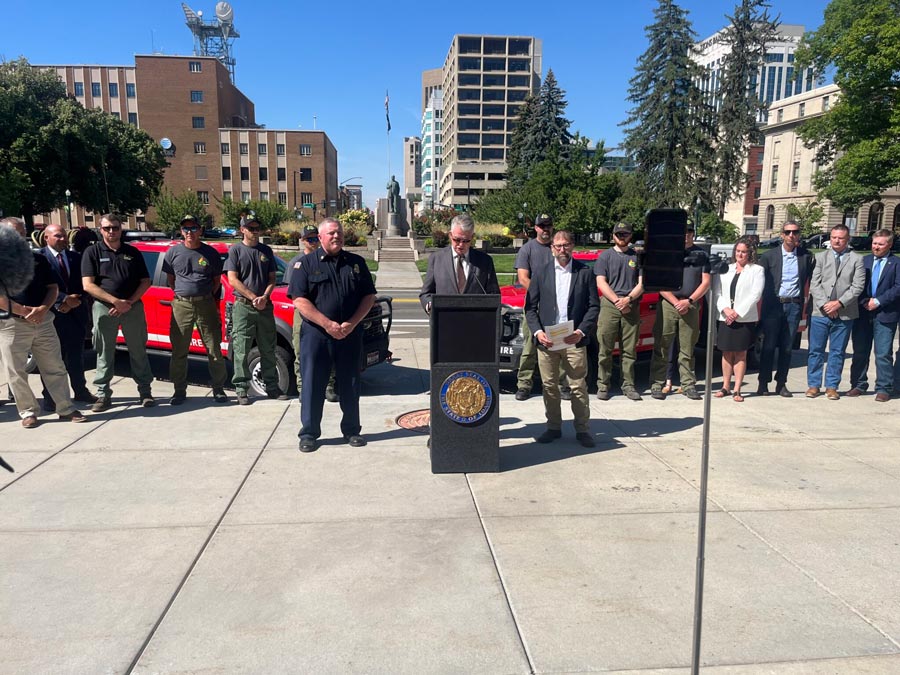
BOISE (Idaho Capital Sun) — Idaho Gov. Brad Little says the state is fully staffed and prepared to take on what could be one of the most challenging wildfire seasons in years – even as wildfire suppression funding provided by the Idaho Legislature runs out.
Surrounded by Idaho Department of Lands firefighters, Little stood on the steps of the State Capitol in Boise on Tuesday to announce that the state is committed to meeting the challenges of wildfire season head on.
“Wildfire is reality in life in the West,” Little said. “We cannot eliminate the threat, but we can be ready for it.”
Little said there are many reasons Idaho is prepared for a potentially challenging wildfire season – including an increase in state firefighters, robust partnerships with groups ranging from local timber associations to the federal government and increased use of technology such as wildfire monitoring cameras.
“I want Idahoans to know that Idaho is prepared,” Little said.
Idaho’s wildfire suppression fund balance drops to $0
Shortly before Little’s press conference, state officials told the governor and the other members of the Idaho State Board of Land Commissioners that the wildfire suppression fund the state uses to pay wildfire expenses ran out of money earlier this month.
“As for the current financial position, as of June 9, 2026, (the Idaho Department of Lands) is actively deficiency spending with the cash balance below $0,” Idaho State Forester Julia Lauch told Little and the other members of the board on Tuesday.
That doesn’t mean the state is out of money or that wildfires will go unchecked. Instead, that means that Idaho is using a process that Little has compared to putting the state’s wildfire bills on a credit card to get through the fire season.
That process uses what are known as deficiency warrants, and the Idaho State Board of Land Commissioners voted unanimously Tuesday to authorize that process to pay for any wildfire bills that exceed the funding provided by the Idaho Legislature.
The Legislature is also transferring an additional $32.8 million to the wildfire deficiency fund on July 1, the first day of fiscal year 2027.
Little said the transfer will help, but it may not be enough. A significant, active wildfire season could cost $70 million or more.
“But in all probability, we’ll probably pretty much burn through it,” Little said.
If Idaho does spend down the $32.8 million, the remaining bills would be paid for using deficiency warrants.
Those deficiency warrant bills would then be brought back to a future session of the Idaho Legislature to pay for, which could increase what is already a tight state budget squeeze caused by years of tax cuts and ongoing revenue uncertainty.
“You’re always in a better negotiating position if you’ve got cash in the bank instead of issuing deficiency warrants,” Little said Tuesday.
The issue of how to pay for the state’s wildfire bills has been debated between Little and legislators for a few years.
At the beginning of the 2025 legislative session, Little requested the Legislature spend $60 million to build up the balance of the wildfire suppression fund, followed by an ongoing transfer of $40 million every year to keep the fund strong.
However, the Idaho Legislature agreed to provide less funding. Legislators authorized a one-time $40 million transfer last year. Then, during the recent 2026 season, legislators authorized the upcoming one-time $32.8 million transfer on July 1.
On Tuesday, Little brought up that Oregon state officials needed to call a special legislative session after the state only set aside $10 million for wildfires and ended up with more than $350 million in wildfire bills in 2024.
How many state firefighters have been hired in Idaho this year?
Idaho will have more state firefighters and more fully staffed fire engines available to fight wildfires in 2026.
This year, the state hired 260 seasonal firefighters, up from 229 firefighters in 2025, according to documents presented to the Board of Land Commissioners on Tuesday.
Additionally, the state has 36 engines fully staffed with qualified engine bosses, up from 25 last year. Some of those engines are staffed by the Clearwater-Potlatch Timber Protective Association and the Southern Idaho Timber Protective Association, which are examples of the partnerships Little and Miller highlighted Tuesday.
“The Idaho Department of Lands and our partners enter 2026 with strong staffing, enhanced resources and stronger coordination than ever before,” Miller said.
Little and Miller stressed that most wildfires are human caused.
So far this year, the Idaho Department of Lands has responded to 53 fires, of which 42 were caused by humans and 11 were caused naturally, state documents show.
Among the human-caused fires, nearly 50% were caused by debris burning and equipment.
“While conditions vary across the state, we know from experience that it only takes a few weeks of hot, dry weather to significantly increase fire danger,” Miller said. “We also continue to see longer fire seasons, increased development in the wildland urban interface and growing competition for firefighting resources across the West. Those trends make preparation more important than ever.”
This weather-related story is brought to you by Pony Express Car Wash, Idaho's premier express car wash destination, renowned for its commitment to exceptional service and quality. Voted the No. 1 car wash company in Idaho for five consecutive years, we pride ourselves on delivering an unparalleled experience for every vehicle and customer. Our state-of-the-art facility utilizes name-brand soaps and cutting-edge equipment to ensure your car receives the ultimate clean. Established in eastern Idaho in 2019, Pony Express is proud to be a locally owned and operated company that caters to the unique car washing needs of our Idaho Friends and neighbors. We invite you to experience the difference at Pony Express, where your satisfaction is our ultimate goal.