



LIVE UPDATES: Day 4 of jury selection in the Lindsay Clancy murder trial
Published at | Updated at
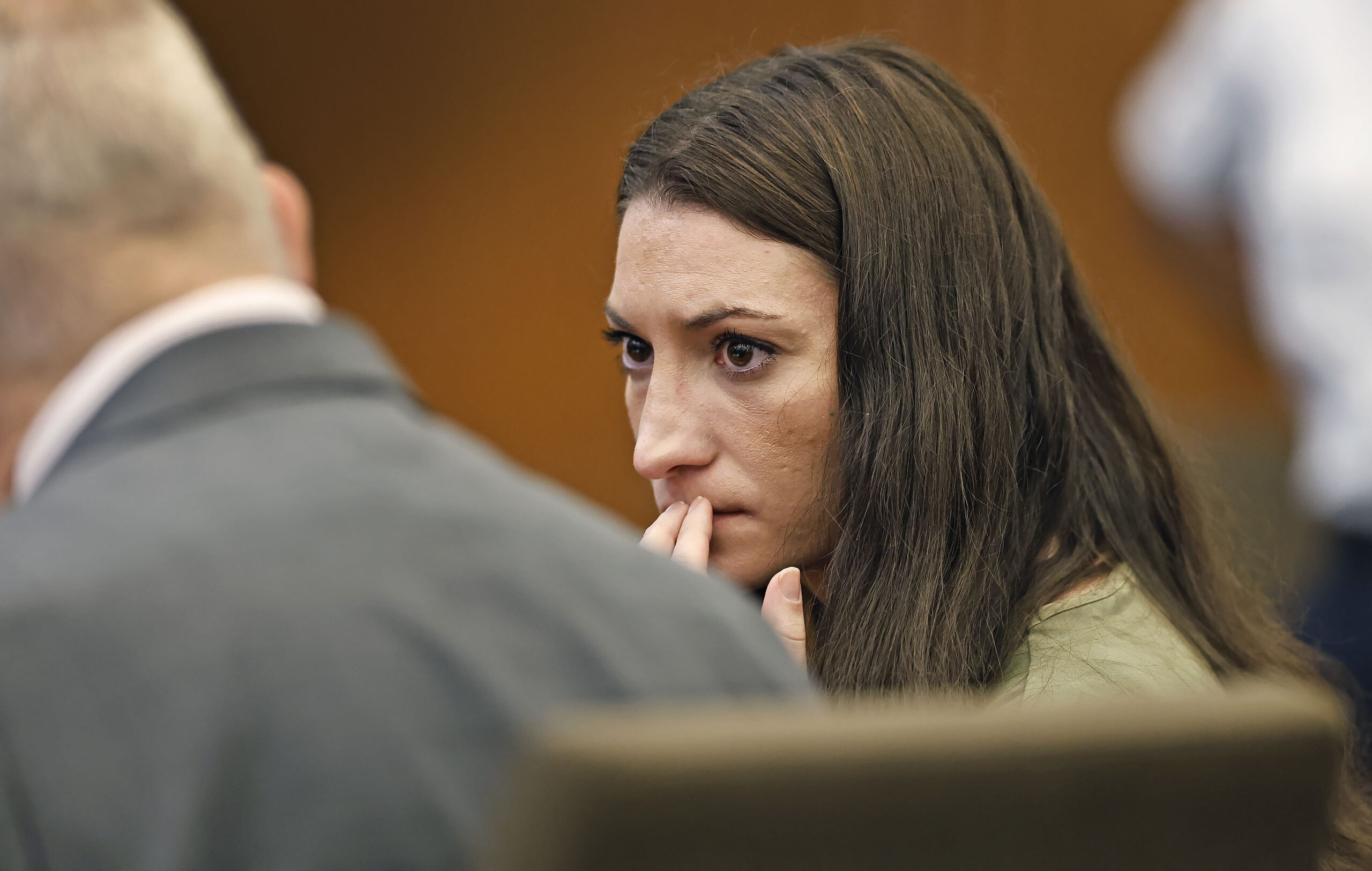
Lindsay Clancy’s murder trial is underway. The 35-year-old Massachusetts woman is charged with three counts of murder for the strangling deaths of her three children, ages 5, 3, and 8 months old. Clancy is present in the courtroom, bound to a wheelchair after she was paralyzed by injuries she sustained when she jumped from her home’s second-story window in an alleged suicide attempt. Her defense lawyer claims she was insane at the time, suffering from postpartum depression and overmedication, and could not appreciate the wrongfulness of her actions. She faces life in prison without parole if she is convicted. Follow here for live updates, and watch the trial livestream above. Times notes are Eastern Daylight Time. Please forgive typos.
3:21 p.m. Judge Sullivan says he will rule on Patrick Clancy’s motion on Friday morning. Court is in recess until Monday at 9 a.m., when we can expect opening statements, jury instructions and the first witnesses to take the stand.
3:20 p.m. The judge says now that he is aware of the issue, he’ll be ready for it. He won’t take action at this time because he anticipates dealing with it as it arises during testimony.
3:17 p.m. Sprague says it’s not the Commonwealth that chose the number of victims or the ages of the victims; the defendant did. The prosecutor continues, “Now, if defense would like us to reduce some of these witnesses, that would mean not talking about one of the children. So, if he (Reddington) would like to tell me which of these children don’t matter…” The judge stops Sprauge from saying anything further. Judge Sullivan says he wants to focus the arguments and tells the attorneys he thinks he’ll handle the issue by having them come to the sidebar for an offer of proof.
3:15 p.m. The judge says he thinks the defense motion might be premature because we don’t know what subsequent witnesses will say. The prosecution responds by arguing that there are multiple victims, requiring more witnesses to testify.
3:10 p.m. Defense motion: Reddington asks the court to restrict the number of first responders’ testimony.
3:06 p.m. Reddington tells the judge he agrees with Meier’s request and adds another jab at the prosecution: “I still think it’s reprehensible the way the government is trying this case.” Prosecutor Sprague tries to address Reddington’s rebuke of the government, but Judge Sullivan steps in and stops her. He says he wants to focus on the motion regarding media access to these four pieces of evidence and will take it under advisement.
3:04 p.m. Defense attorney Kevin Reddington maintains that his client has stipulated to every piece of evidence regarding the crime scene. He argues that the District Attorney’s intent is to inflame the passions of the jury by putting into evidence these items and testimony from Patrick Clancy. He states that Patrick Clancy is trying hard to move on. He is divorced from Lindsay Clancy and has remarried.
Reddington goes on to say that Patrick Clancy’s family has been harassed by the media; out-of-state family members are allegedly being harassed when they “have nothing to do with this case.” They have been hounded by the media, the defense says. “The district attorney wants to put that guy (Patrick Clancy) on the stand and show little onesies, with the bodily fluids of his child?” Reddington asks, rhetorically.
3:01 p.m. Meier asks specifically that the 911 call, photos of the victims, and clothing of the children be restricted. Prosecutor Jennifer Sprague defers to the judge regarding media access but wants to play the 911 call for the jury. She says photographs of the children will not be broadcast, and the children do not appear in crime scene photos. She points out that there has already been mass publication of the photos of the children prior to their deaths, but says the Commonwealth will defer to the judge’s decision on those photos.
2:57 p.m. Meier cites Massachusetts Supreme Court Rule 119, which permits the judge to limit or even suspend electronic coverage of this evidence. In suggesting the court limit media access to the evidence, he cites two cases in the Commonwealth as examples when this was done previously.
Meier says in a case dealing with the sexual assault of a child, the court found that the privacy interests of the victim outweighed the First Amendment right of the media to access that evidence. In that case, he said a proper mechanism to disseminate information about the evidence to the media was to allow them access to the transcript. Meier cites the cases of the Commonwealth v. Winfield and the Commonwealth vs. Chisolm; in both these cases, he says, the court allowed transcripts but not the recording.
2:52 p.m. Attorney David Meier, acting on behalf of Patrick Clancy, tells the judge he recognizes no authority to suggest how to try this case or what evidence should be introduced. He says Patrick Clancy is not seeking to close the courtroom or to exclude evidence from the jury; rather, his client is seeking to restrict, in a limited way, certain exhibits and items of evidence from being shared outside of the courtroom.
Pursuant to the Massachusetts Victim Bill of Rights, Meier says Patrick Clancy has an opportunity and right to be heard through counsel, and through counsel suggests certain items ought to be restricted from distribution outside of the courtroom. Meier is asking the court to mark the following pieces of evidence to be marked for purposes of this restriction request: the recording of the 911 call made by Mr. Clancy on the day he found his children dead; all images of the child victims (whether taken prior to “the alleged incident,” at the scene of the crime, or after their deaths), including video recordings; clothing worn by the child victims. Given the background, Meier asks that the written material and correspondence from Patrick Clancy be marked as exhibits and subject to impound.
2:44 p.m. Six men and 11 women have been assigned seats on the jury box; the last woman questioned was not assigned a seat. She could potentially be the last juror selected and would replace Juror #14, a white male who withdrew from service. The judge and attorneys remain at the sidebar.
2:29 p.m. Meier requests to meet with the judge and attorneys at the sidebar.
2:27 p.m. Patrick Clancy, the victims’ father, is requesting that the court restrict public access to trial exhibits. Patrick Clancy is represented by David Meier.
2:16 p.m. A jury has been selected. The judge says the plan is to begin the trial on Monday with opening statements. The judge will now take up motions.
2:12 p.m. Court is back in session. Jury selection will resume with individual questioning, and Judge Sullivan announced that he will hear Patric Clancy’s motion to restrict public access to trial exhibits once a jury has been empaneled.
1:01 p.m. Court is in a lunch break till 2 p.m. EDT, when jury selection will resume.
12:57 p.m. A white female in her 50s is excused. Juror #384, an Asian female, is excused.
12:43 p.m. Juror #376, a white male in his 40s, is questioned and excused. Juror #378, a white woman in her 60s, is excused. Juror #380, a white female in her 50s, is questioned and excused. Juror #381, a white female in her 60s, is assigned to seat #13.
12:25 p.m. Juror #366, a white male in his 60s, is excused. Juror #369, a white woman in her 70s, is questioned and excused. Juror #370, a white male in his 30s, is excused. Juror #371, a white male in his 30s, is excused. Juror #372, a white female in her 50s, is excused. Juror #374, a white female in her 30s, is questioned and excused. Juror #376, a white female in her 30s, is excused.
12:16 p.m. Juror #360, a white male in his 20s, is questioned and excused. Juror #361, a white male in his 30s, is questioned and excused. Juror #362, a Black male in his 40s, is questioned and excused. Juror #363, a white male in his 60s, is excused. Juror #365, a white male in his 20s, is excused.
11:51 a.m. Juror #346, a white female in her 40s, is excused. Juror #348, a white female in her 30s, is excused. Juror #349, a white male in his 60s, is excused. Juror #351, a white male in his 40s, is excused. Juror #352, a white male in his 40s. Juror #355, a white male in his 60s, is excused. Juror #356, a white female in her 60s, is excused. Juror #357, a white male in his 40s, is excused. Juror #358, a white female in her 40s, is excused. Juror #359, a white female in her 60s, is questioned and assigned to seat #2.
11:49 a.m. Court is back in session and jury selection resumes with Juror #345, a white male in his 60s, who is questioned and excused.
11:12 a.m. Jurors #13 and #14 have been excused. The court must now replace 3 jurors instead of just 1.
11:02 a.m. A white male in his 60s is excused.
10:58 a.m. Court is back in session for individual questioning of the jurors. Juror #178, a Black female in her 40s, is excused.
10:39 a.m. After group questions, in which several dozen people raised cards to respond to questions about their ability to serve and remain impartial, potential jurors have been excused to fill out questionnaires.
10:28 a.m. Group question #1: Are you related to Lindsay Clancy’s family?: One juror says “yes.” Question #2: Several jurors say they have an interest in the case.
10:18 a.m. As has been the practice of the judge throughout jury selection, he advises the prospective jurors how he will proceed. He will read a statement of the case, introduce the lawyers, ask a series of questions, and the prospective jurors will be excused to fill out questionnaires and review the witness list.
10:14 a.m. Jury selection has resumed with a pool of approximately 75 prospective jurors.
9:48 a.m. Court is in session; Judge Sullivan is on the bench and has summoned attorneys to the sidebar.
9:32 a.m. Jury selection will resume shortly with a new panel. Judge William F. Sullivan is looking to replace Juror #2, who withdrew from service.