



Idaho Supreme Court rules in favor of local attorney Bryan Smith, finding Bonneville County overcharged him
Published at
IDAHO FALLS — Idaho Supreme Court justices unanimously ruled that Bonneville County had violated Idaho’s Public Records Act and overcharged a local attorney.
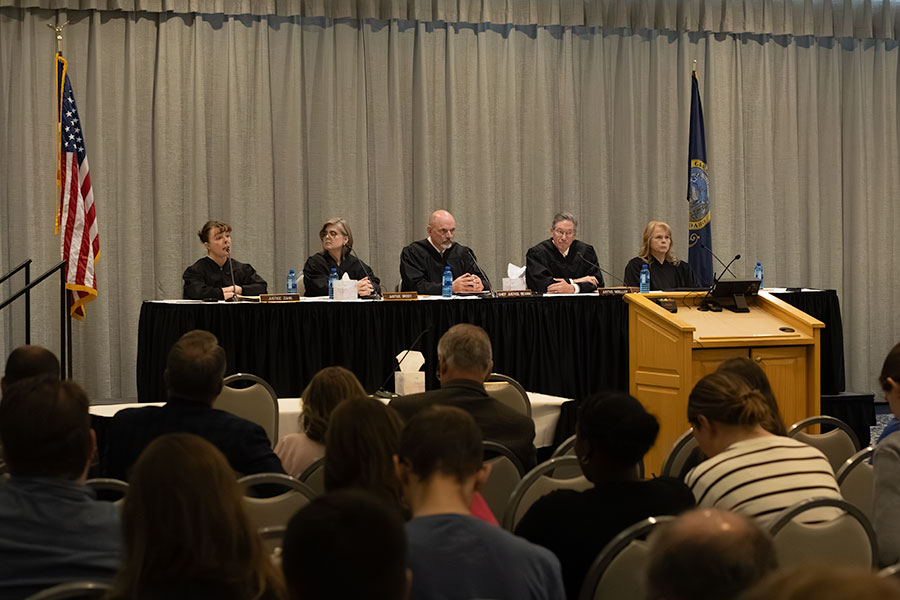
Earlier this year, the Idaho Supreme Court met in Rexburg to hear arguments in a lawsuit filed by Bryan Smith, with Smith Driscoll & Associates, who represented himself, against former Bonneville County Clerk Penny Manning.
The opinion now lists Chris Poulter as the Bonneville County clerk, since Manning had retired while the lawsuits were being handled in court.
RELATED | Idaho Supreme Court to decide if former clerk overcharged and violated open records law
The lawsuit filed by Smith, in 2025, began after he was charged $352 for filing a public records request with Bonneville County. He claims that he was overcharged because the county clerk used a 2017 Administrative Order instead of Idaho Code 74-102 and Idaho Court Administrative Rule 32.
Idaho Code 74-102 and Rule 32 govern public records and how state agencies can charge for them, dependent if they are physical or digital copies. These rules require agencies to use the lowest-paid employee and either charge no fee for the first two hours of compiling records or determine those costs.
A boon or harm for taxpayers?
Smith told us that, per his own policy, he does not respond to inquiries from EastIdahoNews.com, but referred to an an article he wrote about his experience during this lawsuit.
RELATED | Idaho Patient Act goes to House floor after emotionally charged testimony from both sides
According to Smith’s article, his concern during the lawsuit was the effort Bonneville County put into defending it, as he believes the outcome should have been as simple as issuing a refund. The amount of money spent was a grave concern for him, he wrote.
He wrote that the county had paid Nelson Hall Parry Tucker Law Firm $3,632 to defend the clerk. The opinion also entitles Smith to court costs, which could bring the cost up to more than $5,000.
Along with salaries incurred when the Bonneville County prosecutor was brought in to defend the county, Smith believes the total cost could rise to $20,000.
“Somebody also decided that the county should fight all the way to the Supreme Court rather than refund $330.67,” Smith wrote. “I don’t know precisely who authorized each decision. But somebody did, and as the bills mounted, somebody decided the fight should continue.”
Smith said he was concerned that if this incident had happened to a regular county resident, the cost would have been too much to bear. He wrote that he believed the county pursued such a legal battle because it was spending other people’s money.
“The ordinary citizen would have to spend thousands of his own dollars to get $330 back. Most people simply wouldn’t do it,” Smith wrote.
EastIdahoNews.com has reached out to Bonneville County and spoken with Bonneville County Prosecutor Randy Neal about the recent decision.
Neal said his concern over this decision is the ramifications it will have for counties and the cost that will now shift to taxpayers.
“The way it’s been done for years is that those who actually ask for the records are the ones who pay for it, where this is going to shift it towards all taxpayers,” Neal said.
While Smith’s request was for only a few documents, Neal said the county receives thousands of requests. If the first two hours are free, the county loses hundreds of hours of funded work. He also said maintaining these records is a substantial expense.
“This was not a triumph for taxpayers,” Neal said.
Neal also told EastIdahoNews.com that the changes to Rule 32 caught many counties off guard, as the rule has gone through many iterations over the years.
Over the past year, according to the State of Idaho Judicial branch, Rule 32 has gone through 15 amendments, and those continue to add since 2017 when the administrative order was put in place. These changes pertaining to how certain types of documents can be charged or how the costs are set by either the Supreme Court or an Administrative Judge following Idaho code.
“We may have dealt with this differently if we’d been aware of this rule change, but it wasn’t just us; it was everyone in the state,” Neal said.
Neal said the county is considering how to handle public records requests with this new decision. While there are still possible outcomes to comply with state law, a final decision is still pending.
How did we get here?
According to the opinion, when Smith requested the documents, including copies of all 169 small-claims judgments, he was quoted $332 plus $10 for a USB.
The fees came from that administrative order, which states a $10 fee for electronic copies and $1 per page to send over any “portion of a judicial record … by any means.”
The clerk’s office also established that the lowest-paid employee qualified to fulfill the request and earned $17.03 per hour, and that the employee had spent 174 minutes completing the request.
Smith was notified that his total charge was $352. Although he requested a reduction and was denied, he paid the amount owed.
When the lawsuit was filed, both sides moved for summary judgment, and District Judge Steven Boyce granted the clerk’s motion, agreeing that the clerk had quasi-judicial immunity.
The order stated that the clerk was acting as a court official and had complied with the court’s administrative order, thereby granting Manning immunity. Smith argued that the clerk had no immunity because the lawsuit was against the clerk as an official, not as an individual. The court did not discuss whether Smith had been overcharged.
Smith appealed the decision, which led to the case being brought before the Idaho Supreme Court.
Arguments made in Rexburg
When the Idaho Supreme Court was at Brigham Young University-Idaho in Rexburg, Smith and Bonneville County Prosecutor Randy Neal made arguments regarding Smith’s appeal.
Smith reaffirmed his arguments that Manning had no immunity as she was performing her duties as the clerk of Bonneville County, and not as an arm of the courts.
He also told the justices that the 2017 administrative order was void because Idaho Code 74-102 superseded it. But the lower court never addressed it when it dismissed his lawsuit after it found Manning immune.
“I just wanted my money back,” Smith said. “It cannot be the law in the state that a government can overcharge you, and then when you try to get your money back, they say, ‘We’re immune from suit, we’re not even going to get to the issue.’”
Neal argued for the lower court’s ruling, citing the Tort Claims Act, the fact that Smith sought financial damages — regardless of whether Manning was performing her duties in the administrative or judicial realm — and the Act’s grant of immunity.
The justices, however, had issues with this argument, questioning how a clerk processing a record request — using the administrative order — is similar to what a judge does.
Justice Robyn Brody told Neal that a clerk charging an individual while completing a request is simply the clerk performing their administrative duties.
Neal argued that if there was an issue with the administrative order, the Idaho Supreme Court should have decided it, not the clerk.
However, Justice Gregory Moeller said that it wasn’t until this hearing that the issue of the order being wrong was brought up. But it fell on the county prosecutor to realize there was an issue when Smith had filed his lawsuit.
“It was brought to your attention as the county attorney when (Smith) filed the suit,” Moeller said. “You could look at that and say, ‘Well, yeah, he’s right. Let’s just give him his money back.’”
During a tense exchange, Neal doubled down, telling the justices that if an issue existed with the order, it was on the judge who issued it and for the Supreme Court to address.
Moeller told Neal that, as an officer of the court, he could have looked at both the order and the Idaho Code to see whether an issue needed to be fixed.
“The judge missed it, but you missed it too,” Moeller said.
Siding with Smith
The Idaho Supreme Court found that the lower court’s dismissal of Smith’s lawsuit because the clerk had quasi-judicial immunity was an error.
The justices agreed that Smith sued Manning in her official capacity, not as Manning the individual.
The opinion states that quasi-judicial immunity extends absolute judicial immunity to those who perform judicial functions. This form of immunity can also apply when an official is sued in their personal capacity.
Regarding Smith’s complaint about violations of Idaho Law — which the court did not discuss because it dismissed his suit — the opinion states that it found the 2017 administrative order inconsistent with Idaho law.
Although there are clear fee outlines for paper copies—listed in I.C. 31-3201—the courts may set the cost for “any other copy” as determined by the Idaho Supreme Court or a local administrative district judge; the court found the 2017 administrative order invalid.
The order had a blanket $1 per-page fee for physical and digital copies, as well as a $10 fee for reproduction on any digital media.
Another inconsistency was that the order charged Smith for 174 minutes of work. Idaho Code 74-102 states that no fee will be charged for the first two hours or the first 100 pages to process that request.
Using the lowest qualified and paid employee, the billable time left after the two hours was only 54 minutes, meaning Smith should have been charged $15.33. With the $6 USB, the total should have been $21.33.
However, Smith was overcharged $330.67 for that request.
The opinion overturned the lower court’s decision and directed the clerk to refund Smith the overcharged amount.
“The Idaho Supreme Court has now unanimously agreed with me that those charges violated Idaho law,” Smith wrote.