



License-plate cameras just came down in this fast-growing Idaho city. Here’s why
Published at
Rose Evans and Noah Daly, Idaho Statesman
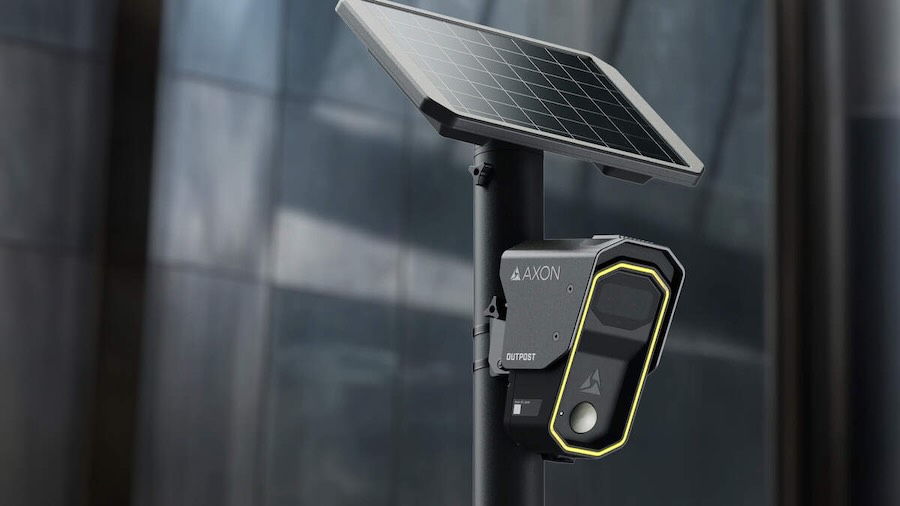
KUNA (Idaho Statesman) — The Ada County Sheriff’s Office has removed its automated license-plate reader cameras from the city of Kuna after Mayor Joe Stear raised concerns that they were sowing “division” among residents.
Seven Axon “outpost” cameras, which use artificial intelligence to scan traffic and automatically pull license-plate data, came down across the city on Sept. 8, just two months after being installed, according to the sheriff’s office.
Across the Treasure Valley and the country, AI-powered surveillance technology has faced intense backlash over concerns around data security and privacy rights, with some Boise-area residents urging officials to ban the cameras, the Idaho Statesman has reported. In August, Kuna had at least two incidents of people vandalizing or stealing the license-plate readers, Emily Walker, a spokesperson for the sheriff’s office, told the Statesman Thursday.
RELATED | Tort claim, vandalized cameras and eastern Idahoans up in arms about Flock cameras
The license-plate readers went up in July, replacing similar AI-assisted cameras by Atlanta, Georgia-based surveillance company Flock Safety that were installed as part of a pilot project in 2025, Walker said.
When the Flocks first went up across Kuna, the boomtown to Boise’s southwest, Stear hadn’t heard “anything negative” about them and “didn’t have any issue” with the cameras, he told the Statesman in a phone interview.
The city, whose population is estimated at roughly 38,000, contracts with the sheriff’s office for police services and, unlike Boise and Meridian, doesn’t have its own city-run police department, Stear noted.
“So we don’t usually get into any kind of discussions on what tools our police can use,” he said. “We just do a contract for service, and then those items are discussed with the Ada County sheriff when he talks to the county commissioners.”
The city’s elected officials don’t receive a “breakdown” of how the service contract is carried out and don’t typically have a say in operational decisions like the use of license-plate cameras, Stear said.
RELATED | Jerome County sheriff cancels Flock camera contract, redirects funds to deputy salaries
But as opposition to the cameras and concerns around mass surveillance grew, Stear said he began to notice “a lot of division in the city and a lot of infighting between community members.”
When the sheriff’s office switched out the cameras to Axons in July, residents took note, and “things really started getting heated,” Stear said. “Timing couldn’t have been worse on that.”
“Our police department has a great relationship with our community, and that was starting to look like that was going to erode that,” he said. “So, although I don’t normally comment on what tools the sheriff’s office and Kuna police use, this one was getting a little out of hand.”
Stear said he approached the Kuna police chief, Chad Hessing, and Sheriff Matt Clifford, with concerns about the cameras roughly a month ago.
It took a few weeks for the agency to arrange for the cameras to be taken down, he said. Idaho News 6 earlier reported on the removal of the cameras.
License-plate cameras stay up in other Boise-area cities
In an email to the Statesman, Walker pointed to the sheriff’s office’s “strong working relationship” with Kuna and its mayor, saying the agency “respected his decision to discontinue (automated license-plate readers) in Kuna for the time being.”
Walker said the sheriff’s office has no plans to reinstall the cameras at this time. But the agency also does not plan to remove the readers from its other areas of service, which include Eagle, Star and unincorporated Ada County, she said.
In Meridian, where residents have also spoken out against “mass monitoring,” the city’s police department operates 66 Axon license-plate readers, along with a suite of other products from the Arizona security company.
For Stear, this jurisdiction-by-jurisdiction approach is concerning.
“What I’m hoping for is some legislative guidance on who can use them and who has access to them, that type of thing,” he said. “So it’d be a statewide thing rather than city-by-city or county-by-county.
“I think that’s the best way to deal with this and relieve the concerns people have.”
Stear noted that he’s spoken with Rep. Chris Bruce, R-Kuna, who also serves as Kuna’s City Council president, and expects the cameras to be taken up in the next legislative session. Meridian Police Chief Tracy Basterrechea has also called for additional state-level “guardrails” around the technology in the upcoming session.
‘United States of Surveillance’
In recent months, the push to get license-plate readers out of Idaho has picked up momentum.
In June, the co-founder of the citizen watchdog group, DeFlock Idaho, Tyler Cain, filed a pair of tort claims against the cities of Caldwell and Wilder — civil claims which act as possible precursors to lawsuits. The claims argued that the cities’ contracts with Flock violate state law by giving the company data that could then be used for non-law enforcement purposes, according to prior Statesman reporting.
In August, Wilder nearly removed its three Flock cameras when a voter initiative started by Cain’s group forced the City Council to review the issue. The measure narrowly failed in a tie-break vote from Mayor Justin Devenberg, who told the Statesman that it likely would have passed if it hadn’t made more far-reaching demands around how the city stores its data. It would have made Wilder the first city in the state to publicly ban the cameras.
Across the country, license-plate readers have been implicated in false arrests. Officers have searched nationwide license-plate reader networks using keywords like “protest” to track activists and people attending political rallies. Investigations into how police use the cameras further revealed a national pattern of unsupervised searches,, allowing officers to stalk romantic interests.
“We’ve seen cities in Idaho get into contracts with these massive security companies while failing to account for how they’re going to be used or managed,” Cain previously told the Statesman.
“If you think that just because you’re doing the right thing that they won’t watch your every move, you’re living in a fantasy,” Cain said. “This is the United States of Surveillance.”