



House Joint Resolution 4: legislative power-grab or chance to insulate Idaho from illegal drugs?
Published at
Mathew Callaghan, Spokesman-Review
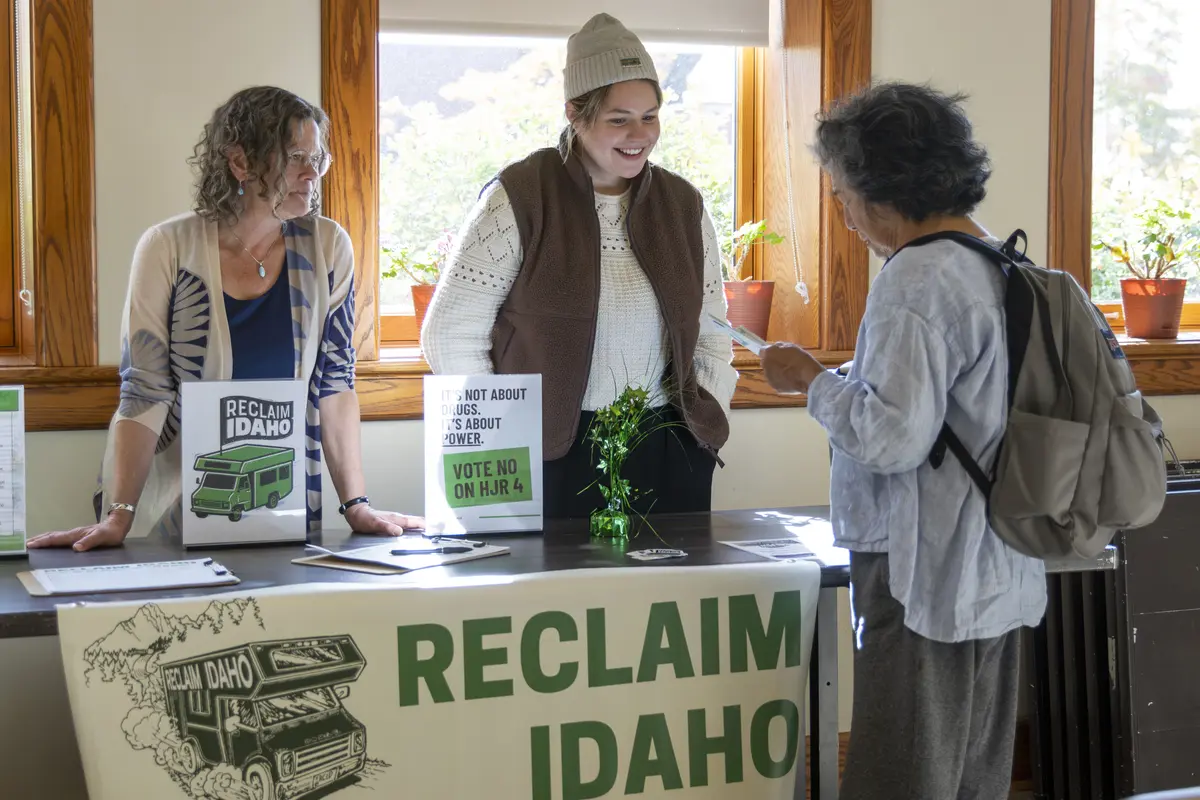
MOSCOW (The Spokesman-Review) — Idahoans next month will vote on a constitutional amendment that would give the state Legislature sole authority to legalize marijuana and other psychoactive substances.
If House Joint Resolution 4 passes, citizens would no longer have the ability to legalize or decriminalize such substances through people-led ballot initiatives. If it doesn’t pass, no policies will change, but it keeps the option open for citizens to put a drug-related initiative on the ballot.
Opponents argue the resolution is a power-grab by the Legislature, while supporters say it’s an added protection needed to keep marijuana and other drugs out of Idaho.
State GOP Rep. Bruce Skaug, of Nampa, is the main sponsor of the proposal. He believes marijuana and other illegal drugs have permanently damaged Idaho’s neighboring states.
“This is an extra tool in the toolbox for Idaho people to vote on,” Skaug said, “if they want to give that to the Legislature to say ‘Only you, the Legislature, can vote to make illegal drugs legal.’ I’m hoping that passes, but we’ll see what the people decide.”
The ability for citizens to put forth initiatives on the Idaho ballot stretches back to 1911. In 1938, the first successful voter initiative in Idaho passed to create the Idaho Fish and Game Commission, with roughly 75% of Idahoans voting yes.
More recently, in 2018, Idaho voters approved a citizen-led ballot initiative that expanded Medicaid access to tens of thousands of residents. Out of the 31 citizen-led initiatives that have been put on the Idaho ballot, 15 were passed by voters, according to the Idaho Capital Sun.
Skaug said he is supportive of the initiative process generally, just not in this case.
“On this one, when we see outside influences or big money from the drug industry come in and influence the states unfairly on the initiative process, I think we need to stop it,” Skaug said.
He said an extra brick needs to be put up to insulate Idaho from “stinkweed” and other illegal drugs. Skaug pointed to a Fiscal Year 2026 Toxicology Report from the Idaho State Police that found cannabis-related compounds were the most commonly detected drugs in adult toxicology samples as evidence that marijuana isn’t just a nuisance, it’s dangerous.
Another study from the Washington University School of Medicine in St. Louis reported in September that near-daily marijuana users with drug-resistant epilepsy had more than twice as many convulsive seizures compared to nonusers.
Other reports from major medical reviews, like the National Institutes of Health, highlight the benefits of marijuana, such as providing relief from chronic pain, chemotherapy-induced nausea and multiple sclerosis spasticity.
“How marijuana or other drugs get legalized in the states through the initiative process is they play on the sympathies of all of us by showing some old veteran who says, ‘Well, this is what gets me through the day,’ ” Skaug said. “And that’s not what it becomes. It’s not about the old veterans. Once it’s legalized in any form, it becomes recreational across the states.”
For Luke Mayville, the executive director of Reclaim Idaho, the resolution on the ballot isn’t about drugs at all.
It’s about power.
Reclaim Idaho started as a grassroots movement in 2018 when they spearheaded the campaign to expand Medicaid in Idaho. Since then, Mayville said they’ve “been advocating for an Idaho government that works for all Idahoans.”
“If HJR 4 passes, Idahoans will have less power than they had before,” he said. “Not just regarding marijuana and narcotics, but also this very wide range of issues that could fall under the term of psychoactive substances, which is a very vague term. The inclusion of that term possibly makes this a very wide-ranging amendment.”
Mayville said he’s spoken with several people across the state who are against the legalization of marijuana, but still firmly believe HJR 4 would strip them of their rights in some ways.
Although it’s a small sample size of just 550 people, a 2022 poll conducted by SurveyUSA found that 68% of respondents believe cannabis should be legalized for medical purposes. Out of that same pool of respondents, 48% were in favor of recreational cannabis use, 41% believed it should be illegal and 10% of people weren’t sure.
State Sen. James Ruchti, a Democrat from Pocatello, is concerned that if HJR 4 passes, other resolutions would land on the ballot in the future that put even harsher restrictions on citizen-led initiatives.
“Given the antagonism I have seen from the Legislature towards the initiative and referendum processes, I just feel like this is the first of the next steps,” Ruchti said.
In 2019, Idaho lawmakers put forward a bill that would’ve required signatures from 10% of registered voters in 32 of Idaho’s 35 legislative districts. Citizens would have also had only 180 days to garner enough signatures. For reference, the current law requires signatures from 6% of qualified voters across only 18 legislative districts. Gov. Brad Little vetoed that bill and another one that came shortly after that would’ve required signatures from 24 legislative districts over the course of nine months. Although Little vetoed both of those bills, he praised what he saw as an attempt to give rural Idahoans more of a voice.
In 2021, Senate Bill 1110 would’ve required citizens looking to get an initiative on the ballot to acquire signatures from 6% of eligible voters from all of Idaho’s 35 legislative districts. That law was signed into effect by Little, but Reclaim Idaho filed a lawsuit soon after that went up to the Idaho Supreme Court.
“Even if an initiative was overwhelmingly popular in 34 districts, if it didn’t get the number of signatures in just one district, the initiative would die (under Senate Bill 1110),” Mayville of Reclaim Idaho said.
In Reclaim Idaho v. Denney, the Supreme Court struck down Senate Bill 1110, saying it nullified the people’s fundamental constitutional right to legislate directly.
State Sen. Carl Bjerke, a Kootenai County Republican, said he doesn’t want to get rid of the initiative process, but if HJR 4 passes, it would put the legalization of marijuana into the same realm as alcohol and gambling. He compared the current national conversation over whether weed should or shouldn’t be legalized to the way states “had the opportunity to take control of their own destiny” after Prohibition was overturned in 1933.
“Some people say, ‘Oh, yeah, we don’t need Big Brother government getting in the way and telling us what we can and can’t do,” Bjerke said. “If that’s the position that people are in, then we really don’t have a role for government anywhere. You can’t pick or choose where and when you want the government to take responsibility to do what I think some citizens would like them to do.”
A big issue for him and Skaug is out-of-state money having an influence, or “distorting the true grassroots Idahoans’ voice by pumping in millions of dollars into a state on an issue.”
“I want this initially in the hands of a slower deliberative body before we just willy-nilly allow some third-party special interest group, national PAC or nonprofit to funnel money into a system that wants something for Idaho that’s not necessarily what the citizens of Idaho want,” Bjerke said.
There are 61 republicans in the Idaho House of Representatives and nine Democrats. Of the 61 Republicans, two abstained from passing HJR 4, while 58 voted in favor. Only one, state Rep. Rob Beiswenger, a Republican, voted against HJR 4. Since then, he’s changed his mind.
“I wasn’t expecting to have to vote on it,” Beiswenger said. “I hadn’t really researched it. So it kind of moved in a hurry, and it had terms like ‘psychoactive substances’ in there. I just didn’t feel like I could vote for something without having more clarity on how this really played out.”
After talking more in-depth about HJR 4 with lawmakers, like Skaug, he felt more favorably about the piece of legislation. He also mentioned that he was new to the job and at the time, had only been a state representative for about six weeks.
Beiswenger said he prefers the legislative process to the initiative process “in general.” He pointed to Idaho’s Medical Cannabis Act as an example, saying it wasn’t just about whether medical marijuana would be legal or illegal, it “ended up being like a corporate giveaway” where “only certain people could grow it.” He said it felt like a political favoritism bill they were trying to enact through the initiative process.
Regular people are busy going to work, taking their kids to school, and living their life, so they don’t have much time to study the legislative language or completely grasp the context of a given issue, he said.
“Even if you put on a ballot a thing that I liked, let’s say you want to get rid of something like the grocery tax, I still would not really like to do that through the initiative process,” Beiswenger said. “I want to take it into the Legislature. And if people don’t like what we’re doing, then either convince us – call us and email us – whatever, or find somebody who would act like they wanted.
“That’s the recourse here. Get people in office who will do what you want.”