



The Hollywood star who trained pilots in Idaho before flying combat missions over Europe
Published at
IDAHO FALLS – James Stewart was already one of Hollywood’s biggest stars when he arrived at Gowen Field near Boise in January 1943. But he wasn’t there to make a movie.
At 33, Stewart had reached the height of his acting career. He enlisted in the U.S. Army Air Corps — the predecessor to the U.S. Air Force — on March 22, 1941. Months after winning an Oscar for his performance in “The Philadelphia Story,” Stewart put Hollywood on hold to serve his country. He received his commission about a month after the attack on Pearl Harbor, according to the National Museum of the United States Air Force. A new film chronicling Stewart’s remarkable journey from Hollywood leading man to World War II combat pilot hits theaters nationwide on Friday.
Stewart’s time at Gowen Field lasted about eight months. Dylan Almendral, director of the Idaho Military Museum at Gowen Field, tells EastIdahoNews.com the actor from Pennsylvania served on base as a B-17 flight instructor for the 59th Bomb Squadron of the 29th Bomb Group.
Gowen Field was Stewart’s fourth training assignment and getting there had been a struggle. Although Stewart earned his commercial pilot’s license before entering the military, Almendral says the Air Corps was reluctant to put a major movie star in harm’s way, repeatedly assigning him to training duties instead.
Before that, he’d had a tough time enlisting because the military apparently thought he was too skinny. The 6 foot 3 actor weighed a mere 138 pounds.
“He started eating spaghetti twice a day, supplemented with steaks and milkshakes,” a Historynet article reports. “At a second physical in March 1941, he still hadn’t gained quite enough weight to be eligible, but he talked the Army doctors into adding an ounce or two so he could qualify.”
Stewart’s service record shows that his desire to serve was genuine. He’d been making about $12,000 a week as an actor. His induction as a private reduced his salary to $21 a month.
His military training began at Moffett Field in California.
Throughout his service, Stewart refused special treatment, insisting he be treated like any other serviceman. Col. E.B. Lyons, his commanding officer at Moffett Field, noted Stewart’s repeated requests for equal treatment in a letter denying his transfer to a base in Ohio.
“He does not desire to engage in any phase of motion picture activity, or publicity, while he is in the Army,” Lyons wrote. “He has repeatedly, while at this station, shunned publicity. He wants to be treated exactly as any other American boy drafted into the service of his country.”
Lyons praised Stewart’s performance as a soldier, saying, “He is proving himself to be of superior officer calibre, and because of his attitude towards duty and his conduct while at this station, this office is affording him every opportunity to forward his ambition.”
Although Stewart declined any publicity, he did appear in a recruiting film for the Army in 1942.
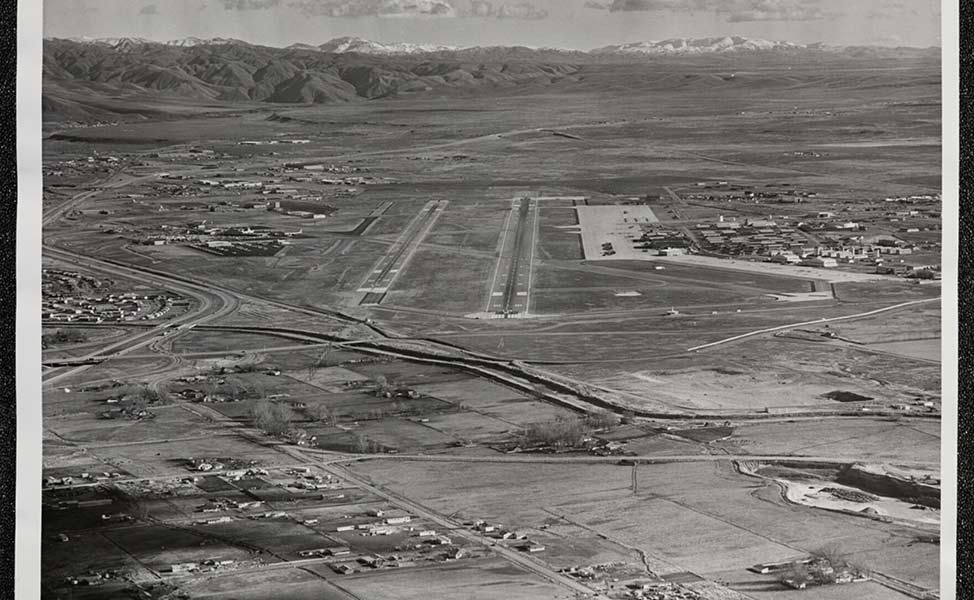
Gowen Field — named for Caldwell pilot Paul Gowen, who was killed in a plane crash in 1938 — became operational in the spring of 1941. The Army selected the site as an air base because of it’s climate and physical conditions. Col. Robin Day took command on March 12, 1941 and the first cadre of soldiers arrived on April 15.
Gowen Field had been in operation for nearly two years when Stewart arrived. Almendral says it was a pivotal assignment for two reasons. One reason is because it’s where he was promoted from second lieutenant to captain. Speaking of Idaho blogger Rick Just reported in 2020 that Stewart earned his captain’s bars in July 1943. An old theater still on site today is one of two places where Stewart likely got the promotion, according to Almendral.
Gowen Field is also the place where Stewart began campaigning for deployment overseas.
“He’d already caught on that (the Army was) hampering (his efforts to join the war). The work of him saying, ‘I want to serve my country actively instead of as a figurehead’ happened here,” Almendral says.
From Boise’s theaters to Europe’s skies
Despite Stewart’s efforts to maintain a low profile with the public, Almendral says his attendance at a theater in downtown Boise caught the attention of locals and the media. An Idaho Statesman article dated June 21, 1943 reported that Lt. Stewart attended a minstrel show performed by Gowen Field servicemen at the Pinney Theater. After the show, he went backstage to get his picture taken with cast members.
“It was wonderful,” Stewart is reported to have said about the show. “A good, fast show and the best I’ve ever seen. It’s been a long time since I’ve been back stage. It’s a nice house.”
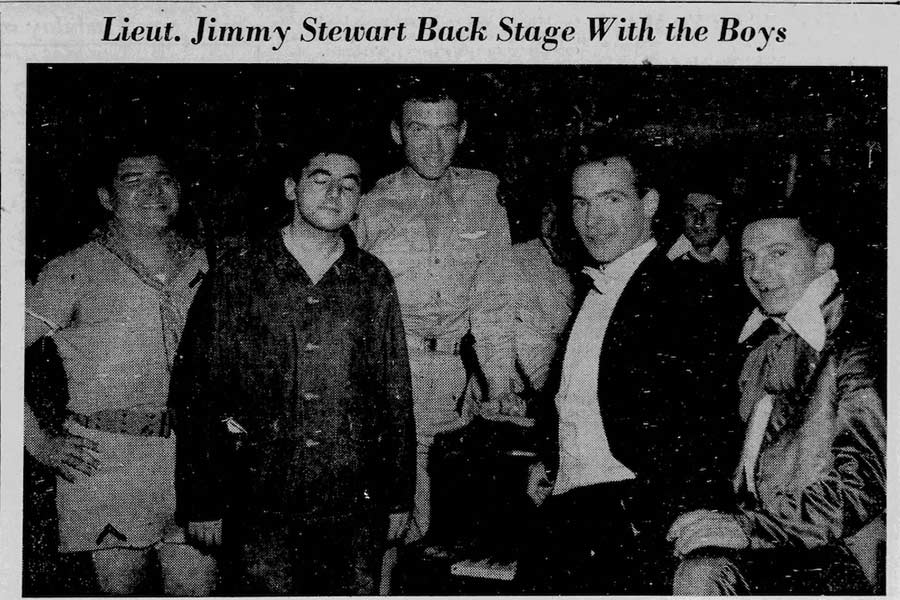
KISU reported earlier this year that some Boise residents still remember him playing the organ after hours at the Egyptian Theatre, but Almendral says it was more likely a piano in the officer’s club on base.
Stewart’s eight-month stint at Gowen Field ended in August 1943, but his stint in the military had just begun. He was sent to England in late November and officially entered the war. From there, Stewart went on to fly 20 bombing missions over Nazi-occupied Europe.
On March 31, 1944, Stewart was appointed operations officer of the 453rd Bomb Group and, later, Chief of Staff of the 2nd Combat wing, 2nd Air Division of the 8th Air Force.
Almendral says he was friends with Stewart’s wingman, Roberto Ruiz. Ruiz and Stewart went on five missions together. Both men have since passed, but Almendral says Ruiz shared memories about Stewart through the years. He reportedly described Stewart as an “affable guy” who was also a dedicated officer.
“He tried really hard to be a regular guy,” Almendral says. “Everybody knew him, but they couldn’t really approach him as Jimmy the actor. They had to approach him as Captain Stewart. But he was also nice enough to sign autographs every now and then.”
Stewart returned to Hollywood after the war and went on to appear in more than 50 films. His role as George Bailey in “It’s A Wonderful Life” was his first acting job after WWII. Stewart reportedly channeled his combat experiences for the emotional scenes in the film.
“You can’t pull off that performance without feeling like that,” Stewart’s daughter, Kelly Stewart-Harcourt, said in an interview with CBS Sunday Morning. She’s the executive producer of “Jimmy,” a new film highlighting her father’s military service at the height of his film career.
It’s not clear whether Stewart ever returned to Idaho, but Almendral says he continued to fly for decades and it’s possible he flew to the Gem State.
Stewart retired from the Air Force in 1968. In 1985, President Ronald Reagan promoted him to Major General on the retired list and presented him with the Presidential Medal of Freedom.
KJ Apa plays the title role in “Jimmy.” It’s rated PG-13 and opens Nov. 6. Several theaters in the Boise area are showing the film, but no local screenings have been listed. Watch the trailer in the video above.