



Told her baby wouldn’t survive, she had to leave Idaho for an abortion. She’s sharing her story
Published at
Kelcie Moseley-Morris, Idaho Capital Sun
MERIDIAN (Idaho Capital Sun) — It didn’t take long for doctors to see that something was amiss with Rebecca Crozier’s pregnancy.
At her eight-week ultrasound in 2025, they mentioned a possible neural tube defect, she said, but after some research, she thought it was something that could be managed or treated.
“If it was a fixable problem, I was ready to quit my job and full-time care for a disabled child,” said Crozier, who is now 27. “That was something that we were prepared to do.”
In the time between the two ultrasounds, she had a dream that she was carrying a baby girl, and she and her husband named her Haven.
The couple lived in eastern Idaho at the time, and drove two hours to the Boise area to see the maternal-fetal medicine specialists at St. Luke’s, the state’s largest health system. Now at 11 weeks’ gestation, the specialists told her Haven had anencephaly, which occurs when the brain does not develop normally and the skull is left open, exposing brain tissue to amniotic fluid that causes the tissue to dissolve. It is a fatal condition.
“She was missing a lot of brain tissue,” Crozier recalled. “They were very clear that this baby will not go home with you. You will not take this baby home. This baby will die in the hospital if the baby survives that long.”
In many states, even ones with abortion bans, Crozier would have had the option to terminate the pregnancy. But Idaho’s near-total prohibition includes no exceptions for fatal anomalies. It’s one of 11 states that do not have exceptions for anencephaly or other fatal anomalies.
Next Tuesday, Idahoans will vote to determine whether the state’s near-total abortion ban should remain the law. Proposition 1, the title of the citizen-led ballot measure, would restore access to abortion until fetal viability, which was the state law before the U.S. Supreme Court’s decision to overturn Roe v. Wade in 2022.
Idaho is the only state this election cycle with an initiative that would restore access in a state with a ban. In Missouri, voters will consider a different initiative — to reinstate a near-total ban after passing a constitutional amendment in 2024 allowing abortion access until viability.
If Idaho’s measure passes, patients like Crozier would no longer have to leave the state for an abortion.
According to the Cleveland Clinic, the rate of anencephaly among newborns is about 1 in 10,000, and those babies die within a few hours or days. Most cases end in miscarriage or stillbirth; the fatal birth defect affects about 1 in 1,000 pregnancies.
Crozier’s was among them.
We called our families and told them: Something is very, very wrong, and we have to decide what we want to do here.
– Rebecca Crozier, recalling the hours after an anencephaly diagnosis
“They told me that I could try and continue my pregnancy and that they would handle my care from then on, or I could just not choose … which was in and of itself a choice,” Crozier said. “We went back to our hotel and we called our families and told them, ‘Something is very, very wrong, and we have to decide what we want to do here.’”
In a post on Facebook this past July, Crozier’s husband, Kris, disclosed their choice. He wrote that if they had decided to continue the pregnancy, every appointment thereafter could potentially be the one where they discovered Haven had died.
“For us, our choice wasn’t whether to let her go or whether she would pass. It was when she would die,” he wrote.
‘Because I loved her’
Dr. Duncan Harmon, the maternal-fetal medicine specialist who diagnosed Crozier in Boise, said he counseled about the high risks of miscarriage or stillbirth with the pregnancy and other risks to Crozier’s health with higher levels of amniotic fluid. And while termination was an option, he said, he couldn’t provide it for her in Idaho. She would have to go out of state and navigate insurance, lodging and any other logistics on her own.
“It’s truly awful that patients can’t receive care in their home state, being surrounded by their primary care team, surrounded by their support people in their time of grief,” Harmon, who now practices in the Southeast, told Stateline.
After a few days of discussion with her husband, Crozier recalled, they decided it was best not to continue the pregnancy for the sake of both her health and their future fertility options.
“I didn’t want my first experience with motherhood to be watching her struggle. I wanted it to be doing something really hard because I loved her,” she said.
But making that decision was only the first step. Idaho is the only state in the West with a near-total ban, but the travel distances between clinics are vast, and those clinics are often overloaded. Calls to clinics in California, Oregon and Washington all yielded appointments that were several weeks away.
The couple have family members who live in Utah. Crozier called clinics in Utah, where abortion is permitted up to 18 weeks, and got an appointment at a hospital within two weeks. Her mom flew in from California to be by her side.
“There was a lot of coordinating with the funeral home, actually, because we had to figure out how to get her transported back to Idaho,” Crozier said.
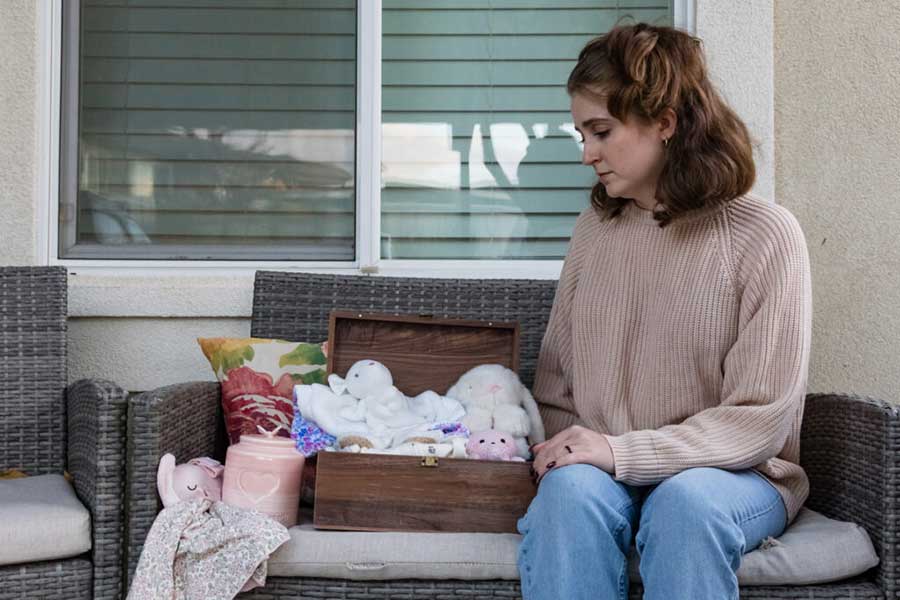
The funeral home suggested the couple pick out a few items to cremate with the remains, including a security blanket with a white bunny at the top, so that there were enough ashes for the urn. Crozier held the items right up until it was time.
She spent $3,000 out of pocket for the procedure, which was not covered by her insurance, and another $1,000 for the urn and cremation, including the costs to transport the remains across state lines. In the recovery room, Crozier asked about footprints and handprints, but learned Haven was too tiny and the tissue too soft.
“I got really upset, and they had to bring my husband in,” she said.
For the next year, they kept the full story extremely private and only told a few close friends and family members. Everyone else just knew that Haven had died. The couple opened up over the summer, including on social media, in support of Idaho’s ballot initiative. But Crozier found that some people’s responses were more dismissive than she’d imagined they would be.
“A lot of people were like, that’s not really an abortion, that doesn’t really count,” Crozier said.
Since the summer, the Croziers have been vocal online and in person about the initiative, telling Haven’s story and trying to convey that an abortion ban like Idaho’s affects many people in situations like theirs.
“With Prop 1 being on the ballot, I feel like people have this kind of idea in their brain of what people who have abortions are like, and I feel like I kind of break that mold for a lot of people,” Crozier said.
“The whole situation was just so heartbreaking, and on top of being in that situation, having to go out of state and to hide what had really happened from friends and family for fear of being judged.”
More babies born with this anomaly under abortion bans
Dr. Kerri Brackney, a maternal-fetal medicine specialist in Tennessee who is a member of the American Association of Pro-Life Obstetricians and Gynecologists and the Society for Maternal-Fetal Medicine, said anencephaly diagnoses are not uncommon, and they are usually clearly identifiable early in pregnancy.
The diagnosis does come with risks, Brackney said, including a buildup of amniotic fluid that can cause preterm labor or high blood pressure, but she said it’s typically manageable.
“The vast majority of patients I care for are able to find some beauty in the hard,” she said. “It doesn’t take away the hard, doesn’t take away the pain, but unfortunately neither does abortion.”
Tennessee also has a near-total abortion ban with no fetal anomaly exceptions, and Brackney said more anencephaly babies are being delivered because of the ban, giving doctors a better sense of what it looks like at full term delivery. Brackney said she is honest with patients about the prognosis, and said the longest she’s seen a baby with anencephaly live after delivery is a couple of weeks.
She has had patients who chose to leave the state and terminate, even though she doesn’t recommend it, and said she will refer a patient to a reputable clinic in another state if that’s what they decide to do.
“But I also really try to encourage my patients that, No. 1, I think they’re stronger than they realize and we can walk through any hard situation with them,” Brackney said. “They’re not alone, and we can help them to find even the small bits of beauty and joy that are found in a very hard journey.”
Brackney said she thinks patients grieve better over the long term when they “follow their pregnancies to their natural conclusion,” whether that’s a miscarriage, stillbirth or death in the hours or days after delivery. She doesn’t think exceptions for fatal anomalies like anencephaly are necessary in states with abortion bans.
“Sometimes moms find stillbirths to be a gift, where they didn’t have to decide and it happened naturally,” she said.
Early on in Idaho’s campaign, polls showed relatively high support for a ballot initiative to restore reproductive rights, including a Boise State University School of Public Service poll last November showing 61% support. A year later, recent polls have tightened considerably or shown more support on the opposing side, after the Church of Jesus Christ of Latter-day Saints donated $1 million and the Roman Catholic Diocese of Boise donated $300,000, helping to usher in a wave of messaging against the measure.
A public memorial
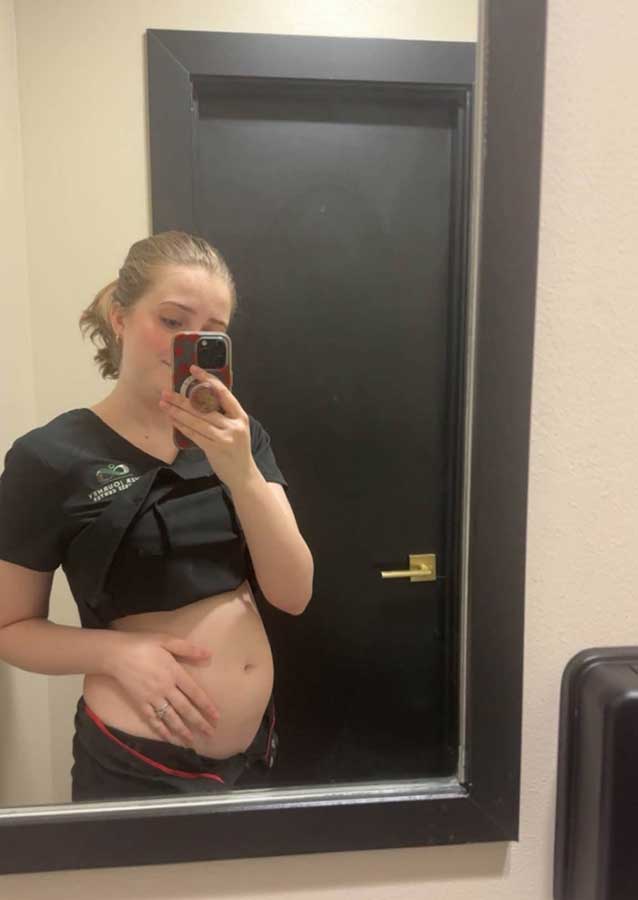
Most of the Facebook posts from the Croziers over the summer didn’t make huge waves. But in early October, Rebecca Crozier made another one that was more direct, complete with multiple photos of her pregnant belly, her ultrasounds and Haven’s memory box.
She wrote that she was affected by Idaho’s abortion laws and recounted her story, and encouraged people to vote yes on the ballot measure.
A lot of people were like, that’s not really an abortion, that doesn’t really count.
– Rebecca Crozier
The post quickly went viral. It was shared more than 2,700 times, with almost as many comments. Although it was a political post, she also felt it was a way she could permanently memorialize the baby she never got to meet.
“I kept telling my friends and my family that I was scared that people were going to forget about her,” Crozier said. “That we would get pregnant, and we would have other kids, or that time would go on and that she would be forgotten.
“And it felt like a way that I could remind myself and other people that she was real, and she mattered to me.”
The Croziers are still trying for a healthy pregnancy.