



Groundbreaking water treatment system sees first real-world use
Published at
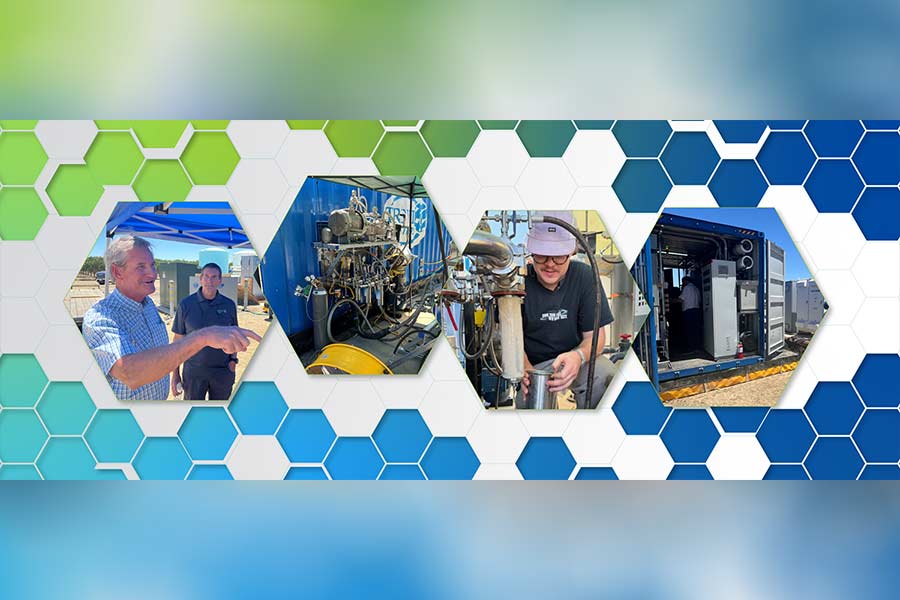
IDAHO FALLS – The pistachio trees of Coalinga, California, are thirsty. The nearest river is miles away, but beneath their roots lies an untapped water source — untapped because it’s full of salt and other minerals that give it the designation “brackish groundwater.”
If researchers at Idaho National Lab can help turn brackish into beneficial, the farmers of the Pleasant Valley can grow more food and ease the burden on the Central Valley Project, the utility that provides the city’s municipal water.
The solution seems simple: Just get the minerals out of the water. But effective desalination requires complicated engineering. Minerals in the groundwater can clog traditional purification systems, and typical desalination technologies leave behind a concentrated salty brine that requires special disposal.
INL researchers asked if there’s a way to make it more difficult for the minerals to stay dissolved in the water. The answer could be a solvent called dimethyl ether (DME), a colorless gas that’s used in numerous chemical processes, including as a next-generation transportation fuel and as an aerosol propellant.
This INL story details how a project spearheaded by INL researcher Aaron Wilson used DME to reduce the solubility of the unwanted minerals, which means they precipitate out of the water like falling snow. DME is one of few desalination technologies that can transform dissolved solids into actual solids. Using DME as a part of the desalination process reduces the energy requirements and the waste generated during desalination. The technology was licensed by Trevi of Petaluma, California, with the goal of engineering a system to make it a deployable solution.
“This highlights the critical role of public-private partnerships in today’s economy,” said INL Commercialization Manager Ryan Bills. “When world-class researchers and forward-looking companies work together, we can bring groundbreaking innovations like this to market.”
To engineer a complete desalination system using DME, Trevi turned to the Department of Energy’s National Alliance for Water Innovation (NAWI) program for funding. NAWI is a research program supported by Department of Energy’s Industrial Technology Office. It brings together a world-class team of industry and academic partners dedicated to lowering the cost and energy of desalination and water reuse.
With NAWI’s support, Trevi developed and built a complete multistep pilot system that combines DME with traditional reverse osmosis desalination. After engineering the system to fit inside a small shipping container, Trevi has now deployed and operated the first pilot project in a Coalinga pistachio orchard. The system extracts the brackish groundwater, combines the DME process with reverse osmosis and produces clean water. Because the system is so efficient, only a small amount of water remains in the extracted mineral solids. The low water content of the solids makes disposal much simpler than that of the waste from conventional desalination systems. In fact, the extracted minerals could be used for other purposes, like applying natural calcium chloride to the ground to reduce dust in the pistachio orchard. The minerals could also be sold to support other industrial processes.
The desalinated water from the Trevi system could also be an additional revenue stream for users. During times of the year when less water is needed for agriculture, farmers could sell the desalinated water to nearby cities, for example.
“This project represents a significant milestone in our efforts to revolutionize water treatment technologies,” said Trevi CEO John Webley. “By combining the unique properties of dimethyl ether with existing desalination technology, we are not only addressing the challenges of desalination but also creating solutions for water reuse to address scarcity challenges.”
Trevi plans to conduct additional pilot demonstrations with the technology and is working closely with Wilson on other potential applications, like critical minerals recovery. The company hopes to begin engineering permanent high-recovery water treatment systems soon. For now, the pistachio trees have another way to quench their thirst.