



LIVE UPDATES | Verdict reached in Kouri Richins murder trial
Published at | Updated at
Kouri Richins, a Utah mother of three boys, is accused of fatally poisoning her husband, Eric Richins, in 2022. She is on trial in Summit County, Utah, on charges of aggravated murder, attempted aggravated murder, insurance fraud and forgery.
Today is the 15th day of the trial, and closing arguments from the prosecution and defense are expected. It is scheduled to begin today at 8:30 a.m. East Idaho News will be posting live written updates all day. Please excuse typos. You can watch the livestream here. The most recent updates are at the top of this page.
6:41 p.m. Sentencing for Kouri Richins is set for 9:30 a.m. on Wednesday, May 13. A pre-sentence investigation report will be ordered. There is nothing further. I will be live tonight for “Courtroom Insider.” Time TBD. Join me on the East Idaho News YouTube channel.
6:39 p.m. Judge dismisses the jury and thanks them for their service. Judge says we need to get a pre-sentence investigation. Judge asks Lewis if Richins’ waives the 45 day rule for sentencing. Lewis says she does. Judge asks if we should look at May for sentencing. Brad Bloodworth asks to confer with the victim’s family. He asks if there are any bad dates in May. Bloodworth says any day in May will work.
6:37 p.m. Judge polls the jurors. They each say, “Yes.” One of the men on the jury seems quite emotional. Another juror is wiping his eyes. Judge tells the jury they can speak with anyone they want. All of his previous instruction no longer applies. He tells the jurors they can speak to media and attorneys if they wish.
6:35 p.m. Count 2 – attempted aggravated murder. GUILTY. Some jurors are staring at Kouri. One juror appears emotional. Count 3 and 4 – insurance fraud – GUILTY. Count 5 – forgery – GUILTY.
6:34 p.m. Count 1 – aggravated murder – GUILTY.
6:32 p.m. Jurors are in. The female foreperson stands up. Judge asks if the jury has reached a unanimous verdict. “Yes we have.” The form is handed to the bailiff, who hands it to the judge.
6:30 p.m. Judge says a verdict has been reached, but he does not know what it is. Judge says there can be no outward reaction whatsoever to the verdict. “There folks are here against their wills. Everybody deserves your respect. There simply cannot be any outward reactions. You have to keep your hands folded in your laps. If you feel overcome with emotion, just look down. We cannot have any outward reaction.”
6:28 p.m. Kouri’s mom and a handful of other supporters/friends are on the 2nd row. Eric’s family and friends/supporters are on the 4th and rows. A few members of the public are on the 3rd row. Judge is on the bench.
6:26 p.m. I had a media pass to be inside the courtroom Tuesday and Wednesday. Seats were assigned last week, before the defense rested. I have been in the courthouse all day, but watching from the media room. I was put on a standby list to go into the courtroom and a seat opened up. Eric’s dad has arrived.
6:24 p.m. Observations from inside the courtroom: it’s tense. Quiet. Nobody speaking. Kouri is trembling. Visibly shaking.
6:19 p.m. Several family members are in the courtroom. Kouri is seated at the defense table with her attorney. Prosecutors are at the prosecution table. Eric’s father has not yet arrived, so it will be a few minutes before the verdict is read.
6:17 p.m. The jury began deliberating around 3 p.m. The judge ordered them dinner around 5 p.m.
5:52 p.m. A verdict has been reached. It will be read at 6:20 p.m. MDT.
3:09 p.m. The stipulation of fact is being included with documents being sent back to the jurors. Judge says we are going off the record but a lawyer from each side needs to stick around. We are now off the record.
3:07 p.m. We are back on the record. Judge says as jurors were walking out, the bailiff received a note from Juror No. 2 saying they thought the jurors were supposed to receive a hard copy containing a factual stipulation. Judge asks attorneys how they want to proceed.
2:59 p.m. Jury is officially deliberating. If the jury goes home for the night or a verdict is reached before 7 p.m., we will have a “Courtroom Insider” live on the East Idaho News YouTube channel. I’ll post updates on my Facebook page and X account.
2:57 p.m. Judge excuses the jury to begin deliberations. He says regarding the schedule, his normal practice is to check in with jury around 4:30 p.m. regarding what they want to do. If they want to retire and come back tomorrow, they can or they can keep working. Four women were the jurors who left. Jury consists of six men and two women.
2:55 p.m. Judge says he will personally call the jurors to let them know when their service is complete. He asks the gallery to stand for the jurors. They are excused. Judge says if the remaining jurors have questions, they can submit them. Judge reminds the jurors that they can \not use outside sources to investigate any manners related to the case. Exhibits will be in the jury room.
2:54 p.m. Judge says service of alternate jurors does not end. They are still subject to the court’s instructions because if an emergency arises during deliberations, one or more of the alternates may be called back to join deliberations at that point. Judge says alternate jurors in this case are 9, 10, 11 and 12. Judge asks them to stand. Judge reminds them the case is not over and they cannot talk about the case.
2:52 p.m. Judge says there is a verdict form in the jury room, and they are separated into each count. Only one verdict for each count should be marked. All verdicts must be unanimous. If jurors have a question, they can write a note and give it to the bailiffs. It will be passed to the judge. Judge explains a jury in Utah is 8 jurors. “There are 12 of you. We intentionally enpanel alternate jurors to ensure against the unforeseen because things happen. Jurors fall ill, they suffer a personal or family tragedy, sometimes they don’t follow my instructions.”
2:50 p.m. Judge asks clerk to swear in the bailiff who will watch over jurors during deliberations. She administers the swearing-in to three bailiffs. Judge has additional instructions for the jurors. He explains that the first thing they should do is appoint a jury foreperson.
2:48 p.m. He continues to read more from the letter and says all the evidence in this case proves Kouri murdered her husband and the father of her three children. “There is no other rational explanation for the evidence.” Bloodworth is done.
2:45 p.m. Bloodworth reads lines from the letter, including a line that if Ronney does not say these things, she’s convicted.
2:42 p.m. Bloodworth says Kouri wrote the book to make money – she wanted to sell 100,000 copies. Bloodworth mentions that Kouri didn’t write the book and not only did she not write the book, she wasn’t a good writer. She wanted to appear as one. Bloodworth brings up the Walk the Dog letter and needed to craft her defense around the letter. “It’s obvious the letter was written to get her brother to testify to a narrative that would explain everything,” Bloodworth says.
2:40 p.m. Bloodworth shows the video taken at Eric’s Celebration of Life the day after he died at their house. The adults are joking around and drinking. He says, “People grieve differently,” and then shows an image of her book cover along with a photo of her on “Good Things Utah.”
2:38 p.m. Bloodworth says the gummies and lots of other stuff were sent to the lab for testing, but none of it confirmed anything. One detective who testified said he’s never seen marijuana tampered with fentanyl. Bloodworth says Kouri’s plan was not tethered to reality when it came to the Midway mansion.
2:36 p.m. Bloodworth says manner of death is immaterial. It’s for statistical purposes. “You determine the manner of death. It’s murder. Aggravated murder.” The medical examiner was retiring and made her determination in the early phases of the investigation. Bloodworth says Eric did not ingest a contaminated THC gummy.
2:33 p.m. Kouri told Eric’s dad that he died from COVID and a lung fungus that Eric’s mom died of. “That is not only covering up her involvement, that is cruel,” Bloodworth says. Bloodworth says Kouri pretended not to know what acetephetimoine was. “She has a master’s degree,” he says. “In feigning ignorance with Dr. Christensen, she was fishing for information to craft her defense.”
2:32 p.m. Bloodworth references the GIFs and says there is “no good reason” these images were accessed the minute Eric’s body was wheeled out of the house. Bloodworth says there’s no evidence Eric sent these messages. He sent an image of the Midway mansion the night before, but it was not the image that was accessed when the GIFs were pulled up. “Details matter,” Bloodworth says. “We don’t know who sent these images, but we do know that they were accessed on Kouri’s phone at 8:29 – the exact minute that deputies signed the log out of the house and that whoever accessed them turned the phone this way to view them better.”
2:30 p.m. “She didn’t tell anybody that night that Eric used fentanyl because she thought she would get away with it,” Bloodworth says. He says the 2016 empty hydrocodone bottle is immaterial because he had no hydrocodone in his toxicology results.
2:28 p.m. Bloodworth says that Kouri walked away and Katie takes the boys upstairs. “In moments of tragedy and profound sorrow, you not only comfort your children, they comfort you,” he says. Bloodworth says Kouri hid her face because she doesn’t know how to react because she’s not grieving. She doesn’t want other people to see her non-reaction. “She just murdered Eric. … She wasn’t crying.”
2:27 p.m. Bloodworth says Kouri could not face her father-in-law that night because she could not face the father of the man she had just killed. Bloodworth plays clips of Kouri reacting to the death of Eric versus Katie’s reaction to the news.
2:24 p.m. “All the testimony of Carmen Lauber and Robert Crozier – it matters,” Bloodworth says. He shows a photo of the gas station where Robert and Carmen met up. Bloodworth shows a text exchange where Carmen writes to Kouri, “Please tell me these pills weren’t for him.” Kouri responds that Eric died of an aneurysm. “Kouri had a guilty conscience.”
2:22 p.m. Bloodworth says Kouri Richins chose Carmen Lauber, not the state. She chose her because she was the drug dealer she knew. Kouri chose Carmen because she had control over her, Bloodworth says. “Kouri Richins chose Carmen Lauber, not me,” Bloodworth says. He says Carmen’s testimony is corroborated. She was only at the Maverik in Draper three times. That’s what the digital evidence shows. “Each of the three times she was there, so was Robert Crozier,” Bloodworth says.
2:20 p.m. Break is over. Bloodworth shows the widow/witch image and says, “Parlor tricks are not legal standards.” He refers to their jury instruction and repeats, “What the lawyers say is not evidence.” He says there’s a reason the state provided cross-references to every piece of evidence they offered, “because what the attorneys say doesn’t matter. And there’s a reason defense counsel didn’t cite you to the evidence.” Bloodworth says a lot of the evidence is circumstantial. “It is. People do not video themselves poisoning their spouse. Circumstantial evidence is just as good as direct evidence.”
1:58 p.m. Lewis asks jurors not to take a vote about guilt or innocence, but to talk about where there is reasonable doubt. She also says if she, Kathy Nester or Alex Ramos did anything to offend that, don’t hold that against Kouri Richins. Lewis says if they have questions, “Be courageous. Courage is what this moment demands. The courage to stand between a member of this community and the state. Do not let them fool you. Do not fall for red herrings. Kouri Richins did not kill Eric Richins. The state did not prove the case beyond a reasonable doubt.” Lewis is done. We are taking a 15-minute recess until 2:15 p.m.
1:54 p.m. Lewis jumps to the forgery count. She says there was no evidence that Kouri is guilty of forgery. She says the state has not proven its case, and it doesn’t have the evidence that Kouri killed her husband. “They’ve tried to present evidence to show her that she’s the type of person who would kill her husband.” Lewis says she is approaching the end. “I’m sure you want me stop talking, but I’m afraid to stop talking.” Lewis says a bunch of questions go through her mind and the jurors are about to start deliberations. “We all wish we could follow you and listen in. But that jury room is yours. It’s sacrosanct. … You must find Kouri Richins not guilty.”
1:53 p.m. Lewis says Eric joked about his wife trying to poison him and when he ate the egg sandwich on Valentine’s Day, he had an allergic reaction to something and took a nap. “There is no world in which that is an attempted murder beyond a reasonable doubt,” Lewis says.
1:50 p.m. Lewis says the state has not proven its case, and they have not proven that Kouri purchased and gave Eric fentanyl. “If after looking at all the evidence you believe Kouri accidentally obtained fentanyl and then Eric died, that is not aggravated murder, and you must find her not guilty.”
1:48 p.m. Lewis says Kouri spent the life insurance money within a matter of weeks and was still in debt. Kouri just wanted the home. “If this case were about money, Eric was worth so much more to Kouri alive,” Lewis says. Lewis asks who else had the opportunity to take the pills. Eric. Lewis says the state can not tell you how Eric ingested the fentanyl. “They want you to do their job for them. Tell them no. Tell them if they’re going to charge a person in your community with a serious crime, they better have the facts.”
1:45 p.m. Lewis says Kouri made a profit on all the homes she flipped. All the foreclosures were after her arrest, Lewis says. She brings up the GIFs. “They made such a fuss about these,” Lewis says. They were accessed on March 4 and were tied to the celebration, Lewis says. The GIFs were accessed at the same time as a photo of the Midway mansion on March 4. Lewis says a photo was sent the night before by Eric, and it’s likely all the GIFs were sent the night before. Lewis says it doesn’t make sense that Kouri killed him for life insurance.
1:43 p.m. Lewis says the state made up what was in people’s heads, and the state did not prove Kouri killed Eric in order to be with Josh. Lewis brings up money. “Was Kouri a brilliant businesswoman? No. Was her business struggling? Yes. Was it fake it until you make it? There was a lot of that going on.” Lewis says Kouri was a young mother trying to run a business.
1:41 p.m. Lewis says Josh Grossmann loved Kouri more than she loved him, and they were having an affair. Lewis says Eric was also having an affair – possibly more than one. She brings up the text about the open relationship with his friend. “You can laugh about that … but there were parts of Eric’s life that he didn’t share with people,” Lewis says. She says we all have secrets, and Eric had secrets. Lewis says Kouri never met up with Josh after Eric died, and Kouri was grieving after Eric’s death. Ultimately she broke things off.
1:37 p.m. Lewis admits they said things in opening statements that didn’t come into trial “but strategies change and we aren’t under any obligation to present evidence. They are.” Lewis asks what was kept in the bottle next to Eric’s bed – an expired prescription bottle with nothing in it but residue. “Why would that be sitting out? A six-year-old prescription bottle? What might be the best way to bring illegal pills back from Mexico?”
1:34 p.m. Lewis says Crozier’s testimony is more credible than Carmen’s because her freedom is it stake. “He has nothing to gain. He just told you the truth.” Lewis says the state claimed it traced the fentanyl. Lewis says that’s not true. “Where are these 90 to 120 pills? We have no idea where that is. They didn’t trace that fentanyl.” Lewis says Eric was not a Carmen or a Robert when it comes to being addicted to drugs. “That didn’t mean he didn’t use. That doesn’t mean he didn’t ask Kouri to get him pain pills. He had Lyme disease. He had knee pain and back pain.” Lewis says right before Eric died, he was texting Pedro Sonora and another friend.
1:31 p.m. Lewis tells the jurors they have no way of knowing whether Carmen is telling the truth. “Can you feel for Carmen Lauber? You can. Can you believe her beyond a reasonable doubt? You cannot.” Lewis now mentions Robert Crozier. Lewis says Crozier changed his story from what the prosecution wanted him to say to what they didn’t want him to say. “Why do this? Why risk his immunity? It would have been so much easier for him to stick with his original story.”
1:30 p.m. Lewis says Carmen lied to a judge by writing a letter saying she had been 100% compliant with drug court so she could go to Las Vegas. “She admitted it on the stand! I was untruthful with the judge to get something I wanted.” Lewis says there is a lot more at stake here than going to Vegas and she’s being untruthful to stay out of prison.
1:26 p.m. Lewis says she didn’t ask Carmen about her disability to be cruel. She says Carmen never dealt with fentanyl and her dates changed. “She’s not a truthful person. There were a couple of little things she lied on the stand about. Not super important, but I’m going to point them out.” Carmen told Lewis she was not on anti-anxiety medicine, but told Bloodworth she was. Carmen says Nancy Peterson drove to pick up the drugs, but then said she actually drove one way.
1:23 p.m. Lewis says Carmen had everything to lose and she was getting a big “get out of jail free.” Lewis says detectives walked into the interview with Carmen to tell them what happened rather than to hear her version of events. Carmen said she was scared of fentanyl. Lewis says Carmen held all of the cards in this case – the state’s entire house of cards is being held by her.
1:20 p.m. Lewis asks why they didn’t do a hair follicle test on Eric. “They were only looking for evidence to confirm their theory. Confirmation bias.” Lewis says the state cannot confirm that Kouri ever bought fentanyl and brings up Carmen’s testimony. “Admittedly, a lot of it was painful to watch. In some ways, she’s sympathetic. She’s looking at multiple long prison sentences and her only way out was to testify in this trial.”
1:17 p.m. Lewis talks about the fentanyl and norfentanyl found in his body. Lewis reminds the jury that the toxicologist said the fentanyl could have been left over from a previous use. Lewis says the fentanyl was not put in a drink because there was no alcohol in Eric’s body. Lewis says the state is throwing around a lot of theories “because they don’t have one. They don’t know what happened.”
1:15 p.m. Lewis brings up the deleted text messages. She says maybe it’s because Kouri was having an affair and she had asked Carmen to purchase pills. “You’d probably want that off your phone.” Lewis says Kouri did the web searches about fentanyl after she learned Eric had died and her searches about women’s prison were done because she was scared to death that she was a suspect.
1:12 p.m. Lewis says O’Driscoll wasn’t prepared to testify but he’s the one the state put on. “He couldn’t testify how the fentanyl got into Eric’s system. He said, ‘Well, he ingested it.’ There was no evidence – none – that fentanyl was put into Eric’s drink. They waited until closing to tell you she put it in a drink without any evidence to back that up. There is no evidence that fentanyl was put into the drink.” Lewis says O’Driscoll didn’t know the evidence even after sitting in the courtroom for the entire trial.
1:11 p.m. Lewis reminds the jury that fentanyl was not found anywhere. There were 90-120 oxycodone pills “somewhere” but they couldn’t find or test the pills, Lewis says. Lewis says a story was fed to Carmen. “Let’s find what confirms our theory, let’s ignore what doesn’t.” Lewis says after four years of investigation, there was an awful lot O’Driscoll couldn’t remember.
1:07 p.m. Lewis says the private investigator sidestepped the Constitution. She mentions lead investigator Detective Jeff O’Driscoll and some steps he took during the early days of the investigation. “He didn’t investigate any other leads. and he didn’t attempt to corroborate information.” Lewis mentions the Walk the Dog letter and says there were several things in the letter that were true and the letter never went to anyone. “So it was nothing more than thoughts on paper.”
1:05 p.m. Lewis mentions Gabler tracking Kouri’s car, Carmen’s car and other cars. “He only tracked people he thought might lead to information for law enforcement. Did he follow up on Eric’s trip to Mexico shortly before Eric’s death? No. Did he go to Mexico to find out where Eric had been before his death? No. … He passed it all onto law enforcement and told them to talk to Carmen Lauber. … Everything about this investigation was led by the Richins family. They started on Day One and continued until trial.”
1:04 p.m. Lewis brings up Todd Gabler, the private investigator. “He was in the house numerous times, not wearing gloves, finding things and calling the police. … Todd Gabler was in and out of that house numerous times by himself. He also told you he was completely fair and unbiased. He had two hypotheses – suicide and homicide. He ignored any others, including accident.”
1:02 p.m. “If she had just killed him with illicit drugs, why, in the name of God, didn’t she say yes? If she had just said yes, we probably wouldn’t be sitting here today,” Lewis says. She says investigators have been back to the house 10 times. “They were still searching for evidence on Feb. 9 of this year – two weeks before trial. They’re still trying to prove Kouri Richins guilty.”
1 p.m. Lewis says this entire case has been an example of confirmation bias – working backwards from a conclusion. Lewis says investigators never asked where gummies were and they didn’t look in places where gummies were found a month later. “You know what else they didn’t do? They didn’t secure the scene. … Kouri gave them consent when they asked to search one place outside of the bedroom. The entire house could have been searched that day, but they didn’t do it. They didn’t even ask.”
12:59 p.m. Lewis says the state wants you to believe that Kouri was celebrating Eric’s death. She says they were celebrating his life and keeping it light for the boys. “Can we not smile in our grief? They want to tell you know, but reason and experience tell you different.” Lewis says the investigation was sloppy and it was driven by bias.
12:57 p.m. Lewis reminds the jury of the image shown them during opening statements showing the witch and the widow. She then shows Kouri on the floor the night Eric died and says, “Witch or widow?” Lewis says Kouri was dreading the most difficult conversation with her young sons – their father was dead. “The father everyone agreed was a wonderful father was gone and she has to tell those little boys they’re never going to see him again. How can a woman be judged on how she handles that moment?”
12:55 p.m. Lewis says Kouri made the call nobody ever wants to make. She calls 911. “A big part of the state’s case is that Ms. Richins is not grieving properly. What does that mean? I was unexpectedly widowed when I was not much older than Kouri, and I had two littles. If I learned one thing during this trial, I learned I didn’t grieve right. They want you to look at a woman during the worst moment of her life and to judge her. There is no wrong way to grieve. They’re asking you to judge how she is acting at that moment and then use that moment as evidence of guilt.”
12:54 p.m. Lewis goes back to the night of March 3. She says Kouri wasn’t feeling well, and she was not inconsistent when she told this story. “What does reason tell you? What does experience tell you?” Lewis asks. “The state asks you to leap to conclusions about what she was doing, yet they have not shown you any evidence of this. They just tell you to believe it. But what does reason tell you?”
12:52 p.m. Lewis reminds jury the state has to prove beyond a reasonable doubt. The burden is on the state. Lewis says one way to understand reasonable doubt is whether there are other reasonable explanations as to what happened. If there are other reasonable explanations about what happened, there is reasonable doubt “and you have to find Kouri not guilty.”
12:51 p.m. Lewis says in the early morning hours of March 4, Kouri Richins is up late, slips into bed, feels her husband and he’s cold. “Something feels wrong. She turns on the light and when she looks at her husband, really looks at him, she realizes something is terribly wrong. In that moment, Kouri Richins’ world collapsed.”
12:50 p.m. Back from lunch. Wendy Lewis will give closing arguments on behalf of the defense. Jury is in the courtroom.
11:45 a.m. Motion for mistrial is denied. Jury is being brought in. Judge gives jury instruction about their observations of Kouri’s demeanor. Lunch break until 12:45 p.m. Judge reminds jurors not to discuss the case.
11:41 a.m. Judge is back. He reviews the defense’s request for a mistrial. He says the black widow comment was not in reference to an insect; rather, a statement about a woman killing her husband. He responds to the defense’s issue with Bloodworth using the phrase “narcissist.” Judge talks about Kouri’s demeanor and says he can tell jurors to consider their own observations and not Bloodworth. Judge says Bloodworth did not comment on her silence or her right not to testify.
11:31 a.m. Judge needs a moment to collect his thoughts. We are in recess until 11:40 a.m.
11:27 a.m. Nester says Bloodworth made up a bunch of stuff out of whole cloth. Judge asks Bloodworth if he objects to the special instruction he will read that jurors must rely on their own observations of the defendant, not what the prosecutor said about her demeanor.
11:24 a.m. Judge says if Kouri were to have burst out in laughter when a photo of Eric’s dead body was shown, he could not tell the jury not to consider it. Nester says she has no idea what the judge is talking about. He says it’s a hypothetical. She is relieved. Judge says he can read a special instruction for the jury that her demeanor does not mean she is guilty. Judge goes back to the black widow statement. He says it’s a statement Chelsea Barney made. Bloodworth says it was in a recorded phone call with Bryce Knutson. Judge says everyone is speculating about what’s in Kouri’s mind.
11:21 a.m. Nester says Bloodworth made incorrect statements, and they need to be corrected. Judge asks what points Nester is moving for a mistrial. She says on all of it. Judge asks what points she wants the curative instruction to give to jurors. She says it’s about the drug statements. Judge says the Utah Court of Appeals disagrees with Nester’s objections about Kouri’s demeanor.
11:19 a.m. Defense attorney Kathryn Nester makes a motion for mistrial. She says at multiple points during the closing, Bloodworth made point to “dehumanize” the defendant, “calling her a black widow and comparing her to a spider.” Nester says it’s improper for Bloodworth to comment on Kouri’s demeanor. She says that’s a comment on Kouri’s failure to testify. Nester says there was “wild speculation” on what was in Kouri’s mind “completely made up by Mr. Bloodworth.”
11:17 a.m. “In listening to defense counsel closing arguments, please only consider the evidence that has been admitted,” Bloodworth says. He is done with his opening statement. Defense attorney asks to address something outside the presence of the jury. Judge excuses jurors.
11:15 a.m. Bloodworth goes through a list of statements made by defense attorneys during the trial. After each statement, Bloodworth says, “There’s no evidence of that.”
11:14 a.m. Bloodworth: “Josh Grossmann loved Kouri Richins. He thought she loved him. You saw him testify. He was gutted. A grown-a** man gutted.”
11:10 a.m. Bloodworth shows the text messages Kouri sent Grossman the day after the attempted murder where she says she wants to marry Grossman and “if he could just go away, life would be better” (referring to Eric). Bloodworth shows messages Kouri was simultaneously sending to Josh and Eric about the Midway closing. She’s very excited in her texts with Josh, but kind of blows Eric off.
11:06 a.m. Bloodworth talks about the fraud on the insurance application and the fact Kouri says she didn’t know where the fentanyl came from, but she knew it came from Carmen Lauber. Bloodworth discusses the forgery charge. “She’s a taker, not an asker,” Bloodworth says. Bloodworth wants to turn to Kouri Richins’ desire for a fresh start.
11:01 a.m. Bloodworth shows insurance documents and changes made to information on the documents. He shows the application for Eric Richins’ life insurance weeks before he died. “Eric did not sign the application. It was probably a simulated forgery,” Bloodworth says, based on the testimony of the handwriting expert.
10:58 a.m. Bloodworth tells jurors Kouri’s motives were money and a fresh start at life with Josh Grossman. The prosecutor now discussing the insurance fraud and forgery charges.
10:54 a.m. Bloodworth reminds the jury about the text message Eric sent to Kouri on Valentine’s Day that he was thinking about going to the hospital. She tells him to take a nap. There is no communication for two hours. Eric thought Kouri was coming home to assist him, Bloodworth says, but instead she was waiting for her cabinet guy in Provo “maybe.”
10:51 a.m. Eric also called his friend Josh and express simliar fears. Bloodworth reminds the jury about Ali Staking’s testimony when she said that Eric joked about his wife trying to poison him. Kouri became defensive, “That is not what happened. It was like an allergic reaction. It wasn’t at all dramatic.” Bloodworth says she was covering up the poisoning.
10:49 a.m. Losing your husband on Valentine’s Day or on the day you’re supposed to close on a big house gets you extra attention – the kind of attention Kouri craved, Bloodworth says. On Valentine’s Day, all activity on Eric’s phone ceases for 87 minutes in the middle of a busy workday after he ate the sandwich. Shortly after activity resumes, he calls Cody Wright, his business partner and best friend. Cody says he could hear the fear in Eric’s voice.
10:46 a.m. Bloodworth shows cell phone tower mapping displaying times of messages between Carmen and Kouri. Carmen got the drugs from the Maverik in Draper. There was active communication with Robert Crozier as well. Kouri called the IRS twice in three days before attempting to murder Eric, according to Bloodworth. She called the Mirror Lake Diner to order “the potentially fatal sandwich.” Kouri ordered it and picked it up herself. Bloodworth points out her signature is one pen stroke – she doesn’t lift the pen off the receipt paper.
10:43 a.m. Bloodworth continues to discuss Kouri’s financial problems. He talks about Kouri trying to poison Eric with a sandwich on Valentine’s Day, and “she learned from her mistake.” Eric could tell something was wrong with the sandwich and set it aside. “You throw a lemon drop shot back. By the time Eric knew something was wrong, it was in his body.” Bloodworth says Kouri distanced herself “from the dirty deed.” “She leaves the bedroom when she murders him. She leaves the county when she attempts to murder him … so when she calls 911, she can say she wasn’t even there.”
10:38 a.m. Kouri’s net worth was -$1.6 million when she murdered Eric, Bloodworth says. Her business was in financial distress and would continue to collapse without an infusion of cash and capital. Bloodworth says the infusion was supposed to be Eric’s money. Bloodworth tells jurors they get to observe Kouri Richins during the case and how she looks during different witnesses. “You observe that when we played the 911 call during trial, her affect was flat. No emotions. You also observed that when Brooke Karrington testified about the financial distress of her business, she was exercised because that testimony pierced her facade. It was a narcissistic injury. She was bothered because the world saw she is indeed not a success and not affluent.”
10:35 a.m. Kouri closed on the Midway mansion the day after Eric died. “Did she close on the Midway mansion in spite of murdering Eric or because she murdered Eric? She hedged. She was supposed to close on the 4th,” Bloodworth says. “She didn’t want to close until she knew Eric was dead because she knew he would have his money, she knew she could do something with the mansion and that’s why she signed on the 5th.”
10:33 a.m. Two days before Eric Richins died, Kouri spent time on the phone with the IRS. Bloodworth shows a picture of the Midway mansion and says, “Kouri Richins needed cash immediately when she murdered Eric.” She wanted to close on the mansion and needed money. “Doesn’t matter if Eric is going to earn a ton of money down the road. That doesn’t help her now. She needs money now because she’s closing on the Midway mansion on March 4.”
10:31 a.m. Kouri then took out another loan on the house that was foreclosed on. Chelsea Barney was then evicted and had to move out. Kouri underreported her expenses in flipping homes to her tax accountant, which resulted in her paying more taxes than she would have. Bloodworth says a sophisticated business person would think to limit their tax liability. “What interested her was the appearance of success in business, the appearance of affluence. She appeared more successful than she was.”
10:29 a.m. Bloodworth reminds jurors that Kouri took $45,000 from her best friend’s tips and said she would be applying it toward a down payment on a house for her friend. Kouri used the money to pay off a payday lender and spent the remainder on expenses to rehabilitate homes or pay off other debt. “Then telling your best friend since middle school that you applied the money to the loan, here’s the deed, sign the deed, and then not filing it.”
10:27 a.m. Kouri lost nearly $900,000 in flipping homes and that doesn’t count the foreclosures, Bloodworth explains. She lost millions more in foreclosures. Jury will have all the financial documents to review during deliberations. “Kouri Richins would borrow money by any means necessary. Six times she submitted inaccurate bank statements to lenders to get money.”
10:25 a.m. Bloodworth says Kouri had loans with extraordinary interest rates. Eventually, payday lenders would no longer lend to Kouri. She was barely paying towards them. “Kouri Richins lost money flipping homes. She was not a sophisticated business person. She didn’t even understand fundamental accounting, fundamental tax reporting,” Bloodworth says.
10:22 a.m. Break is over. Bloodworth continues questioning and talks about aggravated murder. He says there are two aggravators – the why: money. The how: administering any substance in a lethal amount. He displays a chart that shows Kouri had over $359,453 in overdraft charges and another chart that shows Kouri had nearly $8 million in debt when Kouri closed on the Midway mansion. “All the while, she’s not paying it off. She’s barely sending her creditors any money.”
10:05 a.m. Bloodworth says this might be a good place to take a break. We are in recess until 10:20 a.m.
10:03 a.m. Bloodworth says every shred of evidence in the case proves Eric did not die by suicide. They were making plans to go to Disneyland, he loved his sons and he was planning to buy a cabin with his father in the mountains. Bloodworth says Eric took THC gummies but did not use illicit drugs. Kouri never told anyone, including her boyfriend, that Eric used illicit drugs.
10:02 a.m. Bloodworth points out one particular message that says, “If someone is poisoned, what goes down on the death certificate as.”
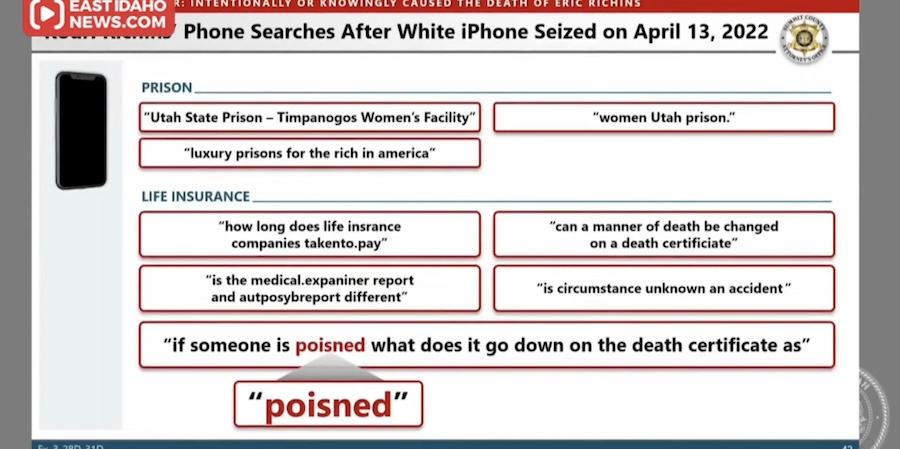
10 a.m. Bloodworth shows searches Kouri made on her phone on April 13, 2022. Here’s a sample:
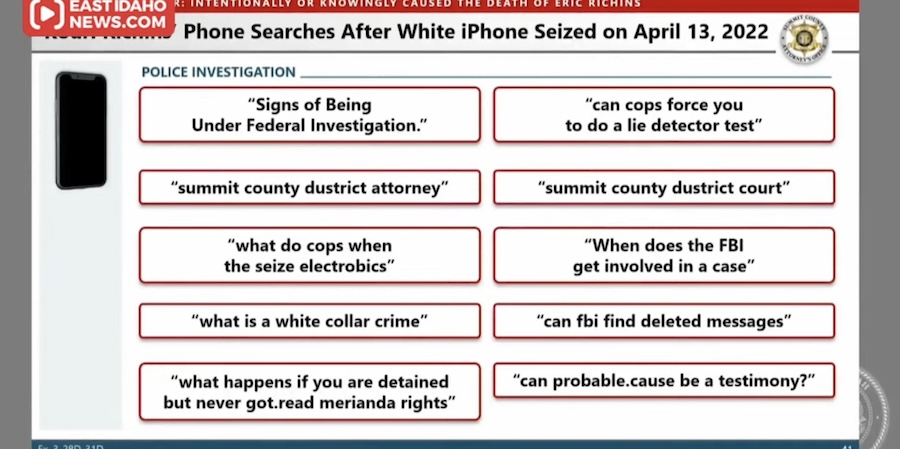
9:57 a.m. In the orange notebook, Kouri said Eric was awake when she went into her son’s bedroom. But she told her friend Chelsea that Eric was asleep when she went into her son’s bedroom. “Her story is inconsistent with the details. That proves that much of it is fake.” Bloodworth mentions the text messages that have been presented during the trial. He says all of the texts were recovered from other phones – not Kouri’s, because they were deleted. “That is part of her cover-up.”
9:55 a.m. Bloodworth says when people make up stories, they are inconsistent in the retelling. He points out an entry in her orange notebook where she says they had the celebratory drink in the bedroom, not the kitchen. In the orange notebook, she said Eric was on the phone when she went into her son’s bedroom around 9:30 to 9:45 p.m. but Eric’s phone activity tells a different story. He was off the phone before 9 p.m.
9:52 a.m. Bloodworth says she never told EMTs, paramedics, Dr. Christensen or anyone else that she bought fentanyl for Eric, like she mentioned in the letter. “It’s a fake story that she wants her brother to testify.” Bloodworth says there are other inaccuracies in the letter – like how she lost it and went to the bathroom to throw up when the EMT approached her. Bloodworth shows the body camera video and we don’t see Kouri running to the bathroom.
9:50 a.m. Bloodworth mentions the Walk the Dog letter. “There’s a lot to unpack in this. … Kouri Richins knows four months after she’s been arrested for Eric Richins’ murder, a year and a half after she’s murdered him, she knows that she bought fentanyl and she has to explain it. And how does she explain it? A year and a half after murdering Eric Richins? She blames it on Eric.”
9:49 a.m. Bloodworth reminds Kouri that, after Eric’s death, she asked Josh Grossman if he had ever killed anybody and how it made him feel. “She asked that because she was working through her own feelings on killing and wanted Josh to help her work through those feelings.”
9:47 a.m. Kouri’s plan with the Midway mansion is consistent with her dream of living there with Josh Grossman – running it and living there with her kids, Bloodworth says. “She had no idea that her home was in a trust, and she couldn’t sell it,” Bloodworth says. He says she didn’t understand the buy-sell agreement or the life insurance going to the trust and not her. “The morning Eric died, she had a plan on how to spend Eric’s money, not realizing it was trust money.”
9:44 a.m. Bloodworth says when Kouri called Eric’s dad and sister, she started with, “I wasn’t there. It wasn’t me.” Bloodworth says when asked for her version of events, Kouri began by talking about the drinks. “For Kouri, that’s when it began – with the Moscow mules.”
9:42 a.m. Bloodworth tells jurors to contrast the 911 call to her “self-serving text messages” with her friend Chelsea Barney. “I tried so f***** hard to save him. His lifeless body on my bedroom floor. I pumped so damn hard, so hard, screaming at him to come back to life that I needed him.” Bloodworth says none of that happened, and she’s covering up her involvement in murdering Eric Richins.
9:39 a.m. The clock is now over five minutes. The dispatcher repeatedly tells Kouri she needs to start CPR and she needs to get Eric on the floor. Kouri says she has Eric on the floor. Dispatcher tells Kouri how to give CPR and starts counting with her – 1, 2, 3, 4. The CPR time clock stops at 5 minutes 56 seconds.
9:36 a.m. As the 911 call is played, there is a countdown clock running on the screen showing how long Kouri waited to give Eric CPR. We hear the dispatcher giving Kouri instructions on how to give CPR and how to get Eric off the bed. “We just need to help him now.”
9:34 a.m. Bloodworth plays the 911 call. If you haven’t heard it, here’s a link.
9:32 a.m. Bloodworth says it was six minutes from when Kouri was told by the dispatcher to do CPR to when she said she started to do it. Bloodworth says Kouri has “dehumanized” Eric Richins in the call – she says, “I can’t move it” rather than, “I can’t move him.” “Eric is no longer a him. She murdered him. Eric is an it.”
9:30 a.m. Bloodworth pivots to the 911 call Kouri made the night Eric died. “Listen to how Kouri Richins, on the 911 call, immediately presents her alibi narrative. Listen to how she tells the 911 dispatcher where she was when Eric died. She is distancing herself,” Bloodworth says. He says she was coming up with her alibi. She’s distancing herself from the time and the place that she murdered Eric, Bloodworth says. When the 911 operator asked her to perform CPR, she says she didn’t know how and couldn’t move him. “She is not immediately trying to revive him,” he says.
9:27 a.m. Bloodworth says Kouri claimed she was in her son’s bedroom and found Eric dead, but there is no evidence she was in the son’s bedroom. He points out the activity on her cell phone that morning and says she could have called someone on Wi-Fi, and the phone records would not have pointed that out. Defense attorney Wendy Lewis objects based on facts not in evidence, and judge immediately says, “Overruled. Please have a seat.”
9:24 a.m. Bloodworth reminds jurors of a witness who says the fentanyl was illicit, not prescription. Bloodworth pays part of the phone call Kouri had with Dr. Eric Christensen. Bloodworth says Kouri Richins recorded the conversation with Christensen. She was prescribed Quetiapine, but she asks Christensen what it was because it was found in Eric’s body. “She feigns the ignorance,” Bloodworth says.
9:22 a.m. Bloodworth points out that the cause of death from the death certificate was fentanyl. “We know that Eric ingested the fentanyl from the Moscow mule, the lemon drop shot or both,” Bloodworth says. All the medical experts testified that an extraordinary amount in Eric’s stomach indicates oral ingestion.
9:20 a.m. Bloodworth says evidence proves Kouri killed Eric with a Moscow mule and lemon drop shot. She wrote about it in her orange notebook journal, which Bloodworth says he will discuss more later.
9:16 a.m. Bloodworth says digital forensics shows Kouri communicated with Carmen to get the drugs. He shows the mapping and part of the timeline. There was an “extraordinary” amount of communication between Kouri, Carmen, and Robert, Bloodworth says.
9:15 a.m. She doesn’t know how to get the drugs, but she wanted them because they are lethal and fatal. “She wants lethal and fatal.” Bloodworth shows part of the jailhouse interview detectives did with Robert Crozier, the man who obtained the drugs and gave them to Carmen.
9:12 a.m. Bloodworth explains the charges to the jury and breaks down the evidence in each charge by pointing out different aspects in a slide presentation. He shows the New York Life Insurance policy and reminds jurors about Kouri changing the beneficiary information on Cody Wright’s insurance policy. She didn’t understand the policy, so she changed it back. Bloodworth says Kouri asked two people – Hayden Jeffs and Carmen Lauber – for some Michael Jackson drugs.
9:08 a.m. Bloodworth says the evidence proves that Kouri Richins caused the death of Eric Richins by purchasing illicit street drugs from Carmen Lauber.
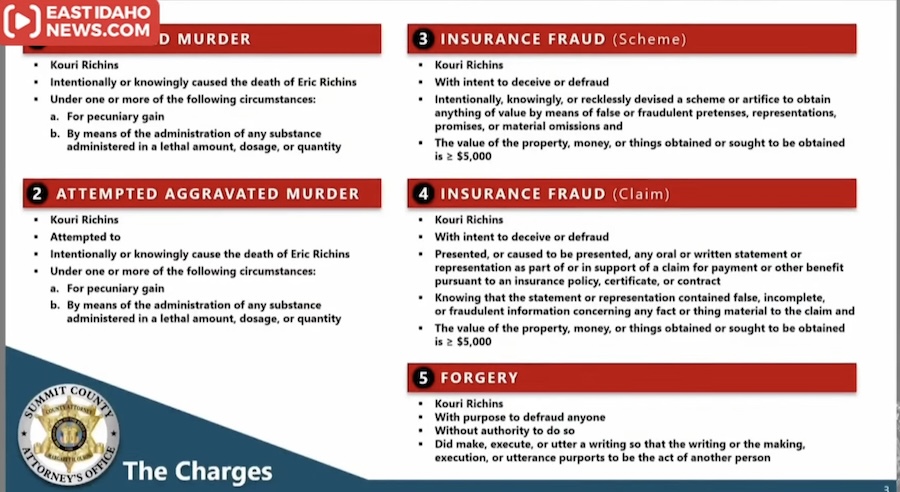
9:06 a.m. Bloodworth shows the five counts on the screen. He says he will go count-by-count and element-by-element to show how the state has met its burden of proving them.
9:05 a.m. Kouri created a facade of being a perfect businesswoman. She gambled other people’s money and more. Her business was in trouble. “All the while, Kouri Richins was more interested in spending time with Josh Grossman than Eric. She dreams of living in the Midway mansion with Josh, running it as an event center, farming it and raising kids. But she did not have the money to leave Eric.”
9:02 a.m. Bloodworth begins by saying Kouri Richins’ father went to prison and her mom was an alcoholic. Kouri wanted to appear privileged. She met Eric, a successful businessman who had money. They had three kids and “Kouri Richins was on her way.” But she was unhappy. She wanted to leave Eric Richins “but did not want to leave his money.” Their prenuptial agreement meant she left him, she would leave his money. Kouri took $250,000 in equity out of Eric’s home without him knowing so she could start her own business and earn enough money to leave Eric.
9:01 a.m. Jury instructions are over. Summit County Prosecutor Brad Bloodworth will now begin his closing arguments.
8:58 a.m. Defendant has been charged with more than one crime. It’s the jury’s duty to consider each of the crimes separately. A verdict is one charge should not determine the verdict on any other charge. Every single juror must agree with the verdict before the defendant is found guilty or not guilty. They must be unanimous. Methods of chance cannot be used such as drawing straws or flipping a coin.
8:57 a.m. Count 4 – insurance fraud. Count 5 – forgery.
8:54 a.m. Count 3 – insurance fraud – Kouri Richins, with intent to deceive or defraud, intentionally devised a scheme to obtain something of value exceeding $5,000.
8:53 a.m. Count 2 – attempted aggravated murder – Kouri Richins attempted to intentionally or knowingly cause the death of Eric Richins.
8:50 a.m. Judge explains the charges. Count 1 – aggravated murder – Kouri Richins intentionally and knowingly caused the death of Eric Richins. Judge says each and every element must be proven beyond reasonable doubt to prove Kouri committed the crime.
8:47 a.m. Judge tells jurors that they should not consider law enforcement testimony above the testimony of other witnesses. The judge says that because the defendant didn’t testify does not mean she’s guilty, and that shouldn’t be considered during deliberations.
8:45 a.m. Judge reminds jurors that defendant is on trial for the crimes charged in this case. They can not convict her for other acts that may have been committed at other times. He explains the difference between fact witnesses and expert witnesses.
8:43 a.m. Judge says if there is a real possibility the defendant is not guilty, and jurors must not find her guilty. Mrazik explains the difference between direct and circumstantial evidence. If someone looked outside and saw it was raining, that would be direct evidence that it was raining. Circumstantial evidence would be if someone saw the ground was wet and people were closing their umbrellas.
8:41 a.m. Judge explains testimony by people who have been given immunity. Carmen Lauber and Robert Crozier were both given immunity in exchange for their cooperation with prosecutors and their testimony. Judge says someone given immunity can be prosecuted for perjury if they lie on the stand. Judge reminds jurors that the fact the defendant has been charged with a crime is not evidence of guilt.
8:39 a.m. Judge explains what jurors should consider when it comes to witness testimony. Jurors don’t have to believe everything witnesses said – they can believe all, part or none of the testimony. Nobody’s memory is perfect – honest people may remember the same event differently.
8:36 a.m. Judge tells jurors they have to follow his instructions even if they disagree with the instructions. Closing arguments are not evidence, and jurors are to rely on their memory of the evidence. Judge says he is neutral – if he has done or said anything that appears he favored one side or the other, that was not intentional. Eric Richins’ father, sisters and other family members are in the courtroom. Kouri Richins’ mom is in the courtroom.
8:34 a.m. Judge will begin by reading jury instructions. Jurors are welcome to follow along. He skips to instruction No. 13 – says the first 12 were given before opening statements. Judge explains prosecution will go first for closings, then defense, then prosecution will get a rebuttal. Judge says jurors have two main duties – decide what the facts are from the evidence and apply the law to the facts to decide if prosecution has found the defendant guilty beyond a reasonable doubt.
8:31 a.m. Judge says when it’s time for deliberations, the jury will get a computer that contains the evidence. The computer will not be able to connect to the internet. Jury walks into the courtroom.
8:29 a.m. Judge Mrazik on the bench. He asks Prosecuting Attorney Brad Bloodworth if he’s ready to proceed with closing arguments. He is. Defense team is also ready. Jurors are being brought into courtroom.
8:27 a.m. Packed courtroom this morning. Kouri Richins’ family received 24 wristbands to attend, and Eric Richins’ family also received 24 wristbands. Ten journalists are on the front row, so the courtroom is full.