



Local couple who got married hours after Teton Dam collapsed look back on historic day
Published at | Updated at
EDITOR’S NOTE: This is the third in a series of stories highlighting the 50th anniversary of the Teton Dam Disaster. Click here to read the first installment. Read the second installment here.
IDAHO FALLS – Gerald and Millie McNabb were hours away from getting married when they heard the Teton Dam had collapsed.
It was just before noon on Saturday, June 5, 1976. The couple — who will be celebrating 50 years of marriage on the anniversary of the disaster — had met in Blackfoot on March 30, 1975. The daughter of the minister at First Baptist Church had helped introduce them at her birthday party. Millie was from Blackfoot, but she’d been teaching in northern Idaho. Gerald lived in Pocatello and worked as a radio chemist at the nuclear testing site near Arco — what is now Idaho National Lab.
The wedding date had been determined months in advance, and just before the wedding, the rehearsal dinner was scheduled that evening at the Riverside Inn, a building in Blackfoot that no longer exists.
“That was the last event held at that facility before it was wiped out by the flood,” Millie tells EastIdahoNews.com.
The Pocatello couple recalled the events of that day and where they were when they first heard the news.
Gerald says he was at home in Pocatello when he turned on the TV and heard the reports about the dam’s collapse.
“I’d never heard of the Teton Dam,” Gerald says. “The news media had a real sense of urgency that (the flood) was happening in real time.”
RELATED | Remembering the Teton Dam’s contentious backstory 50 years after its collapse
RELATED | The Teton Dam broke 44 years ago today. This man was sitting on it when it happened (2020)
Millie remembers getting a call from Gerald about the collapse around 10 a.m. Historical records indicate the dam failed at 11:55 a.m., but contractors on site that morning had been noticing seepage hours earlier. They worked frantically to fill in the holes but were ultimately forced to stop when failure became imminent.
Thousands of people evacuated their homes as 80 billion gallons of water spilled into eastern Idaho. Eleven people died in the disaster, along with 13,000 head of livestock. About 3,000 homes and tens of thousands of acres of land were heavily damaged or destroyed, according to news reports at the time.
Gerald remembers hearing about a woman in the direct path of the floodwaters who rejected pleas from authorities to evacuate immediately. A 300-foot wall of water destroyed her home.
Despite the news reports, Gerald says he and Millie didn’t know what to think. He says they asked themselves if they should postpone the wedding.
Later that day, the Army Reserves Civil Defense Force showed up at the farm house of Millie’s grandmother at Cottonwood Ranch north of Blackfoot. Gerald says that they told her she had 15 minutes to evacuate because of the pending flood.
Despite this, Gerald and Millie decided to proceed with the wedding.
“We had the wedding and the reception (at First Baptist Church) and then proceeded on our honeymoon and were not in touch with what was happening on the farm,” Gerald recalls.
Millie says a student choir she worked with in Buhl came to perform at their wedding. She helped them prepare and says the circumstances that day made it stressful to have that added responsibility, but she’s grateful they attended and that everything turned out well.
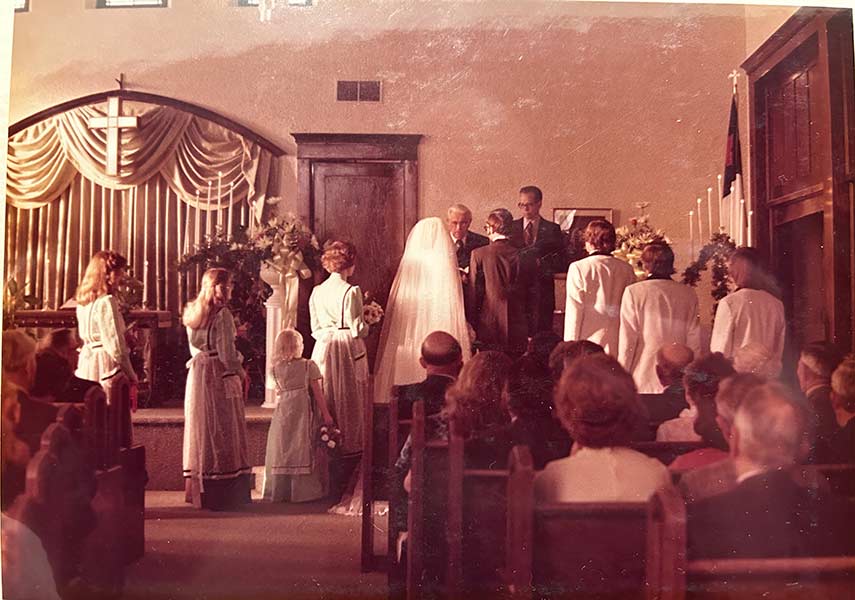
‘We were married, come hell or high water’
The newlyweds spent the first night in American Falls, and Gerald says water was being let out of American Falls Reservoir.
“The Snake River was essentially at flood level to release water to capture what was coming from the Teton Dam,” he says.
After spending several days in Hells Canyon, they had radio reception for the first time. They turned it on and immediately heard Millie’s uncle, Keith Johnson, telling a reporter about the condition of the family farm.
They learned that the water hit Blackfoot three days after the dam’s collapse. About a foot of water flooded the home of Millie’s grandmother, which sat about a mile from the Snake River.
They continued on to California and eventually returned home to help with the cleanup. Gerald says they took down the wet drywall in Millie’s childhood home to prevent mold and later replaced it with new drywall.
“They drilled holes in the bottom of the cabinets … to dry it out,” Millie recalls.
Her grandmother Mildred’s home was also damaged. Millie says the floor tiles were permanently warped because of the flood. Mildred lived there for several years after the flood. It was eventually torn down and replaced with a manufactured home.
Although the floodwaters impacted the farmland, Gerald says the damage was minimal because there wasn’t any debris. The McNabbs don’t remember whether there was crop damage, but Millie says the cattle were spared because her family had the presence of mind to move them to higher ground.
“My parents had taken the wedding gifts home from the church, and they moved them all upstairs before they had to (evacuate),” says Millie.
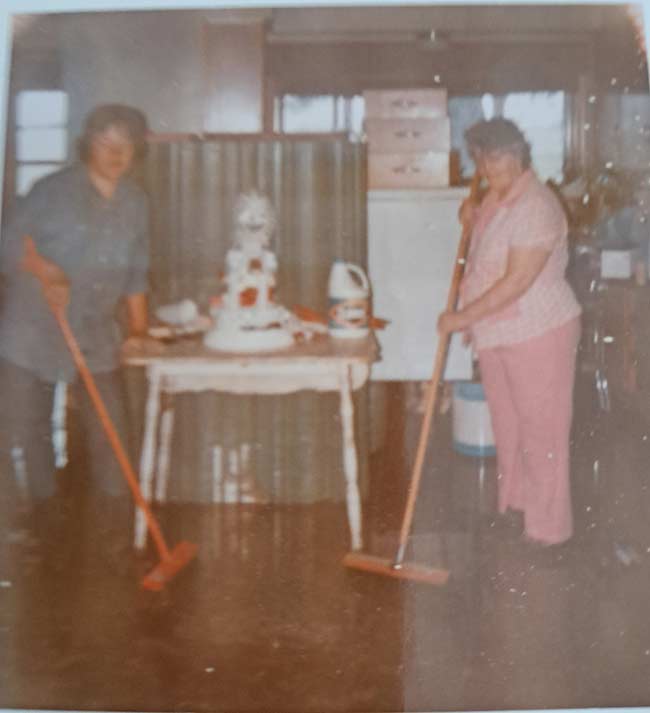
The following year, the McNabbs moved to Spokane, Washington, and pioneered a personal computer business. Before Radio Shack or IBM had produced a personal computer, they were selling them to customers.
Gerald obtained a graduate degree in chemistry and physics and had a career doing classified research and development work. A job with J.R. Simplot brought them back to Pocatello in 1991. It’s here where they finished raising their four daughters.
Millie’s family sold the Cottonwood Ranch in the late 1990s. She says the Butler family owns it today.
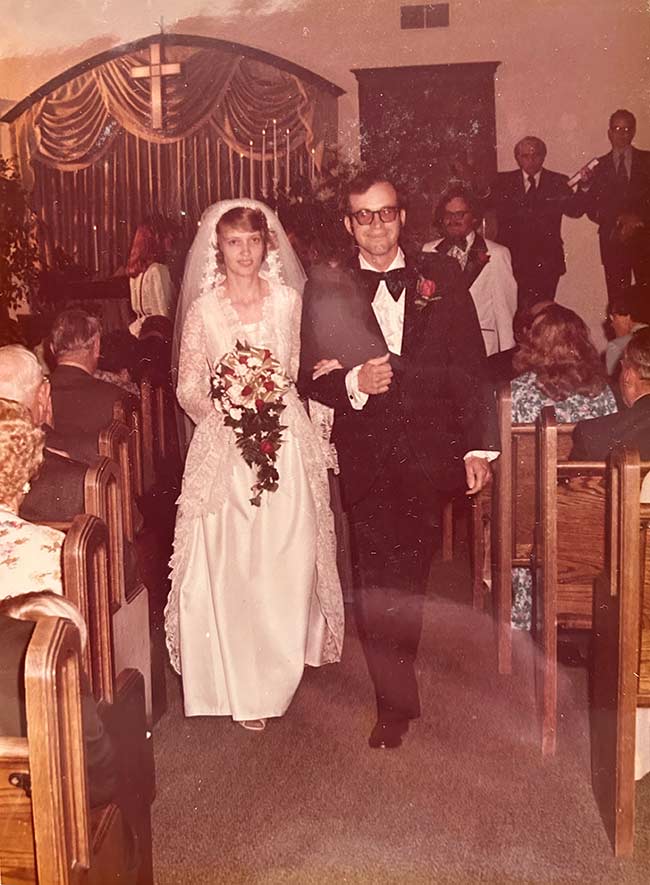
Fifty years after the flood, the McNabbs, now in their 70s, say they’re grateful they were able to have a joyous celebration in the midst of a tragedy. Gerald credits “God’s providence” for allowing them and their loved ones to be safe that day.
In hindsight, Gerald says their decision to move forward with the wedding “took a lot of courage.”
“We made the decision to have the wedding … and once we made the decision, we were not focused on the flood that was coming,” he says. “We didn’t know how quickly the water would come south.”
Gerald jokingly utters a fitting phrase in honor of that historic beginning.
“We were married, come hell or high water,” says Gerald.
WATCH OUR INTERVIEW WITH THE MCNABBS IN THE VIDEO ABOVE.